Compound (compound) vs. isolation exercises

Squat, deadlift, bench press, lying press vs. curls, distance; which for strength, which for hypertrophy
Short answer: Compound exercises (squat, deadlift, bench press) are most effective for building overall strength and mass as they activate large muscle chains and allow for heavy lifting. • Isolation exercises (bicep curl, tricep extension) are ideal for targeted hypertrophy, correcting muscle imbalances, and rehabilitation. • An optimal training program combines both types of exercises – compound for foundation and progress, and isolation for details, symmetry, and injury prevention.
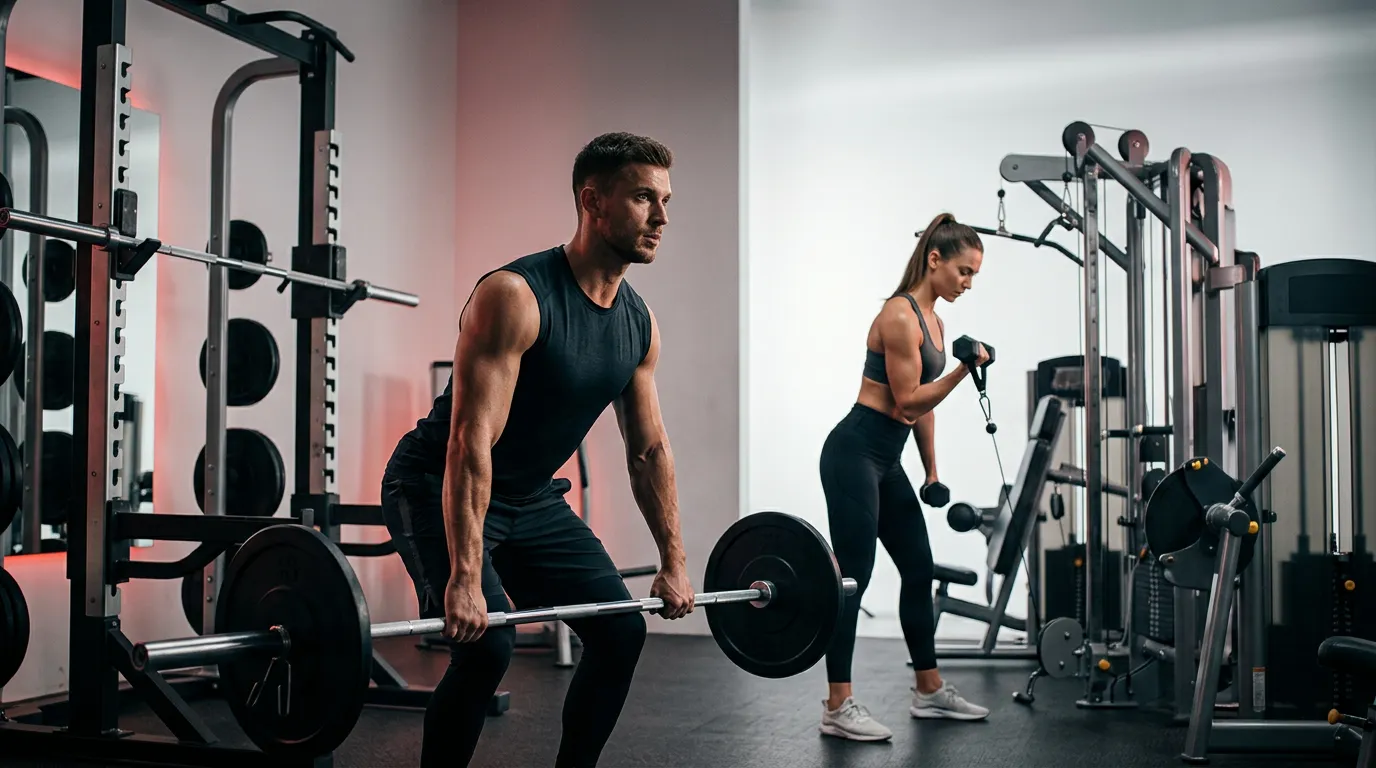
Compound exercises load multiple muscle groups and joints simultaneously, while isolation exercises focus on a single muscle or joint, allowing for specific targeting and shaping.
3 Key Takeaways
- Compound exercises (squat, deadlift, bench press) are most effective for building overall strength and mass as they activate large muscle chains and allow for heavy lifting.
- Isolation exercises (bicep curl, tricep extension) are suitable for targeted hypertrophy, correcting muscle imbalances, and rehabilitation.
- An appropriate training program combines both types of exercises – compound for foundation and progress, and isolation for details, symmetry, and injury prevention.
What Exactly Are Compound and Isolation Exercises?
Compound exercises are movements that load multiple muscle groups simultaneously, while isolation exercises focus on the work of one specific muscle group.
- Squat: Engages the hip, knee, and ankle joints, loading the quadriceps, glutes, hamstrings, adductors, and core stabilizers.
- Deadlift: A hip and knee hinge movement that activates almost the entire posterior kinetic chain – glutes, hamstrings, spinal erectors, traps, and forearms.
- Bench Press: Involves the shoulder and elbow joints, loading the chest muscles, anterior deltoids, and triceps.
- Bicep Curl: The movement occurs only at the elbow joint to load the biceps.
- Leg Extension: Activates only the knee joint to isolate the quadriceps.
- Lateral Raise: Movement only at the shoulder joint to load the medial deltoid.
What is Strength vs. Hypertrophy?
Although both types of exercises can contribute to both strength and muscle mass (hypertrophy), they have different effectiveness depending on the goal. For maximum strength: Compound exercises are the undisputed winner. Strength is the nervous system's ability to activate the maximum number of muscle fibers to overcome great resistance. Since compound exercises engage entire kinetic chains, they allow for the use of much heavier weights. For example, an 80kg athlete might squat 120kg for 5 reps, but it would be impossible to load their quads with the same intensity solely through leg extensions. Strength training typically involves compound movements in the 1-6 rep range with weights above 80-85% of one-rep max (1RM). For targeted hypertrophy: The picture here is more nuanced. Hypertrophy is primarily stimulated by three factors: mechanical tension, metabolic stress, and muscle damage.- Compound exercises provide immense mechanical tension due to heavy weights. They are excellent for building overall mass.
- Isolation exercises are masters at generating metabolic stress. Through higher rep ranges (e.g., 10-15) and shorter rest periods, sustained tension and "pump" are achieved in the target muscle. This leads to the accumulation of metabolites like lactate, which is a strong signal for growth. For example, 4 sets of 12 reps of bicep curls with 12kg dumbbells will create much more concentrated metabolic stress in the biceps than pull-ups, where the load is distributed and involves the back.
Strength is the nervous system's ability to activate the maximum number of muscle fibers to overcome great resistance, while hypertrophy is the increase in muscle mass.
I worked with a basketball player after an ACL surgery. In the early stage of rehabilitation, his ability to voluntarily activate his quadriceps was severely reduced (arthrogenic muscle inhibition). We started with an isolation exercise: a machine leg extension with no weight, just a 10-15 second static hold at the end range. This allowed the nervous system to "find" the muscle. Only after restoring basic control through isolation did we move to compound movements like shallow bodyweight squats. The combination was key – isolation "woke up" the muscle, and compound movements integrated it back into functional movement.
How to Use Compound and Isolation Exercises in Your Program?
Structuring your workout around these two types of exercises is necessary for achieving results and preventing injuries. 1. Start with compound movements: Always place the heaviest, most taxing compound exercises at the beginning of your workout. This is when your energy levels and concentration are highest. A typical leg workout might start with 3-4 working sets of squats, followed by lunges or leg presses. 2. Add isolation for volume and details: After you've finished with heavy compound movements, move on to isolation exercises to add volume and focus on specific muscles. After squats and lunges, you can do 3 sets of leg extensions (for quads) and 3 sets of leg curls (for hamstrings).
Structuring your workout around these two types of exercises is necessary for achieving results and preventing injuries. 1. Start with compound movements: Always place the heaviest, most taxing compound exercises at the beginning of your workout. This is when your energy levels and concentration are highest. A typical leg workout might start with 3-4 working sets of squats, followed by lunges or leg presses. 2. Add isolation for volume and details: After you've finished with heavy compound movements, move on to isolation exercises to add volume and focus on specific muscles. After squats and lunges, you can do 3 sets of leg extensions (for quads) and 3 sets of leg curls (for hamstrings). 3. Use isolation to correct imbalances: If you notice that one arm or leg is weaker, or a particular muscle is lagging aesthetically (e.g., the medial deltoid), add extra isolation exercises for that area. Single-arm dumbbell curls are a great example for correcting strength imbalances between the two arms. 4. Beginner Priority: Beginners should focus primarily on mastering excellent technique on 3-5 key compound exercises (squat, deadlift, bench press, overhead press, rows). This builds a solid strength foundation and coordination, upon which specialized work can be built later.Comparison Table
| Characteristic | Compound Exercises | Isolation Exercises |
|---|---|---|
| Number of joints involved | Multi-joint (2+) | Single-joint (1) |
| Potential for strength | Very high | Low to moderate |
| Muscle targeting | Low (entire chain) | Very high (specific muscle) |
| Risk of injury (with poor technique) | High | Lower |
| Time efficiency | High (you work many muscles at once) | Low (requires more exercises for the whole body) |
What Are Common Mistakes and Misconceptions?
A dogmatic approach to training often leads to mistakes. Understanding the nuances between the two types of exercises is key to avoiding them.Common mistakes and misconceptions represent a dogmatic approach to training, which often leads to errors and a misunderstanding of the nuances between compound and isolation exercises. "Machines are for beginners, free weights are for advanced lifters" is a false notion, as isolation machines are a valuable tool for everyone, including elite bodybuilders, to achieve metabolic stress, while beginners should start with compound movements to build a foundation. Ego-lifting in compound exercises is the most common cause of injuries.
- "Machines are for beginners, free weights are for advanced lifters": False. Isolation machines are a valuable tool for everyone, including elite bodybuilders, to achieve metabolic stress. At the same time, beginners should start with compound movements to build a foundation.
- Ego-lifting in compound exercises: The most common cause of injuries. Using too much weight on squats or deadlifts with compromised technique is a recipe for disc herniation or joint problems. Form always comes before weight.
- Relying solely on isolation for growth: A program consisting only of isolation exercises is often ineffective for building solid muscle mass and strength because it lacks the heavy mechanical tension that only compound movements can provide.
As a beginner, is it better to do only compound exercises?
In the beginning, the focus should be on mastering excellent technique on 3-5 key compound exercises (squat, deadlift, bench press, overhead press, rows). They build the best foundation. You can add 1-2 isolation movements at the end of the workout, but they should not be your main focus.
Can I build muscle mass with only compound exercises?
Absolutely. Compound exercises are entirely sufficient to stimulate significant hypertrophy throughout the body, especially in the first few years of training experience. Isolation exercises become more important when the goals are more specific – for example, if you want to emphasize the peak of the bicep or the side head of the shoulder.
Are isolation exercises safer than compound exercises?
Generally, yes. The movement is more controlled, often stabilized by a machine, and the weights are lighter. The risk of acute, severe injury is lower. However, any exercise performed with poor form or excessive weight carries risk. The highest risk of serious injury comes from compound exercises performed with poor technique and heavy weights.
See more in the fitness guides of Sport Zona Academy.
Expert Note from Sport Zona
From over 12 years of working with Bulgarian athletes, I've noticed that those who rely primarily on compound movements achieve the fastest progress. We incorporate isolation exercises as a supplement, but they are rarely the main driver of progress.
See more in the fitness guides of Sport Zona Academy.
Recommended products

Frequently asked questions
Which is better for building overall muscle mass – compound or isolation exercises?
Compound exercises are more effective for building overall mass as they activate multiple muscle groups and allow for working with heavier weights. They stimulate a stronger hormonal response that aids muscle growth.
Can a training program include both compound and isolation exercises?
Yes, the optimal program combines both types. Compound exercises serve as the foundation and for progress, while isolation exercises help with details, symmetry, and injury prevention.
Which exercises are more suitable for building strength?
Compound exercises are the undisputed leader for strength. They engage entire muscle chains and allow the use of much heavier weights than isolation exercises.
For what cases are isolation exercises ideal?
Isolation exercises are ideal for targeted hypertrophy of a specific muscle, correcting muscle imbalances, and rehabilitation, as they allow for precise loading.