Folic Acid vs. Vitamin B12: The Cell Regenerator vs. The Nerve Stabilizer

Folic acid and B12 are leading B vitamins. They cooperate for energy and recovery, with folic acid supporting cell division and B12 supporting the nervous system.
Short Answer: Vitamin B12 is directly responsible for energy production and nervous system health, while Folic Acid (B9) is critical for DNA synthesis and cell growth. Practical Tip: For optimal synergy, combine 400 mcg of methylfolate (active folic acid) with 500-1000 mcg of methylcobalamin (active B12) daily. This approach supports both energy and recovery.
Folic acid (vitamin B9) and vitamin B12 are important B vitamins. They often work together, but each has its unique functions in the body. For every athlete, it is crucial to understand the role of both vitamins for energy, recovery, and overall performance.
The body needs folic acid and B12 for various processes. Folic acid helps create and copy DNA and RNA for new cells – from red blood cells that carry oxygen to muscle fibers that repair after training. Without folic acid, cell division slows down or is inefficient. Vitamin B12 supports the nervous system, ensures communication between cells, and "recycles" key substances so that folic acid can continue its work.
This article examines these vitamins separately, explains how they interact, and offers specific guidelines on when to prioritize one, the other, or take them together for maximum results in training and daily life.
This article is part of the Expert Supplement Hub — over 270 expert-verified articles by Petar Mitkov and the Sport Zona team.
What is the difference between Folic Acid and Vitamin B12?
Folic acid (Vitamin B9) and Vitamin B12 (Cobalamin) are water-soluble B vitamins, with vitamin B9 focusing on DNA/RNA synthesis, cell division, and red blood cell formation, while vitamin B12 is responsible for the nervous system, energy metabolism, and red blood cell maturation.
| Criterion | Folic Acid (Vitamin B9) | Vitamin B12 (Cobalamin) |
|---|---|---|
| Biological Status | Water-soluble Vitamin B9 | Water-soluble Vitamin B12 |
| Primary Focus | DNA/RNA synthesis, cell division, red blood cell formation | Nervous system function, energy metabolism, red blood cell maturation |
| Mechanism | Involved in one-carbon metabolism for nucleotide synthesis | Cofactor for the enzyme methionine synthase, which regenerates folate and metabolizes homocysteine |
| Risk of Deficiency | Megaloblastic anemia; neural tube defects in pregnancy | Pernicious anemia, irreversible neurological damage |
| Main Food Sources | Leafy green vegetables (spinach, broccoli), legumes, citrus fruits, fortified cereals | Animal products (meat, fish, dairy, eggs) |
| Recommended Supplement Form | Methylfolate (5-MTHF) – bioactive form bypassing MTHFR gene variations | Methylcobalamin or adenosylcobalamin – bioactive forms |
What is the In-depth Mechanism Analysis?
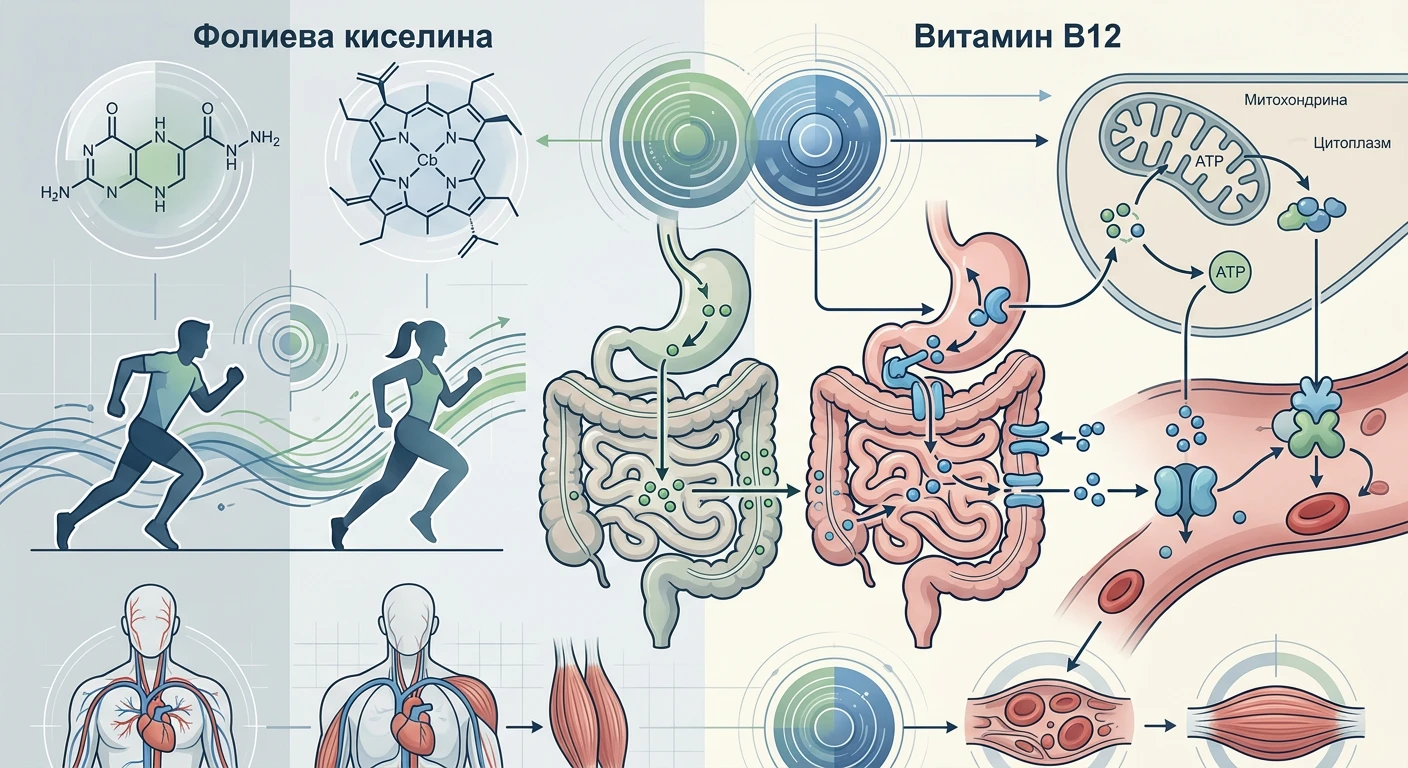
1. Folic Acid (B9): Supporting Cell Division
Folic acid is the general name for a group of compounds, but the body converts it into its active form, L-methylfolate (5-MTHF), to function. Its primary role is in "one-carbon metabolism" – a process where it transfers carbon groups necessary for DNA and RNA synthesis. This is important for creating new cells. For athletes, this means:- Red Blood Cell Production: Adequate folate levels are essential for producing healthy red blood cells that transport oxygen to working muscles. Deficiency leads to megaloblastic anemia – a condition where red blood cells are few, enlarged, and inefficient, reducing aerobic capacity (VO2max).
- Muscle Recovery: After intense training, the body repairs and grows (hypertrophy), which requires intensive cell division. Folate provides the necessary "building blocks" for this process.
- Homocysteine Metabolism: Folate helps convert the amino acid homocysteine into methionine. High homocysteine levels are a risk factor for cardiovascular disease.
The in-depth mechanism analysis involves exploring how folic acid supports the creation of new, healthy cells in the body, affecting processes like oxygen transport and muscle recovery after training.
2. Vitamin B12: Supporting the Nervous System and Energy
Vitamin B12, or cobalamin, is the most complex vitamin k in structure. It acts as a cofactor for two important enzymes in the body.- Methionine Synthase: This is where B12 and folate intersect. B12 (as methylcobalamin) takes a methyl group from methylfolate and gives it to homocysteine to convert it into methionine. This process has a dual effect: it lowers homocysteine and Restores active folate, which can be used again for DNA synthesis. Without B12, folate remains inactive.
- L-methylmalonyl-CoA Mutase: This enzyme is important for energy metabolism. It helps convert certain fatty acids and amino acids into succinyl-CoA, which participates directly in the Krebs cycle – the main pathway for energy production (ATP) in cells.
Simply put: Vitamin B12 supports the nervous system and helps folic acid work. Without it, energy production is inefficient, and nerve signals to the muscles worsen.
Scientific Sources
- Folate and vitamin B12 status in the Americas: a systematic review, 2021
- Vitamin B12 Fact Sheet for Health Professionals - National Institutes of Health (NIH)
- Folate - Linus Pauling Institute at Oregon State University
- Scientific Opinion on Dietary Reference Values for vitamin B12 - EFSA Journal, 2015
- Vitamin deficiency anemia - Mayo Clinic
- Vitamin B12 - Examine.com
The Synergistic Effect: Why Do They Work Better Together?
The most important aspect of the relationship between folic acid and B12 is that they depend on each other. Only in the case of B12 deficiency does folate accumulate in its methylated form (5-MTHF) because the methionine synthase enzyme (which requires B12) cannot use it. This leads to a functional folate deficiency, even with adequate intake, as it cannot be recycled into the other forms needed for DNA synthesis. From a clinical perspective, this has a dangerous consequence: high doses of folic acid can "mask" a vitamin B12 deficiency. Folate will correct the megaloblastic anemia, which is a symptom of both deficiencies. The blood count will appear normal, but the neurological damage caused by the lack of B12 (such as myelin sheath damage) will continue to progress silently and irreversibly. Therefore, it is important for anyone suspecting a deficiency to test for both vitamins. It is often wise to take a combined product or a B-complex.What is the Practical Algorithm for Selection?
Choose Folic Acid (Methylfolate) if:
- You are planning pregnancy or are pregnant. Needs are much higher for preventing neural tube defects.
- You have a diagnosed MTHFR gene variation. Taking synthetic folic acid is ineffective for you.
- You aim for cellular regeneration and your diet is rich in animal products (i.e., the risk of B12 deficiency is low).
- You have high homocysteine and proven normal B12 levels.
🔵 Choose Vitamin B12 (Methylcobalamin) if:
- You are vegan or strictly vegetarian. This is an essential supplement.
- You are over 50 years old. The ability to absorb from food significantly decreases.
- You experience unexplained fatigue, numbness, or neurological symptoms. Consult a doctor.
- You suffer from gastrointestinal diseases such as Crohn's disease, celiac disease, or atrophic gastritis.
The recommended stack for mutual enhancement is taking folic acid and vitamin B12 together, with a combination of 400-800 mcg of Methylfolate and 500-1000 mcg of Methylcobalamin daily, taken with food, recommended for most active athletes.
When Should We Take B Vitamins to Ensure Their Effectiveness?
For optimal performance and health, the recommended approach is daily maintenance with targeted intake around workouts.- Daily Basis: Take a high-quality B-complex in the morning with breakfast. Ensure it contains at least 400 mcg of methylfolate and 250-500 mcg of methylcobalamin. This covers basic needs for energy metabolism and cellular health.
- Specialized Intake (if needed):
- For vegans/vegetarians: Additional intake of 1000 mcg of methylcobalamin 2-3 times a week (a higher dose compensates for lower absorption).
- During intense training blocks: A slight increase in methylfolate dosage (up to 800 mcg) can be considered to support recovery processes.
Expert Note on Protocol
Daily intake of B vitamins is key, as they are water-soluble (except for B12, which has liver stores) and do not store for long. The goal is to maintain stable and adequate plasma concentrations, regardless of the exact timing around training.
🧭 When to Choose What?
- Choose Folic Acid (methylfolate) if you want to support cell division and recovery, especially if you have an MTHFR mutation and your B12 levels are adequate.
- Choose Vitamin B12 (methylcobalamin) if you are vegan, over 50, or have neurological symptoms like fatigue and numbness. This is the first step.
- Combine both in most cases. For active athletes, this is the safest and most effective approach to maintain energy, nervous system function, and recovery, while avoiding the risk of masking a deficiency.
📖 What are Folic Acid and Vitamin B12?
Folic Acid (Vitamin B9): This is a water-soluble vitamin necessary for the synthesis of DNA, RNA, and amino acids. It is important for rapidly dividing cells, including red blood cells and immune system cells.
Vitamin B12 (Cobalamin): A complex water-soluble vitamin containing cobalt, vital for nerve cell function, energy production, and red blood cell formation, working alongside folic acid.
What are the Pros and Cons of Folic Acid and Vitamin B12?
Folic acid is critical for cell growth, easily accessible in foods, and the methylfolate form is highly effective, but high doses can mask B12 deficiency, and the synthetic form is ineffective with MTHFR mutations.
| Pros | Cons | |
|---|---|---|
| Folic Acid | Critical for cell growth, easily accessible in foods, methylfolate form is highly effective. | High doses can mask B12 deficiency; synthetic form is ineffective with MTHFR mutations. |
| Vitamin B12 | Essential for nervous system and energy, body can store it, effective for neurological issues. | Found only in animal foods; absorption decreases with age and with stomach problems. |
What is the difference between Folic Acid and Vitamin B12?
Folic acid and vitamin B12 are vital vitamins that play a key role in energy production and bodily recovery, working in close synergy for optimal cellular function.
- Folic Acid is the Blueprint Designer. It creates and replicates the detailed plans (DNA) for every new component (cell) the machinery needs.
- Vitamin B12 is the Master Mechanic. It maintains the electrical system (nerves) and ensures the designer has the necessary supplies to keep working by recycling used materials.
If the mechanic (B12) is absent, the designer (folate) runs out of materials, and the whole process halts, while the electrical system starts to malfunction.
How to Choose the Right Product for Your Goal?
- General Health and Prevention: To cover all basic needs, choose a quality multivitamin and mineral complex.
- Energy and Focus: If the goal is to improve energy metabolism and cognitive function, B-complexes or standalone vitamin B12 are good choices.
- Recovery and Growth: To support cellular regeneration after intense workouts, combining with protein and amino acids is important.
⚖ When to Choose Folic Acid
- You want to optimize cellular recovery.
- You have an MTHFR gene variation (choose methylfolate).
- You are planning pregnancy.
- Your blood tests show a folate deficiency with normal B12.
⚖ When to Choose Vitamin B12
- You follow a vegan or vegetarian diet.
- You are over 50 years old.
- You have symptoms like chronic fatigue or numbness.
- You have stomach absorption issues.
Expert Note from Sport Zona
Methylcobalamin is a sublingual vitamin B12 that is absorbed directly under the tongue, bypassing the stomach, and can improve energy and concentration within a few weeks.
Frequently asked questions
Can Folic Acid and Vitamin B12 be taken together?
Yes, and it is even highly recommended. They work synergistically in the methylation cycle, which is critical for energy production, DNA synthesis, and homocysteine regulation. Their combined intake prevents the risk of high doses of folic acid masking a B12 deficiency.
Which is better for beginners - Folic Acid or Vitamin B12?
Both are essential vitamins. If you have to choose only one, B12 (in its active form like methylcobalamin) often has a more noticeable effect on energy, especially for vegans or vegetarians. However, the best start is a quality B-complex that contains both vitamins in balanced doses.
When is the best time to take Folic Acid and Vitamin B12?
It is best to take them in the morning, with or without food. Taking them in the morning supports energy metabolism throughout the day. Since B12 can have a mild energizing effect, taking it late at night can sometimes disrupt sleep in more sensitive individuals.
Are there side effects from taking Folic Acid or Vitamin B12?
Both vitamins are water-soluble and generally very safe, as excess is excreted in the urine. However, prolonged intake of high doses of synthetic folic acid (over 1000 mcg/day) can mask the symptoms of vitamin B12 deficiency, which is dangerous. For B12, there is no established upper safety limit (No Tolerable Upper Intake Level).
What is the recommended dosage of Folic Acid and Vitamin B12?
For active athletes, the recommended daily doses are: 400-800 mcg of folic acid (preferably methylfolate) and 500-1000 mcg of vitamin B12 (preferably methylcobalamin or hydroxocobalamin). In case of diagnosed deficiency, the doses should be determined by a specialist.