Glucosamine vs. Chondroitin: The Building Block vs. The Flexible Lubricant

Glucosamine builds cartilage, while chondroitin lubricates it. Their combination provides complete protection and restoration of joints.
Short Answer: Glucosamine is the "brick" for building new cartilage, while chondroitin is the "shield" that retains water in the joint and protects it from enzymatic breakdown. Scientific data is mixed but shows the greatest benefit when they are combined. Practical advice: For optimal effect, combine 1500 mg of Glucosamine Sulfate with 800-1200 mg of Chondroitin Sulfate daily, taken with food for a period of at least 3-6 months.
Every serious athlete knows the feeling – a slight stiffness or dull ache in the knee, shoulder, or ankle after a tough workout. Joints are the silent heroes of every movement, but constant strain wears them down. In the search for a solution, two supplements always come to the forefront: glucosamine and chondroitin. They have become synonymous with joint support, but are often offered both together and separately, which confuses many athletes.
Your joints are a complex mechanism, similar to the hinges of a heavy door. To work smoothly, these hinges need a strong structure and good lubrication. Glucosamine is the raw material for building the hinge itself – it provides the "bricks" for maintaining and recovering cartilage tissue. Chondroitin, on the other hand, is the "lubricant" – it attracts fluids into the joint, providing cushioning, smooth gliding, and protection from friction.
We will conduct an in-depth analysis of both components to answer the most important question: When to choose one, when the other, and why is it most often best to combine them? We will examine their mechanisms of action, the scientific evidence behind them, and offer a clear practical protocol for athletes who want to invest in the long-term health of their joints.
This article is part of the Expert Hub for Nutritional Supplements — over 270 expertly verified articles by Petar Mitkov and the Sport Zona team.
What is a Comparative Matrix from Systems Analysis?
A comparative matrix from systems analysis is a tool that presents the main characteristics and effectiveness of Glucosamine and Chondroitin by comparing their biological role, mechanism of action, time horizon for initial effects, and key influence.
| Criterion | Glucosamine | Chondroitin |
|---|---|---|
| Biological Role | Amino monosaccharide, building block | Glycosaminoglycan (GAG), structural component |
| Main Focus | Stimulates cartilage synthesis (building) | Hydration, elasticity, inhibition of degradation (protection) |
| Mechanism | Precursor for the synthesis of proteoglycans and GAGs | Attracts water into cartilage; inhibits enzymes that degrade cartilage |
| Time Horizon | Slow acting (4-8 weeks for first effects) | Slow acting (6-10 weeks for first effects) |
| Key Influence | Structural integrity of cartilage | Shock absorption and "lubrication" |
| Specific Bonus | May have a mild anti-inflammatory effect, especially the sulfate form | More pronounced effect on reducing joint space loss |
What is the Mechanism of Action of Glucosamine?
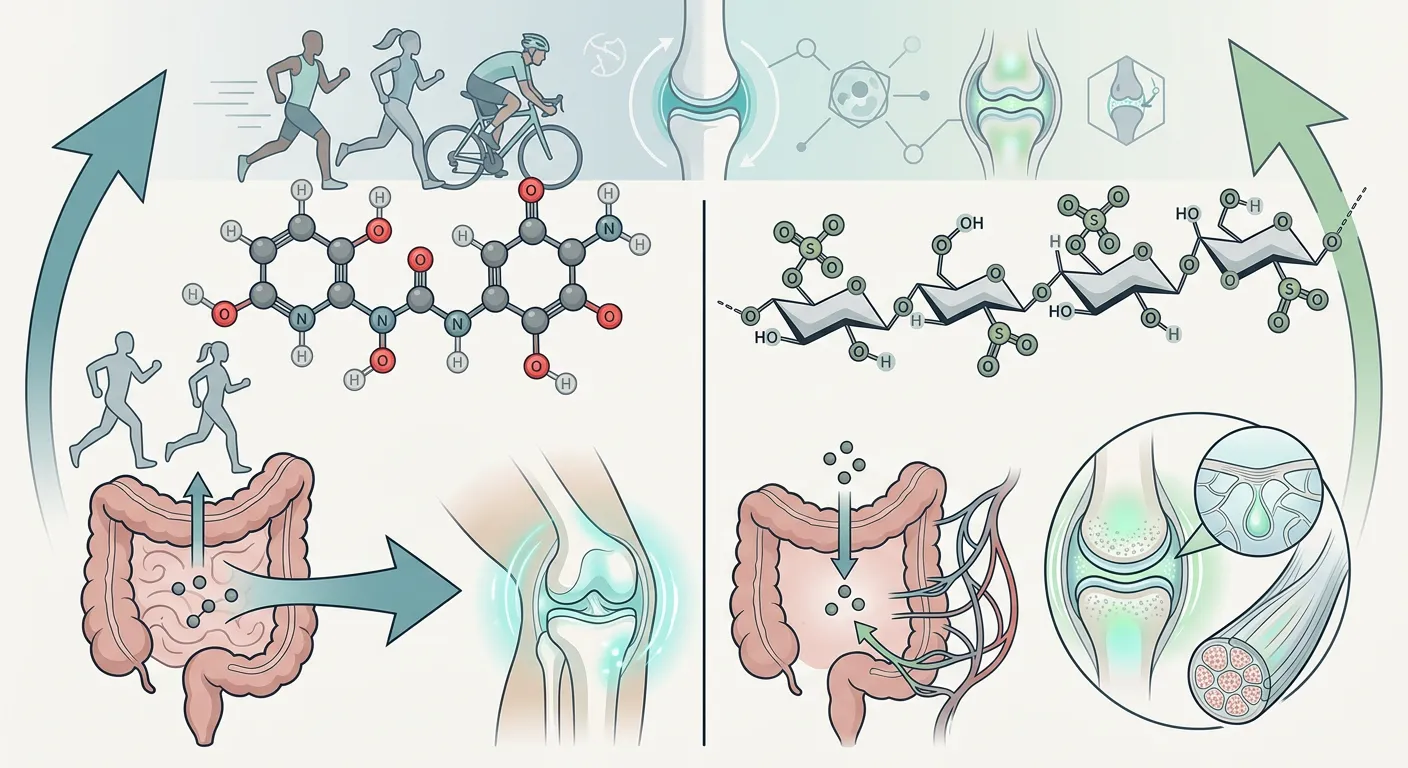
1. Glucosamine: The Raw Material for Cartilage
Glucosamine is a naturally occurring amino sugar compound that serves as a primary building block for the synthesis of glycosaminoglycans (GAGs), proteoglycans, and hyaluronic acid – critical components of articular cartilage and synovial fluid. The most effective form is Glucosamine Sulfate, as the sulfate group is necessary for proteoglycan production.
Simply put: Glucosamine is like the delivery of bricks and cement for building cartilage tissue. Without it, the body lacks the essential materials to repair wear and tear.
2. Chondroitin: The Joint's Shock Absorber
Chondroitin sulfate is a large and complex glycosaminoglycan (GAG) that is a major structural component of cartilage. Its function is multifaceted. First, due to its highly negative charge, it attracts and retains large amounts of water within the cartilage matrix, much like a sponge. This gives cartilage elasticity, resistance to compression, and the ability to absorb shocks. Second, chondroitin inhibits the action of enzymes (such as metalloproteinases) that degrade cartilage. Third, it stimulates the synthesis of proteoglycans and collagen by chondrocytes (cartilage cells). Thus, chondroitin improves the "mechanical" properties of the joint and actively protects it from further destruction.
Simply put: Chondroitin is the water shock absorber in the joint. It keeps it "juicy" and elastic to handle load, while simultaneously protecting the structure from enzymes trying to break it down.
Scientific Sources
- Zhu, X., et al. Effectiveness and safety of glucosamine and chondroitin for the treatment of osteoarthritis: a meta-analysis of randomized controlled trials. Journal of Orthopaedic Surgery and Research, 2018
- Examine.com, Glucosamine Scientific Review, 2023
- Office of Dietary Supplements - NIH. Glucosamine and Chondroitin for Osteoarthritis, 2021
- Linus Pauling Institute at Oregon State University, Glucosamine, 2018
- Mayo Clinic, Glucosamine, 2023
- Lugo, J. P., et al. Efficacy and tolerability of an undenatured type II collagen supplement in modulating knee osteoarthritis symptoms: a multicenter randomized, double-blind, placebo-controlled study. Journal of the International Society of Sports Nutrition, 2016
The Synergistic Effect: Why Do They Work Better Together?
Although with different primary mechanisms, glucosamine and chondroitin have a strong combined effect, meaning their combined intake leads to better results than taking them individually. This is due to their complementary roles in maintaining cartilage health.
Glucosamine provides the building blocks, chondroitin creates a suitable environment for their use. You are building a house. Glucosamine is the delivery of bricks. Chondroitin is the water you mix with the cement to bind the bricks, and at the same time, it protects from vandals (degrading enzymes) trying to tear down the wall. Without bricks, there is no construction. Without water and security, even if you have bricks, they won't turn into a strong wall. That's why the combination of the two is the gold standard in most joint support protocols.
When to Choose Glucosamine, When Chondroitin, and When – a Combination of Both?
The combination of glucosamine and chondroitin is the most commonly recommended approach, but there are specific scenarios where one component or the other may be emphasized.
Choose Glucosamine if:
- Your goal is primarily Prevention and maintaining healthy cartilage structure.
- Your training load is high, but you don't yet have pronounced symptoms of pain or "creaking."
- You are looking for a more budget-friendly, basic option for long-term support.
- You want to provide the basic "building material" for your joints.
🔵 Choose Chondroitin if:
- Your main problem is a feeling of Friction, stiffness, and "creaking" in the joints.
- You need better "cushioning" and shock absorption.
- You want to actively suppress cartilage degradation processes.
- Your symptoms include mild pain and discomfort related to movement.
Recommended stack for maximum effect: For most athletes, the best approach is combined intake. The standard protocol includes 1500 mg Glucosamine Sulfate + 800-1200 mg Chondroitin Sulfate per day. Often, MSM (Methylsulfonylmethane) is added to this combination for additional anti-inflammatory effect and sulfur delivery.
What is the "Foundation and Performance Stack" Protocol for 2026?
The "Foundation and Performance Stack" protocol is a modern approach for athletes who invest long-term in their joint health, based on scientific data and practical experience.
- Daily Foundation (Year-round): Take daily, divided into 2 or 3 doses with food to reduce stomach discomfort.
- Glucosamine Sulfate: 1500 mg
- Chondroitin Sulfate: 1200 mg
- MSM (Methylsulfonylmethane): 1000-2000 mg
- Performance Stack (During periods of heavy training): Add to the foundation:
Expert Note: Don't expect miracles immediately. Glucosamine and chondroitin are not painkillers. They work slowly, at a structural level. Give them at least 2-3 months to feel a difference. Consistency is important. Taking them is a marathon, not a sprint.
🧭 When to Choose What?
- Choose only Glucosamine if you are a young athlete without complaints and are looking for basic prevention on a limited budget.
- Choose only Chondroitin if your main problem is a feeling of friction and stiffness, but you have no signs of structural damage.
- Combine both if you are over 30, train hard, have occasional discomfort, or simply want the most complete and complementary protection for your joints. This is the recommended approach in 90% of cases.
📖 What are Glucosamine and Chondroitin?
Glucosamine is an amino sugar that serves as a primary "building block" for the synthesis of cartilage tissue and other connective elements in the body.
Chondroitin is a large, complex carbohydrate (glycosaminoglycan) that is a key structural component of cartilage, responsible for its hydration, elasticity, and resistance to compression.
⚖ Pros and Cons
| Pros | Cons |
|---|---|
| Glucosamine | |
|
|
| Chondroitin | |
|
|
🗣 Explained Simply
| Criterion | Glucosamine | Chondroitin |
|---|---|---|
| Analogy | 🧱 Bricks | Sponge/Shock Absorber |
| Main Function | Building | Lubrication and protection |
| How it Helps? | Provides material for repair | Keeps the joint "juicy" and stops degradation |
| Molecule Type | Small and simple | Large and complex |
In short, glucosamine is the builder, chondroitin is the protector and maintenance engineer. You need both to have a healthy and functional "building" (joint).
Choose the Right Product for Your Goal:
By combining the right supplements, you can build a comprehensive joint health strategy. Here's how to get started:
For comprehensive structural support: Explore our combined joint formulas.
For connective tissue support: Add high-quality hydrolyzed collagen or collagen type II.
For inflammation control: Include Omega-3 fatty acids in your regimen.
Combined Protocol for Athletes:
- FOUNDATION: Combined formula with glucosamine, chondroitin, and MSM daily.
- SUPPORT: Add collagen for the health of cartilage, tendons, and skin.
- OPTIMIZATION: Include anti-inflammatory agents like Omega-3 on days with the heaviest training.
⚖ When to Choose Glucosamine
- As a preventive measure for young athletes.
- When seeking basic, structural support.
- In early stages of discomfort without pain.
- If your budget is more limited.
⚖ When to Choose Chondroitin
- With a feeling of "creaking" and friction in the joints.
- When there is a need for better shock absorption.
- With more pronounced symptoms of pain and discomfort.
- For active counteraction of enzymatic degradation.
Expert Note from Sport Zona
In my practice with athletes, I almost never recommend Glucosamine or Chondroitin separately. The debate "which is better" is largely academic because their synergistic effect is too valuable to ignore. The most common mistake I see is a lack of patience. People take them for 2-3 weeks, feel nothing, and give up. This is a mistake. These compounds are not painkillers, but food for cartilage. For me, the combination of Glucosamine + Chondroitin + MSM is a mandatory foundation for any athlete over 25 who trains hard and wants to keep their joints healthy in the long term.
Recommended products
Frequently asked questions
Can Glucosamine and Chondroitin be taken together?
Yes, not only is it possible, but it is also the most recommended approach. Most major studies show that they work synergistically – glucosamine provides building blocks, and chondroitin protects the structure. Most quality joint formulas contain them together.
Which is better for beginners - Glucosamine or Chondroitin?
For a beginner with general joint discomfort, without a specific diagnosis, it is most practical to start with a combined product. If only one is to be chosen, Glucosamine sulfate is a good starting point, as it is a primary building block. However, the evidence for taking either alone is weaker than for their combination.
When is the best time to take Glucosamine and Chondroitin?
The exact timing is not critical, but consistency is key. It is best to take them with food to reduce the risk of stomach discomfort. The daily dose can be divided into two or three intakes throughout the day for better absorption (e.g., 3 times 500 mg glucosamine and 400 mg chondroitin).
Are there any side effects from taking Glucosamine or Chondroitin?
Both supplements are considered safe, with rare and mild side effects. The most common are gastrointestinal discomforts such as nausea or heartburn. Glucosamine is often derived from shellfish, so people with allergies should look for vegetarian sources. Chondroitin may have a mild blood-thinning effect, so consulting a doctor is mandatory when taking anticoagulants.
What is the recommended dosage of Glucosamine and Chondroitin?
The standard dose used in clinical studies is 1500 mg per day for Glucosamine sulfate and 800–1200 mg per day for Chondroitin sulfate. It is important to use the "sulfate" forms as they are the best studied. The effect is not immediate and may take between 4 and 8 weeks to become noticeable.