Deadlift — A Complete Guide to Safe Technique
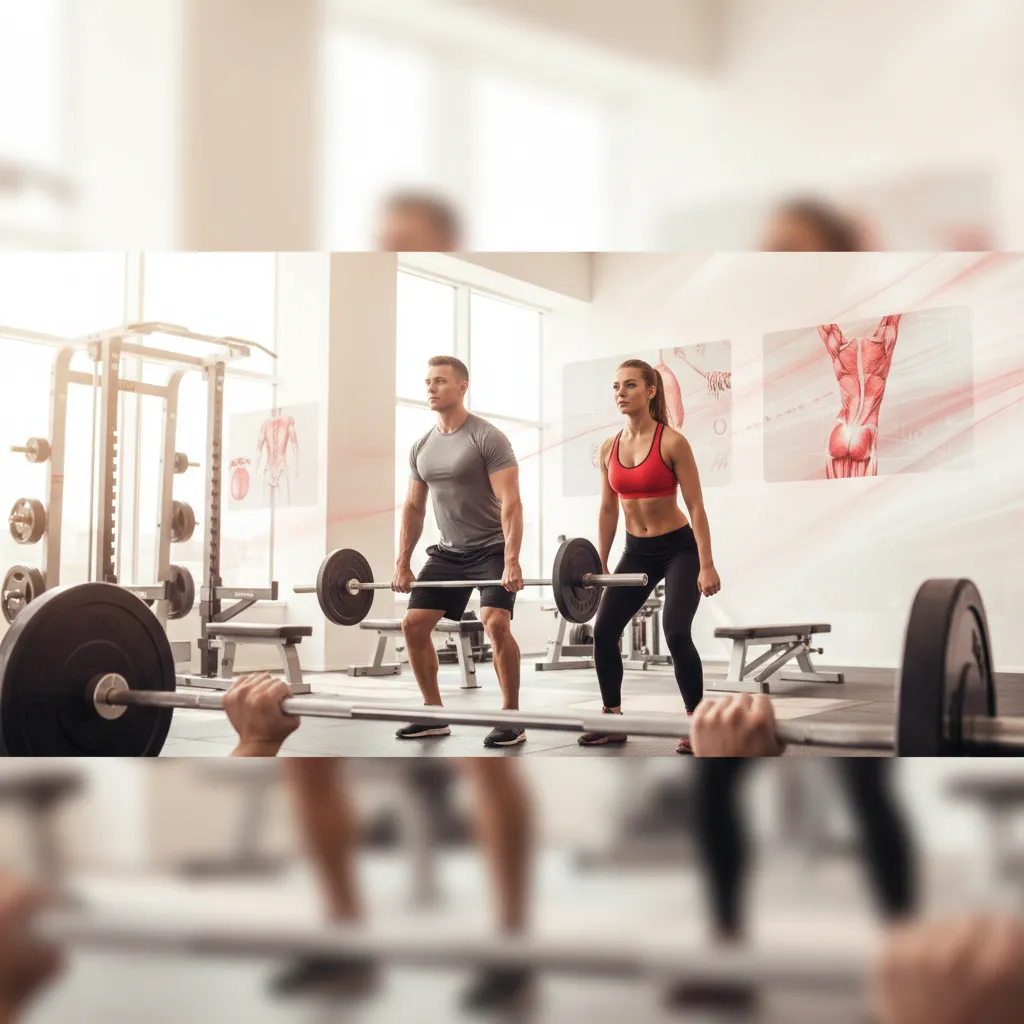
Conventional vs Sumo, Hip Hinge, Neutral Spine, Lat Engagement, Mistakes
The deadlift is a fundamental strength movement for building muscle across the entire posterior chain, but it requires uncompromising technique for maximum effectiveness and injury prevention.
📌 3 Key Takeaways
- A neutral spine (straight back) is absolutely mandatory; any rounding, especially in the lower back, is a direct path to injury and must be avoided at all costs.
- The movement is a hip hinge, not a squat; the focus is on pushing the hips back, not lowering them down, to properly load the glutes and hamstrings.
- Start with a light weight to perfect your form before thinking about personal records; technique always trumps ego and the weight on the bar.
Why is the Deadlift the "King" of Exercises?
💬 Simply put: The deadlift is a complex strength exercise that develops almost the entire body, but it absolutely requires proper technique for safe and effective results.
The deadlift is often called the "king of exercises," and for good reason. Unlike isolation movements that target a single muscle, the deadlift is a compound, multi-joint movement that engages almost the entire body. The primary focus falls on the so-called "posterior chain" — the muscles on the back of your body: traps, lats, erector spinae, glutes, and hamstrings. Simultaneously, it engages the quads when lifting off the floor, the forearms and biceps for grip, and the abs for torso stabilization.
Beyond hypertrophy, the deadlift is one of the best exercises for building raw, functional strength. The ability to lift a heavy object off the ground with proper mechanics is a fundamental human movement. Training it increases strength in the gym while also translating that strength into everyday life — whether carrying heavy groceries, moving furniture, or playing with children. A properly executed deadlift builds density and strength in the back, which actually protects against future pain and injuries, as long as technique is prioritized.
Last but not least, lifting heavy compound movements like the deadlift and squat elicits a powerful endocrine response in the body. This means it stimulates the production of anabolic hormones like testosterone and growth hormone, which are key for building muscle mass and recovery throughout the body, not just in the working muscles.
Conventional vs. Sumo Deadlift: Which is Right for You?
One of the first questions every beginner asks is which deadlift style to choose — conventional or sumo. Both variations are legitimate and effective, but they load the musculature in slightly different ways and are suited for different body structures. The choice isn't just a matter of preference, but of biomechanical efficiency. In the conventional deadlift, the feet are shoulder-width apart, and the hands are on the outside of the legs. In the sumo deadlift, the stance is much wider, and the hands are on the inside of the thighs.
The conventional deadlift typically has a greater range of motion and places more stress on the erector spinae and hamstrings. It's more suitable for people with shorter torsos and longer arms, as this allows them to achieve a more upright starting position without excessively bending their knees. The sumo deadlift, on the other hand, has a shorter range of motion, allowing for heavier weights to be lifted. It targets the quads, glutes, and adductors (inner thighs) more significantly. It's ideal for athletes with longer torsos and shorter arms, as the wide stance allows them to "open" their hips and bring their body closer to the barbell.
My advice is to experiment with both variations using light weight. Film yourself from the side and see which style allows you to maintain a neutral spine more easily. For most beginners, I recommend starting with the conventional deadlift because it builds a better foundation of lower back strength. You can incorporate the other variation as an accessory movement in your program.
| Characteristic | Conventional Deadlift | Sumo Deadlift |
|---|---|---|
| Stance | Shoulder-width/hip-width | Significantly wider than shoulders |
| Grip | Hands on the outside of the legs | Hands on the inside of the legs |
| Range of Motion | Greater | Shorter (approx. 20-25% less) |
| Primary Muscles Worked | Erector spinae, glutes, hamstrings | Quads, glutes, adductors, traps |
| Best Suited For | People with shorter torsos and longer arms | People with longer torsos and shorter arms |
The Hip Hinge: The Key to a Safe Deadlift
The biggest and most dangerous mistake I see daily in the gym is confusing the deadlift with a squat. People try to squat down to the barbell, lowering their hips too much, which compromises their back position. The deadlift is NOT a squat. It's a "hip hinge." Imagine you're trying to close a car door with your hips while your hands are full. The movement is pushing your hips BACK, keeping your back straight, and bending your knees only slightly. Your spine and shins should remain almost vertical.
To master this movement, I recommend the following exercise outside of the deadlift. Stand with your back to a wall, about a foot away. With slightly bent knees, start pushing your hips back until you touch the wall. Focus on the feeling of stretching in your hamstrings. Your back should remain perfectly straight the entire time. Repeat 10-15 times. As you feel more confident, increase the distance from the wall slightly. This is the fundamental movement you need to apply to the deadlift. The barbell simply adds weight to this pattern.
When setting up for a deadlift, think "hips back" first, and only then "bend knees" as much as needed to grab the bar. I often see beginners starting with their hips too low — almost in a squat position. When they pull, their hips shoot up first, leaving the entire load on their lower back. The correct starting position is a compromise: hips should be higher than the knees but lower than the shoulders, with the back in a neutral position.
Setting Up for the Pull: Neutral Spine and Engaged Back
Safety in the deadlift is forged before the bar even leaves the ground. Proper setup is 90% of a successful rep. The first step is foot positioning. Stand so that the middle of your feet is directly under the barbell. When you bend down to grip it, your shins should almost touch it. Grip the bar slightly wider than your feet, with your hands just outside your shins. You can use a double overhand grip (both palms facing you) or a mixed grip (one palm facing forward, the other backward). The mixed grip is stronger but creates a slight rotational torque. I recommend using it only for your heaviest sets (above 85% of your max) and alternating hands.
After gripping the bar, the most crucial moment arrives: establishing a neutral spine. This does NOT mean a perfectly flat back, but maintaining its natural curves without rounding (flexion) or excessive arching (hyperextension) in the lower back. The easiest way to achieve this is to imagine you want to "show the logo on your t-shirt to the wall in front of you." This will automatically cause you to puff out your chest and brace your upper back. Your gaze should be slightly forward and down, a few feet in front of you, to keep your neck aligned with your spine.
The final element before the pull is engaging the latissimus dorsi. Imagine you're holding oranges under your armpits and want to squeeze them. Another useful mental cue is to imagine you're trying to "bend" the bar around your shins. This engagement "locks" the shoulders, pulls the bar tight to your body, and creates immense tension throughout your back, protecting your lower back. You'll feel the bar "click" as you take out the slack. The movement shouldn't start with a jerky pull, but with a smooth yet powerful creation of tension throughout the chain.
🔬 From Practice
A few years ago, a client, Martin, a 42-year-old IT specialist, came to me with chronic lower back pain and a fear of the deadlift. The first thing I did was make him forget about the barbell for a month. We started with Romanian deadlifts using two 10kg dumbbells, with my sole goal being to teach him perfect hip hinging. We repeated "hips back, chest up" until it became second nature. After two weeks, we moved on to trap-bar deadlifts, which are gentler on the back. Only after he built confidence and strength there did I bring him back to the conventional deadlift, starting with an empty 20kg bar. Today, Martin pulls 140kg for 5 reps with impeccable technique, and his lower back pain is completely gone because he has built a strong and stable back to support him.
The Execution: From Floor to Lockout
Once you're in the perfect starting position — neutral back, engaged lats, slack out — it's time for the pull itself. Think of the first part of the movement not as "pulling," but as "pushing the floor away" with your legs. This is the same mechanics as a leg press. All the power should come from your legs and glutes. The barbell and your torso should move up simultaneously, with the angle of your back relative to the floor remaining unchanged until the bar passes knee level. I often see hips shooting up first. This is a sure sign that the legs aren't engaged enough, and the lower back will take the brunt of the load.
Throughout the entire movement, keep the barbell in contact with your body — sliding it up your shins and thighs. If the bar drifts even a few inches away from you, the stress on your lower back increases exponentially. The lat engagement we discussed is key here. Once the bar passes your knees, the movement transitions into an aggressive hip thrust forward. "Meet" the bar with your hips and squeeze your glutes hard at the top.
The lockout is the final phase. Stand up fully, shoulders back, chest out. It's important not to hyperextend your lower back, meaning don't lean back trying to "finish" the movement. This again puts unnecessary stress on your vertebrae. The top position is simply a fully upright body. The descent, or negative portion, should be controlled but not overly slow. Simply reverse the movement: start with a hip hinge (hips back) and once the bar passes your knees, bend them to return it to the floor. Don't drop it uncontrolled (unless attempting a 1-rep max), but also don't perform an excessively slow negative, as this increases fatigue and the risk of form breakdown on subsequent reps.
⚠️ Common Mistakes
- "Cat back" (rounding the spine): The most dangerous mistake. It indicates either the weight is too heavy or you haven't mastered maintaining a neutral position. Stop, reduce the weight, and focus on the chest-up position.
- Jerking the bar off the floor: Trying to use momentum instead of strength. This leads to a loss of position and strain on the lower back. Take the slack out before every pull.
- Hyperextension at the top: Excessive arching of the lower back at lockout. Lockout is simply standing up straight and squeezing the glutes.
- Bar drifting away from the body: A result of lacking lat engagement. This drastically increases the stress on the back. Think about "sliding" the bar up your legs.
How to Program Deadlifts for Progress?
The deadlift is an extremely taxing exercise on the central nervous system (CNS). For this reason, it's not necessary, and not recommended, to do it too often or with too much volume. For most trainees, performing heavy deadlifts once a week is sufficient for steady progress. More advanced athletes can do it twice, with one session being heavy and the other lighter, focusing on technique or a different variation (e.g., Romanian deadlifts or deficit deadlifts).
For a beginner, a good starting point is 3 working sets of 5 reps (3x5 scheme). This allows you to work with relatively heavy weights without fatigue leading to form breakdown. Start with a weight you can do for 8 reps, but only do 5. For example, if you can do 8 reps with 60kg, your working weight for 3x5 will be 60kg. Aim to add 2.5kg to the bar each week. This linear progression works excellently at the beginning. When you reach a point where you can no longer complete 3x5 with perfect form, reduce the weight by 10% and start climbing again.
Warming up before a heavy deadlift is critical. Start with 5-10 minutes of light cardio to raise your body temperature. Then, perform dynamic stretches like cat-cow, bird-dog, and glute activation exercises like glute bridges. Before your working sets, do a few warm-up sets with lighter weight. For example, if your goal is a working set of 100kg, the warm-up might look like this: 10 reps with the empty bar, 5 reps with 50kg, 3 reps with 70kg, 1 rep with 90kg. Only then are you ready for your first working set at 100kg.
- Should I use a weightlifting belt?
- A belt helps increase intra-abdominal pressure, which stabilizes the torso. However, it's not a magic bullet for bad technique. Use it wisely — only for your heaviest sets, typically above 85-90% of your one-rep max (1RM). For all other sets, work without a belt to strengthen your natural core musculature.
- I feel pain/discomfort in my lower back. What should I do?
- Mild soreness in the erector spinae is normal. Sharp pain, however, is a red flag. It almost always indicates compromised technique, most likely rounding of the back. Stop immediately. Drastically reduce the weight (even to an empty bar) and focus on hip hinging mechanics and a neutral spine. Film yourself and analyze your technique.
- What shoes should I wear for deadlifts?
- Wear shoes with a thin, firm, and flat sole. The goal is to be as stable and close to the ground as possible. Running shoes with soft, elevated heels are the worst choice because they create instability. Specialized weightlifting shoes, flat-soled sneakers, or even going barefoot/in socks are excellent options.
- How often can I deadlift?
- Due to the high CNS demand, once a week is the optimal frequency for most people. Advanced athletes can train deadlift variations up to twice a week, but with careful planning of intensity and volume.
See more in the fitness guides of Sport Zona Academy.
🔬 Expert Note from Sport Zona
From my years of experience with Bulgarian athletes, I've noticed that even minor technique errors in the deadlift are amplified as the weight increases. I always recommend taking the time to perfect your form before chasing new personal bests. This is an investment that pays off many times over in the long run.
See more in the fitness guides of Sport Zona Academy.
Recommended products



Frequently asked questions
What are the key principles for safe deadlift execution?
The key is maintaining a neutral spine (straight back) throughout the entire movement, avoiding any rounding. Focus on a 'hip hinge' movement rather than a squat, and always prioritize proper technique over weight.
What is the difference between conventional and sumo deadlifts, and which is more suitable for beginners?
In a conventional deadlift, the feet are shoulder-width apart, and the hands are outside the legs; in a sumo deadlift, the stance is wider, and the hands are inside the legs. Generally, most beginners are recommended to start with the conventional deadlift as it builds a good foundation for lower back strength.
Why is the deadlift such a valued exercise in strength training?
The deadlift is called the 'king of exercises' because it engages almost the entire body, especially the entire posterior chain (back, glutes, hamstrings). It also builds raw, functional strength, improves back density, and stimulates the production of anabolic hormones.
What are the most common deadlift mistakes and how can we avoid them?
The most common mistakes include rounding the spine (especially the lower back), excessive knee bending instead of a 'hip hinge', and attempting to lift too much weight. Always work with a light weight to master perfect technique, and focus on maintaining a neutral spine.