Overhead Press — Technique and Programming
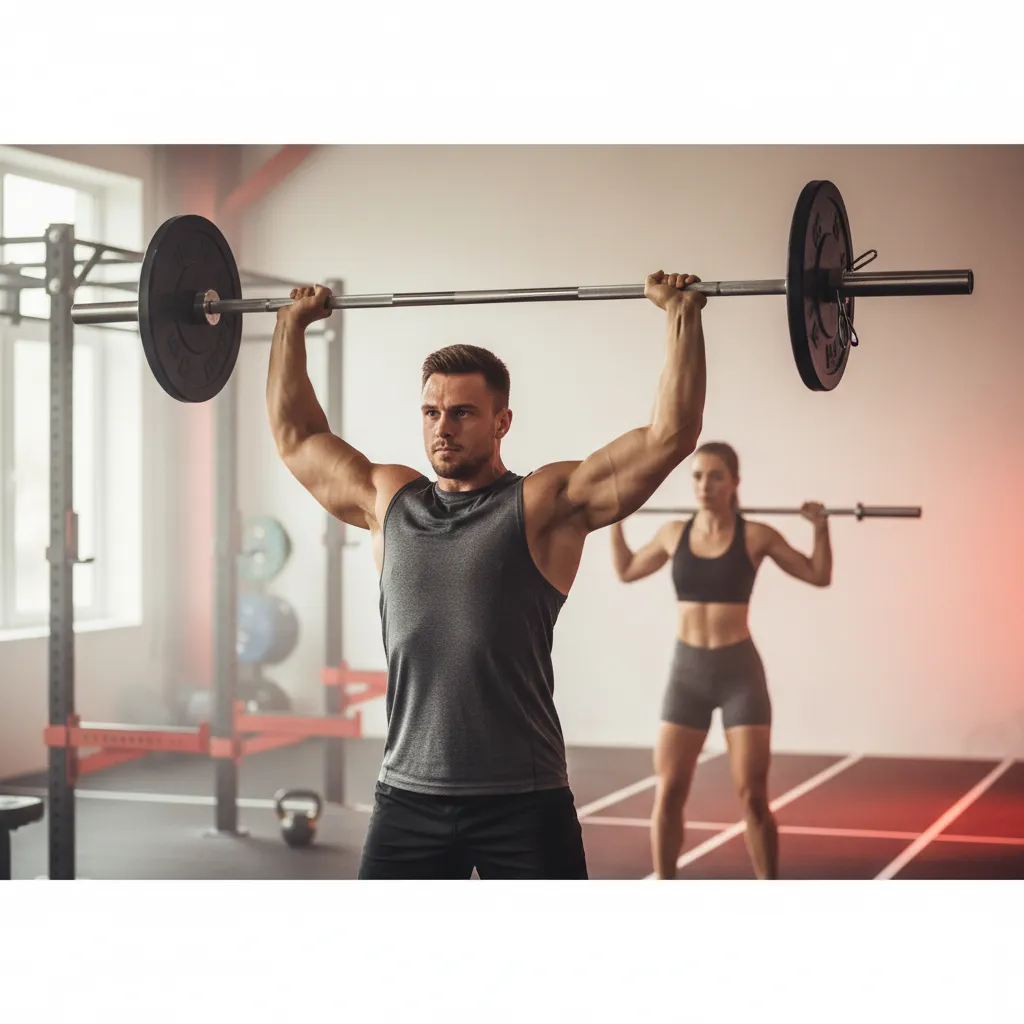
Standing Overhead Press, Push Press variation, valid ROM, common faults
The overhead press is a fundamental full-body strength exercise that builds massive shoulders, a strong core, and functional strength by pressing a weight overhead.
📌 3 Key Takeaways
- A tight core and glutes are 50% of the success. The press is a full-body exercise, not just for the shoulders.
- Start every repetition from a complete rest on the clavicles and finish with a full lockout overhead. Halfway reps don't build strength.
- The Push Press variation is not "cheating" but a strategic tool to overcome plateaus and work with heavier weights to develop explosiveness.
Why is the Overhead Press a Test of True Strength?
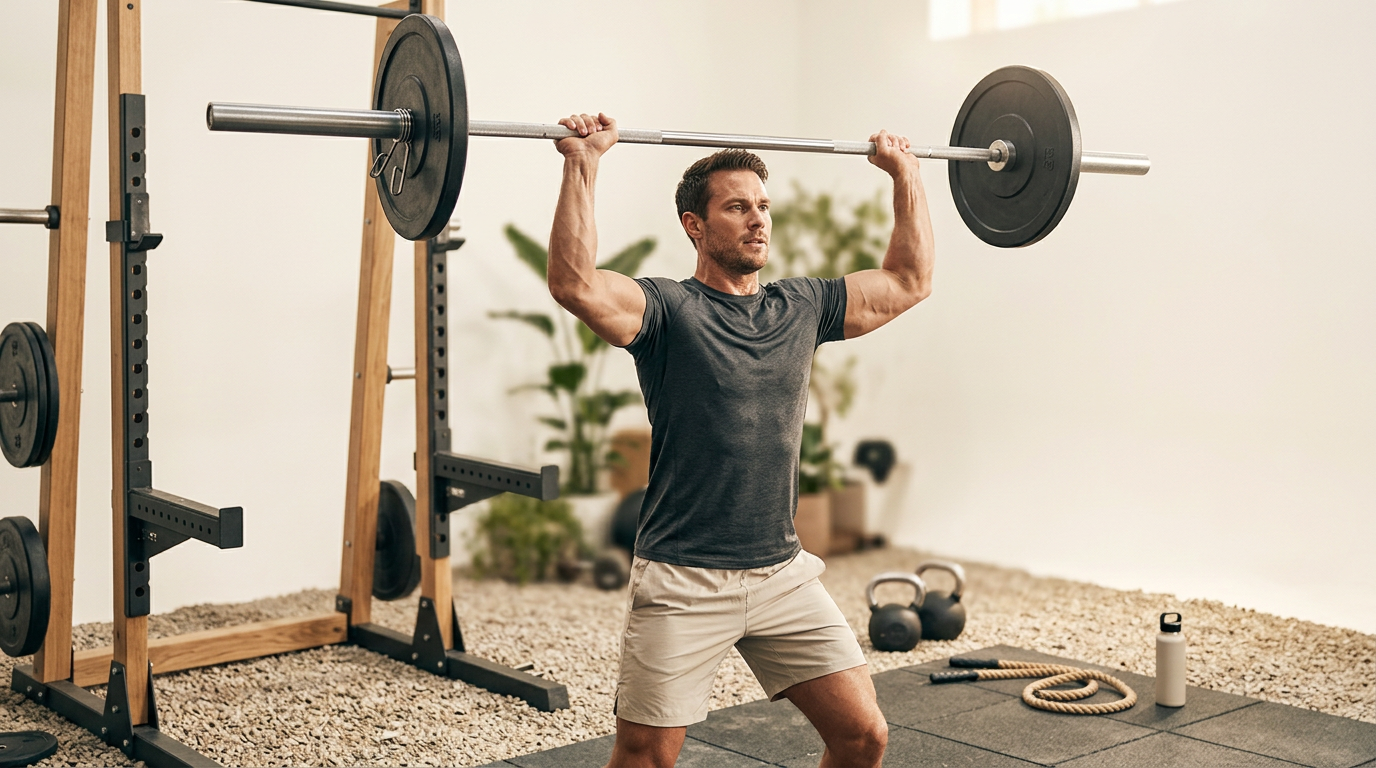
💬 Simply Put: The overhead press is one of the best exercises that engages the entire body to push a weight overhead, building strength and stability.
In the world of strength training, there are a few big lifts that serve as a barometer for an athlete's overall strength: the squat, the deadlift, the bench press. But for me, as a coach who has worked with dozens of fighters and athletes, the standing barbell overhead press (or OHP) is perhaps the most honest test of all. Unlike the bench press, there's no bench to support you. Your entire body—from your feet to your wrists—must work in perfect synchrony to stabilize the weight and press it against gravity. It's one of the few upper-body movements where you're anchored only to the ground.
I often see trainees with an impressive 140kg bench press struggling with 60kg on the overhead press. The reason? The press ruthlessly exposes weak links. Weak core? Your spine will arch like a question mark. Weak glutes? You won't be able to generate stability from the base. Lack of shoulder mobility? The bar will drift forward instead of upward. That's why the OHP isn't just an exercise for "pumping" the shoulders. It's a movement that builds a strong midsection, improves scapular stability, and creates the kind of raw, functional strength that's applicable far beyond the gym—in combat sports, in strongman competitions, or simply when you need to lift a heavy suitcase into the trunk of your car.
Anatomy of the Perfect Starting Position
As with any great lift, 90% of success lies in the preparation before the actual repetition. If the starting position is compromised, the entire movement is doomed. Let's break it down into components. First, the grip. Stand in front of the bar on the rack. Grip it slightly wider than shoulder-width. When the bar rests on your shoulders, your forearms should be as close to vertical as possible. Too narrow a grip will unnecessarily load the wrists and triceps, while too wide a grip will drastically reduce your power potential and strain the shoulder joint.
Second, the bar position. It should rest securely on the front of your shoulders and clavicles. DO NOT hold it with your hands in the air in front of you. The weight should be supported by your body's structure, with your arms merely guiding it. Your elbows should be slightly in front of the bar, not directly underneath it or flared out to the sides. This creates a "shelf" from which to press. Third, the body position. Stand with your feet shoulder-width apart or slightly narrower. Your toes should point forward. Before unracking the bar, take a deep breath, brace your core as if expecting a punch, and squeeze your glutes maximally. This locks your pelvis and lumbar spine, creating a solid and immobile foundation.
Phases of the Movement: The Bar Path and the Role of the Head
Once you've assumed the perfect starting position and braced your entire body, you're ready for the main event. The movement has two main phases: concentric (pressing) and eccentric (lowering). The concentric phase begins with an explosive press of the bar straight upward. Here comes one of the most crucial technical details: the bar path. For it to travel in a vertical line, your head must move back. Think of it as "ducking through." As soon as the bar clears your forehead level, "duck" your head forward under it, so that in the final position, the bar is directly over the center of your head (and over the middle of your feet), not in front of you.
At the top position, your arms should be fully locked out, your shoulders shrugged up towards your ears (as if you're shrugging), and your body should be in a straight line. I often see people stopping the movement just short of full lockout. This is a partial rep and even leaves the shoulders in a vulnerable position under the weight. After a brief pause at the top, the eccentric phase begins. Lower the bar under control along the reverse path—first, the head moves back to make room, then the bar returns to the starting position on the clavicles. Don't "catch" the bar with your hands or let it drop. Each repetition should start and end with the shoulders at a complete rest.
🔬 From Practice
I worked with an amateur MMA fighter who had a very strong bench press (130kg) but was stuck at a 65kg overhead press for 2-3 reps for months. His strength in wrestling and clinching wasn't optimal. We analyzed his technique: with every rep, he leaned back slightly and lost core tension. We replaced one of his press workouts with Push Presses for 4 weeks, focusing on explosiveness from the legs and brutally tightening the core at the moment of the "drive." We also added weighted planks. The result? After those 4 weeks, he achieved 75kg for 3 reps on the strict press, and not only that, but he also reported feeling much greater stability and strength when controlling an opponent against the cage. This is a perfect example of how the OHP, performed correctly, translates directly to sport.
The "Push Press": The Strategic "Cheat" for More Strength and Power
When people hear "Push Press," many imagine a sloppy movement with a lot of swaying. The reality is that it's a distinct, technical exercise with a clear purpose: to allow you to work with weights above your strict press maximum (typically 10-20% more) and develop explosive power. It's a staple in the arsenal of weightlifters and strongmen. Unlike the strict press, the movement starts with a slight and quick dip in the knees and hips—a "dip." The depth is no more than 10-15 cm, as if preparing for a jump. The back remains perfectly straight.
Immediately after, there's an explosive extension of the legs and hips—a "drive." This impulse provides the initial acceleration to the bar and helps it overcome the sticking point, which is usually around eye level. The arms and shoulders then engage to finish the movement and lock the weight overhead. It's crucial to understand that this is not a clean and press. The legs provide only the initial thrust, after which they lock out and remain stationary. The Push Press is a fantastic tool for breaking through plateaus. If you're stuck at 70kg for 3 reps on the strict press, a few weeks of working with 80kg on the Push Press for 3-5 reps will stimulate the central nervous system and build confidence under heavier loads, often leading to a breakthrough in your strict press.
⚠️ Common Mistakes
- Excessive Lumbar Hyperextension: The most common and dangerous mistake. It turns the press into something like a standing "incline" press. The cause is a weak core or too much weight. Solution: Brace your core and glutes throughout and reduce the weight.
- Elbows Flared Out to the Sides: This places the shoulder joint in an internally rotated position, potentially causing impingement. Elbows should point forward or slightly out (around a 45-degree angle), not directly to the sides.
- Incomplete Range of Motion (ROM): Stopping 10-15 cm above the chest on the descent or not locking out the elbows at the top. This is just ego lifting. Full ROM is harder but builds strength throughout the entire movement.
- Using the Legs on a Strict Press: Any "bouncing" or bending of the knees turns the movement into a Push Press. Be honest with yourself. If the goal is a strict press, lock your knees and don't use them.
Sample Programming for Beginners and Advanced Lifters
Programming the overhead press depends on your goals, but a few principles are universal. Train it once or twice a week. As it heavily taxes the central nervous system, more than that often leads to overtraining, especially if you're doing other heavy lifts. Place it at the beginning of your workout, after your warm-up, when you're freshest.
For a beginner looking to build a strength foundation, simple linear progression works excellently. For example, start with a weight you can do for 3 sets of 5 repetitions (3x5) with perfect technique. Each subsequent workout, add 1.25kg or 2.5kg to the bar. When you can no longer complete 3x5, reduce the weight by 10% for the next workout and start again. For more advanced lifters who have hit a plateau, methods become more complex. One popular scheme is to have one "heavy" day and one "light" or "dynamic" day. On the heavy day, you might work up to a heavy triple or five (e.g., 5/3/1 protocol). On the light day, you might do Push Presses for explosiveness (5x3 @ 80% of Push Press max) or strict presses with lighter weight for more volume (e.g., 4x8 @ 65-70% of 1RM).
| Characteristic | Strict Press (Overhead Press) | Push Press |
|---|---|---|
| Primary Goal | Maximal upper body strength, hypertrophy | Explosive power, speed, strength endurance |
| Leg Involvement | None. Legs are stabilizers only. | Active. A brief "dip and drive" initiates the movement. |
| Typical Weights (% of Strict Press 1RM) | 70-95% | 100-120% |
| Primary Stimulus | Muscular tension, time under tension (TUT) | Neuromuscular adaptation, rate of force development |
| Suitable For | Building foundational strength and muscle mass | Athletes, breaking plateaus, strength sports |
Accessory Exercises for a More Powerful Press
Even if you perform the overhead press perfectly, you'll eventually reach a point where weak links in other muscle groups hold you back. Therefore, intelligent programming also includes accessory (assistance) exercises targeting these weak points. To have a strong press, you need a strong back. Any type of rowing—barbell, dumbbell, cable—is essential. They balance the pushing muscles and provide scapular stability. My personal favorite is the wide-grip pull-up; it builds width and upper back strength that serves as a shelf for heavy presses.
Triceps play a huge role in the lockout phase of the movement. If you frequently fail in the top half of the press, your triceps are lagging. Exercises like weighted dips, close-grip push-ups, or skullcrushers with a barbell or dumbbells are excellent choices. Don't neglect the smaller, stabilizing shoulder muscles either. Face pulls are absolutely essential for rotator cuff and rear delt health. Do them with light weight for 12-20 reps at the end of your workout. And of course, a strong core. Exercises like weighted planks, ab rollouts, and farmer's walks build the kind of 360-degree stability needed to stay "concrete" under a heavy bar.
Is it better with a barbell or dumbbells?
Both have their place. The barbell press allows you to lift heavier absolute weight and is a better measure of maximal strength. The dumbbell press requires more stabilization, works on muscle imbalances between sides, and allows for a more natural shoulder joint movement. It's a good idea to alternate or include both in your program.
Can I do the press seated?
You can, but doing so eliminates one of the exercise's biggest benefits—the full-body engagement and core stability work. The seated version isolates the shoulders more, but often encourages lumbar arching without back support. The standing press is the more functional and "honest" movement.
Isn't the overhead press dangerous for the shoulders?
Any exercise performed with poor technique and excessive weight is dangerous. With proper form, full range of motion, and adequate mobility, the overhead press is not dangerous. On the contrary, it strengthens the muscles and structures around the shoulder joint, making it more resilient to injury.
What should I do if I feel wrist pain?
Wrist pain is most often caused by two things: excessive hyperextension (bending backward) of the wrist under load, or too narrow a grip. Try to keep your wrists as straight as possible (in line with your forearm) and slightly widen your grip. Using wrist wraps can also help.
How often should I take the overhead press to failure?
Rarely. Training to complete muscular failure on heavy, compound exercises like the OHP is extremely taxing on the nervous system and increases the risk of injury and technique breakdown. In most of your sets, it's good to leave 1-2 reps "in the tank." Save maximal efforts for planned strength tests once every few months.
See more in the fitness guides of Sport Zona Academy.
🔬 Expert Note from Sport Zona
Working with Bulgarian athletes, I've noticed that the overhead press is often neglected in favor of the bench press. This is a mistake. It exposes weaknesses in almost every joint and muscle—from the ankles to the grip. There's no better indicator of functional strength than the ability to press a significant weight overhead while standing upright.
See more in the fitness guides of Sport Zona Academy.
Recommended products
Frequently asked questions
What are the most important elements for proper execution of the overhead press?
Key elements are tight core and glute muscles for stability, a proper grip, positioning the bar on the clavicles, and locking out the upper body. Full range of motion from start to full lockout is mandatory.
Why is full-body stabilization emphasized in the overhead press?
The overhead press is a full-body exercise requiring synchronization between the feet, core, back, and shoulders. The lack of support tests and develops functional strength, revealing weak links.
What is the role of the push press variation in the overhead press?
The push press is not 'cheating' but a strategic tool to overcome plateaus. It allows for the use of heavier weights and develops explosiveness by utilizing momentum from the lower body.
How does the head move during an overhead press to achieve a vertical bar path?
To keep the bar moving vertically, the head must move back at the start. As the bar progresses upward, the head 'drives' forward under it to be directly over the center in the final position.