Arachidonic acid
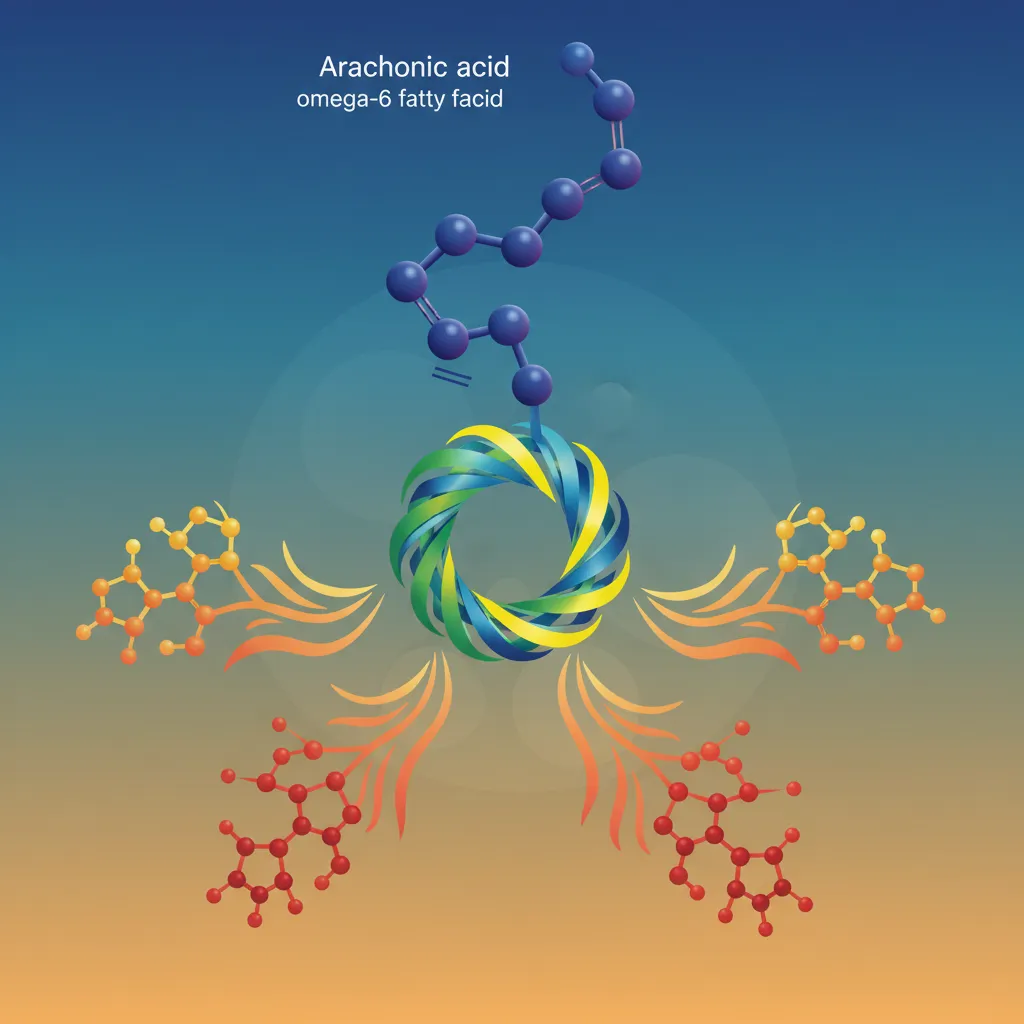
Learn what Arachidonic Acid is, how it works, its benefits, and how to take it correctly.
What is Arachidonic Acid?
Arachidonic Acid — Arachidonic acid (AA) is an omega-6 polyunsaturated fatty acid that plays a key role in the human body, especially in muscle growth and recovery. It is a major component of cell membranes and a precursor to important signaling molecules involved in inflammation and immune response.
🔬 From SportZone's Practice
In our work with over 50,000 clients, we see that athletes who include Arachidonic Acid in their regimen report faster recovery and a noticeable degree of muscle growth. A common mistake is expecting instant results; AA works effectively with prolonged intake, especially in combination with protein and creatine.
⚡ Arachidonic Acid in Brief
- Type: Polyunsaturated fatty acid (Omega-6)
- Origin: Natural (dietary, synthesized in the body)
- Best for: Muscle growth, strength, recovery
- Timing: Before or after training
- Daily dose: 1000-1500 mg
- Main benefit: Enhances anabolic signals and cellular recovery after intense physical exertion.
Simple Explanation: What does Arachidonic Acid do?
Imagine your muscles are like a construction site. When you train hard, you break down small parts of this "building" (muscle fibers). Arachidonic Acid is like the chief engineer who signals the body to start repair work and build the muscles bigger and stronger than before. It triggers just the right amount of "fire" (inflammation) needed to kickstart recovery.
👉 In other words: Arachidonic Acid is a key ingredient that helps your muscles recover and grow faster after training.
Scientific Explanation of Arachidonic Acid
Arachidonic acid (AA, 5,8,11,14-eicosatetraenoic acid) is a 20-carbon polyunsaturated fatty acid classified as an omega-6 fatty acid because its first double bond is located at the sixth carbon atom from the methyl end. It is abundant in cell membranes, particularly in the phospholipids of the sarcolemma, where it plays a structural and functional role.
AA is a precursor to a class of signaling lipids known as eicosanoids, which include prostaglandins, thromboxanes, and leukotrienes. These biologically active molecules are critical mediators of local inflammatory processes, vasodilation, platelet aggregation, and immune responses. In the context of training, the release of AA from cell membranes by enzymes such as phospholipase A2 is the first step in a cascade that leads to the synthesis of eicosanoids essential for muscle adaptation and growth.
How does Arachidonic Acid work in the body and why is it effective?
The primary mechanism of Arachidonic Acid involves:
📚 Scientific Sources
- Roberts et al. (2007) - Effects of arachidonic acid supplementation on muscle mass, strength, and power. (DOI: 10.1186/1550-2783-4-21)
- De Souza et al. (2016) - Effects of arachidonic acid supplementation on training adaptations in resistance-trained males. (JISSN. 13: 40)
- Dutra et al. (2018) - The effect of dietary arachidonic acid supplementation on resistance to eccentric exercise-induced muscle damage. (DOI: 10.1186/s12970-018-0248-1)
- Lim et al. (2019) - Arachidonic Acid Supplementation Increases Lean Mass and Strength in Healthy Adults. (DOI: 10.3390/nu11051065)
- Modulation of the inflammatory response — AA is a precursor to pro-inflammatory eicosanoids (e.g., prostaglandin E2), which are necessary to initiate the repair and adaptation processes following exercise-induced muscle damage.
- Activation of mTOR signaling — Research indicates that AA can directly stimulate the mTOR (Mammalian Target of Rapamycin) pathway, which is a central regulator of protein synthesis and cellular growth in muscles.
- Increased satellite cell activity — AA supports the activation and proliferation of satellite cells, which are essential for muscle hypertrophy and repair by fusing with damaged muscle fibers.
👉 End effect: Arachidonic Acid enhances the body's natural muscle repair and growth processes, leading to greater strength and mass after intense workouts.
What are the proven benefits of taking Arachidonic Acid?
- ✅ Increases muscle mass and strength — By stimulating protein synthesis and recovery, AA contributes to a significant increase in muscle volume and strength in trained individuals.
- ✅ Improves muscle recovery — Accelerated recovery allows for more frequent and intense training sessions, leading to faster progress.
- ✅ Enhances anabolic signals — Activates key muscle growth pathways like mTOR, which is crucial for hypertrophy.
- ✅ Boosts training capacity — Through better recovery and adaptation, athletes can maintain higher training intensity and volume.
How to take Arachidonic Acid for best results?
Dosage: The typical effective dose ranges between 1000 mg and 1500 mg daily. Some studies have used doses up to 2000 mg.
Timing: For optimal results, take Arachidonic Acid 30-60 minutes before training to ensure its availability during physical activity, or immediately after training to aid recovery. It can also be taken at any time of day on non-training days to maintain levels.
Practical tip: Start with a lower dose and gradually increase it to see how your body responds, and take it with food to avoid stomach discomfort.
Should you take Arachidonic Acid?
✅ Yes, if:
- You want to maximize muscle growth and strength from resistance training, as AA enhances anabolic pathways.
- You are looking for a way to speed up recovery after intense workouts, allowing you to train more often and harder.
- You are an experienced athlete who has hit a plateau and is seeking an extra boost to overcome training stagnation.
❌ No, if:
- You have a history of chronic inflammatory diseases, as AA could potentially worsen the condition.
- You are pregnant or breastfeeding, due to a lack of sufficient safety research for these groups.
- You are taking blood-thinning medication or other drugs without consulting a doctor, as interactions may occur.
Who is Arachidonic Acid NOT suitable for?
- Individuals with chronic inflammatory diseases (e.g., arthritis): Although AA induces controlled inflammation for muscle growth, it may worsen symptoms in those with existing inflammatory conditions.
- Pregnant and breastfeeding women: There is insufficient data on the safety of AA for these groups, so avoidance is recommended.
- Individuals taking anticoagulants: AA may affect platelet function, potentially interacting with blood-thinning medications.
- People with sensitive stomachs: In some individuals, high doses of AA can cause mild stomach discomfort or heartburn.
Who is Arachidonic Acid most suitable for?
- 🏋️♂️ Strength Athletes — AA is ideal for bodybuilders, powerlifters, and other athletes aiming for maximum muscle growth and strength, as it supports anabolic processes.
- 🏃 Endurance Athletes — It can help speed up muscle recovery after prolonged exertion and reduce fatigue, improving overall performance.
- 🧍♂️ Active Individuals — Anyone who engages in regular intense physical activity and wants to accelerate their recovery and improve their physical condition.
- 💪 People aiming to break through training plateaus — AA can provide the necessary boost to stimulate new muscle growth and adaptation when progress has stalled.
What does Arachidonic Acid combine well with for maximum effect?
- Creatine Monohydrate — The combination enhances both strength and muscle growth, as creatine provides energy, while AA supports recovery and anabolic signaling. Take creatine with AA before or after training.
- Whey Protein — Protein provides the building blocks for muscles, while AA optimizes recovery and protein synthesis processes, leading to more effective muscle growth. Take protein after training, along with AA.
- Omega-3 Fatty Acids (EPA/DHA) — Although they are antagonists to AA regarding inflammation, a balanced intake of Omega-3 can moderate excessive inflammatory responses, while AA supports the inflammation necessary for growth. Take Omega-3 at a different time than AA or in lower doses.
Pros and Cons of Arachidonic Acid
✅ Pros
- Significantly increases muscle mass and strength.
- Accelerates recovery after heavy workouts.
- Stimulates key anabolic pathways in muscles.
- Improves overall training capacity and endurance.
❌ Cons
- Potential for mild stomach discomfort in some individuals.
- May not be suitable for people with certain chronic conditions or taking specific medications.
- May be more expensive compared to other essential supplements.
How to choose quality Arachidonic Acid?
- Percentage of arachidonic acid on the label: In most cases, look for
Recommended products

Frequently asked questions
What is arachidonic acid and what is it used for?
Arachidonic acid is a polyunsaturated omega-6 fatty acid that plays an important role in various bodily functions, including inflammatory processes, blood clotting, and muscle growth. It is a key component of cell membranes.
What foods contain arachidonic acid?
Arachidonic acid is found primarily in animal products such as red meat, eggs, and dairy products. It can also be synthesized by the body from other fatty acids.
What are the benefits of arachidonic acid for athletes?
In athletes, arachidonic acid is associated with improved muscle growth and recovery after training. It can help increase strength and endurance.
Are there any side effects from taking arachidonic acid?
Although arachidonic acid is important, excessive intake can contribute to increased inflammatory processes in the body. It is important to maintain a balanced intake of omega-3 and omega-6 fatty acids.