Betaine
Learn what Betaine is, how it works, its benefits, and how to take it correctly. Expert analysis from SportZone.
What Exactly is Betaine and What is Its Role in Sports Nutrition?
Betaine — Key takeaway: Betaine is a naturally occurring compound that optimizes cellular hydration and metabolism, leading to improved strength, power, and endurance during training.
🔬 From SportZone's Experience
In our work with over 50,000 clients, we've seen Betaine become increasingly popular among athletes looking to boost their strength and power without stimulants. A common mistake is expecting an immediate effect like with creatine; Betaine works at the cellular level and requires consistent intake for optimal results.
⚡ Betaine in a Nutshell
- Type: Amino acid derivative (trimethylglycine)
- Origin: Natural (plants, animals), dietary, synthetic
- Best for: Increasing strength, power, and training volume
- Timing: Pre-workout or split throughout the day
- Daily Dose: 1.5 - 6 grams
- Main Benefit: Enhances athletic performance by optimizing cellular function.
Simple Explanation: What Does Betaine Do?
Imagine your muscle cells are like tiny balloons that need a certain amount of water to stay full and healthy. Betaine acts like a "pump" that helps these balloons hold more water, making them more resistant to stress and more efficient during exercise. It also helps the body get rid of harmful substances by converting them into useful ones.
👉 In other words: Betaine makes cells stronger and more hydrated so you can train harder and recover faster.
Scientific Explanation of Betaine
Betaine, chemically known as trimethylglycine (TMG), is an N-methylated derivative of the amino acid glycine. It is a zwitterionic compound, meaning it contains both a positively charged quaternary ammonium ion and a negatively charged carboxylate ion. This unique structure allows it to function as a potent osmolyte, regulating cell volume and water content, which is crucial for cellular homeostasis and enzyme activity.
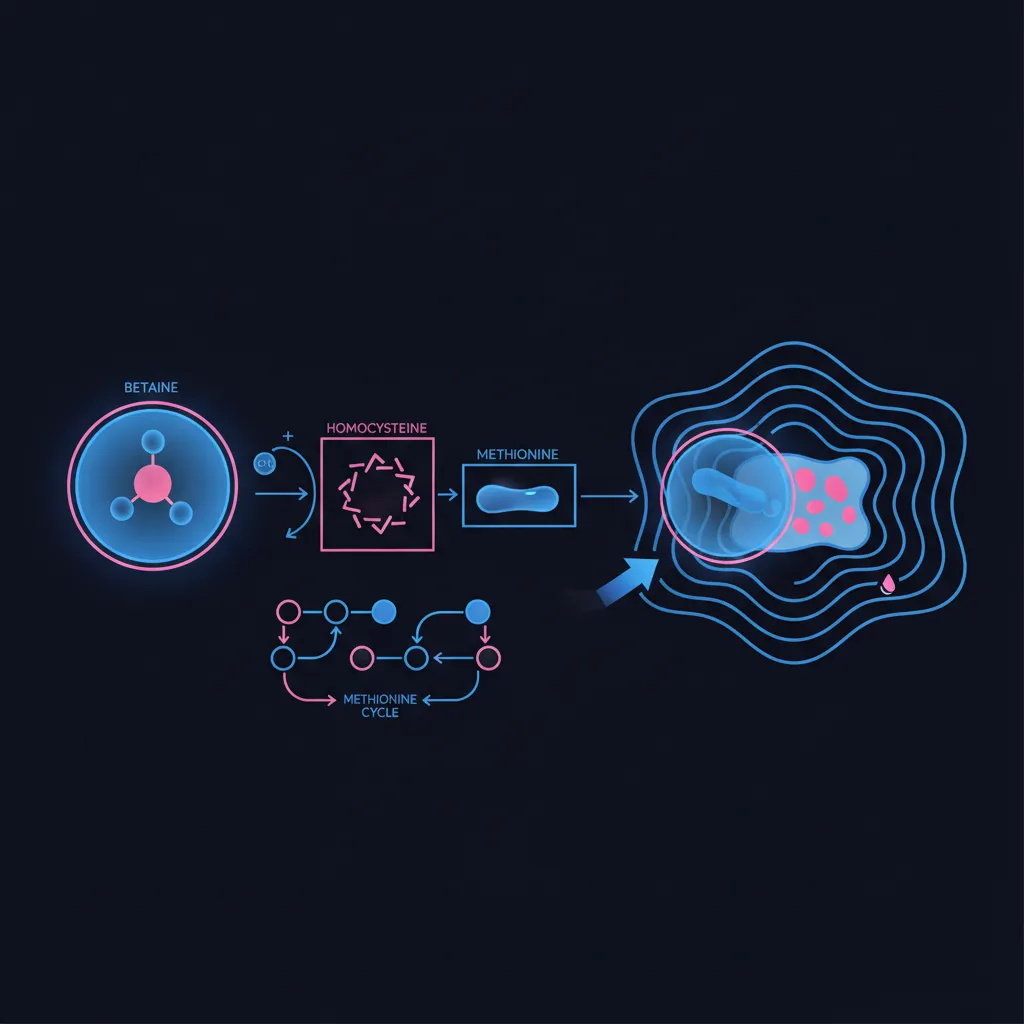
In addition to its role as an osmolyte, Betaine is also an important methyl group donor. In this capacity, it participates in the remethylation of homocysteine to methionine, a key step in the metabolism of one-carbon units. This process is essential for maintaining healthy homocysteine levels, potentially reducing the risk of cardiovascular disease. Through these two primary mechanisms – osmoregulation and methylation – Betaine exerts a broad influence on physiological functions, including energy metabolism, gene expression, and cell signaling.
What Are the Mechanisms of Action of Betaine in the Human Body and Why Is It So Effective?
The primary mechanisms of Betaine include:
📚 Scientific Sources
- Cholewa, J. et al. (2013). Effects of betaine on body composition, performance, and homocysteine thiolactone. Journal of the International Society of Sports Nutrition, 10(1), 39. DOI: 10.1186/1550-2783-10-39
- Trepanowski, J. F., et al. (2011). The effects of betaine on body composition and performance in professional boxers. Journal of the International Society of Sports Nutrition, 8(1), 10. DOI: 10.1186/1550-2783-8-10
- Lee, E. C. et al. (2010). Ergogenic effects of betaine supplementation on repeated sprint performance, oxidative stress, and inflammatory markers in football players. Journal of Excercise Science & Fitness, 8(2), 117-128.
- Virtanen, J. K. et al. (2016). Effects of betaine supplementation on exercise performance and body composition. Critical Reviews in Food Science and Nutrition, 56(16), 2795-2802.
- Optimizing Cellular Hydration (Osmoregulation) — As an osmolyte, Betaine maintains intracellular water balance, protecting cells from dehydration and osmotic stress. This leads to improved cell volume and functionality, critical for the efficiency of muscle contractions.
- Methyl Donor and Metabolic Support — Betaine provides methyl groups (CH3) for the conversion of homocysteine to methionine. Methionine is important for creatine synthesis, which in turn is key for the production of adenosine triphosphate (ATP) – the primary energy source for muscle work.
- Reducing Training Fatigue — By maintaining cellular homeostasis and optimizing energy pathways, Betaine can contribute to delaying the onset of fatigue during intense physical exertion, allowing for longer and more productive workouts.
👉 End Effect: These mechanisms lead to improved muscle strength, power, endurance, and reduced fatigue, optimizing athletic performance.
What Are the Scientifically Proven Benefits of Regular Betaine Intake for Athletes?
- ✅ Increased Explosive Strength and Power — Research shows that Betaine can improve maximal strength and power, especially in short, high-intensity movements like weightlifting and sprinting.
- ✅ Enhanced Training Capacity — By supporting cell hydration and reducing fatigue, Betaine allows athletes to perform more repetitions and sets, leading to a more effective training stimulus.
- ✅ Improved Physical Endurance — Some studies suggest that Betaine may delay fatigue onset and improve endurance, particularly in high-intensity interval training.
- ✅ Support for Optimal Body Composition — Indirectly, by facilitating more intense and voluminous training, Betaine can contribute to more effective fat burning and lean muscle mass building.
What is the Optimal Dosage and Method of Betaine Intake for Maximum Results?
Dosage: The most common and well-researched effective dose is 2.5 grams per day, split into two doses of 1.25 grams. Some protocols recommend up to 6 grams per day for advanced athletes.
Timing: For optimal results, take 1.25 grams about 30-60 minutes before your workout and another 1.25 grams during or after your workout. Alternatively, you can split the daily dose into morning and evening intake.
Practical tip: Start with a lower dose and gradually increase it to assess your individual tolerance and response to the supplement.
Should You Take Betaine?
✅ Yes, if:
- You want to increase your strength and power: Betaine improves muscle contractions and explosive strength, which is key for weightlifting and sprinting.
- You aim for higher training volume: By supporting cell hydration and reducing fatigue, Betaine allows you to do more repetitions and sets.
- You are looking for a way to optimize recovery and reduce muscle soreness: Optimized cellular function can contribute to faster recovery after intense workouts.
❌ No, if:
- You have serious kidney or liver diseases: Consult a doctor, as Betaine is metabolized in these organs.
- You are taking certain medications that may interact: It is always advisable to consult a medical professional if you are taking other medications.
- You are pregnant or breastfeeding: There is insufficient research on the safety of Betaine for pregnant and breastfeeding women.
Who is Betaine NOT Suitable For?
- Individuals with known hypersensitivity to Betaine: Although rare, allergic reactions can occur.
- People with specific genetic metabolic disorders: In some rare cases related to methionine metabolism, additional Betaine intake may not be recommended.
- Patients with chronic gastrointestinal problems: In some cases, Betaine may cause mild stomach discomfort.
- Children and adolescents under 18 years of age: There is insufficient data on safety and efficacy in this age group.
For Which Groups of Athletes is Betaine the Most Suitable Supplement?
- 🏋️♂️ Strength Athletes — Enhances explosive strength, power, and overall training volume, which is essential for muscle growth and adaptation.
- 🏃 Endurance Athletes — May delay fatigue onset and improve performance in high-intensity interval training.
- 🧍♂️ Active Individuals — Supports more effective workouts and speeds up recovery after physical activity.
- 💪 Bodybuilders — By increasing training volume and intensity, it contributes to better results in building muscle mass.
With Which Other Supplements Does Betaine Combine Best for Maximum Effect?
- Creatine Monohydrate — For a synergistic effect on strength, power, and cell volume, as Betaine is involved in creatine metabolism. Take them together before training.
- Citrulline Malate — For improved blood flow, reduced fatigue, and better nitric oxide production, which Betaine complements by optimizing cellular function. Take before training.
- Beta-Alanine — While Betaine is the "Cellular Architect of Strength," Beta-Alanine is the "Metabolic Shield Against Fatigue." Their combination provides both strength and endurance, taken before training.
Pros and Cons of Betaine
✅ Pros
- Proven to increase strength and power.
- Enhances training volume and endurance.
- Supports cell hydration and function.
- Relatively safe and well-tolerated.
- May support cardiovascular health by regulating homocysteine.
❌ Cons
- Possible mild stomach upset at high doses.
- Effect may vary individually.
- Not suitable for all groups of people without medical consultation.
How to Choose Quality Betaine?
- Betaine Percentage on the Label: For quality products, the Betaine content (as Betaine Anhydrous or Trimethylglycine) should be clearly stated and be above 95%. In most cases, a higher percentage means fewer fillers.
- Form of Betaine: Prefer Betaine Anhydrous (Trimethylglycine - TMG) as it is the most researched and effective form for sports purposes. Avoid Betaine Hydrochloride (Betaine HCl) unless it is specifically intended to aid digestion.
- Additives: Check for unnecessary sweeteners, colorings, and fillers. In quality products, the ingredient list is short and primarily contains Betaine.
- Certifications and Third-Party Testing: The presence of certifications like Informed-Sport or testing by independent laboratories can contribute to purity and label accuracy. In most cases, this is an indicator of a reliable manufacturer.
When to Choose Betaine Over Alternatives?
- Choose Betaine if:
- You are looking for improved strength and endurance: Studies show that doses of 2.5 grams of Betaine daily can support these aspects.
- You want to support cell hydration: Betaine acts as an osmolyte, which can be beneficial during intense workouts.
- You aim to reduce fatigue during training: Some data suggests Betaine can contribute to this.
- Choose Creatine Monohydrate if:
- The priority is maximizing strength and muscle mass: Creatine is better researched and proven for these purposes, typically in doses of 3-5 grams daily.
- You want to enhance high-intensity, short bursts of effort: Creatine directly supports ATP resynthesis.
What to Compare Betaine With?
Understand how Betaine differs from other supplements:
- Betaine vs. Creatine — Betaine is the "Cellular Architect of Strength," optimizing the cellular environment, while creatine is the "Energy Bank," providing direct fuel for muscles; Betaine is better for direct cell hydration, while creatine is better for rapid ATP recovery.
- Betaine vs. Beta-Alanine — Betaine is more focused on strength and power through cell hydration, while Beta-Alanine targets buffering lactic acid and extending endurance; Betaine is better for explosive movements, while Beta-Alanine is better for training to failure.
- Betaine vs. Glutamine — Betaine is an osmolyte improving cell volume and strength, while glutamine is an amino acid supporting recovery and immune function; Betaine is better for direct performance enhancement, while glutamine is better for overall recovery.
📖 Detailed Comparisons with Betaine
Recommended products
Frequently asked questions
What is betaine and what is it used for?
Betaine is a naturally occurring compound found in many foods such as beets, spinach, and quinoa. It is known for its osmoprotective properties, meaning it helps cells retain water. Betaine is used as a dietary supplement to improve digestion, support cardiovascular health, and as a detoxifying agent.
Does betaine have side effects?
Betaine is generally well-tolerated by most people and does not have significant side effects. However, in some individuals, it may cause mild stomach upset or diarrhea, especially at high doses. It is always advisable to consult a doctor before taking new supplements.
Can betaine help with liver problems?
Yes, betaine can be beneficial for liver health. It helps reduce fat accumulation in the liver and supports detoxification processes. This makes it potentially useful in conditions such as hepatic steatosis (fatty liver).
What is the recommended dosage of betaine?
The recommended dosage of betaine can vary depending on the purpose of use and individual needs. Common dosages for dietary supplements range from 500 mg to 2000 mg per day. It is best to follow the product label instructions or consult with a healthcare professional for personalized recommendations.