Taurine
Learn what Taurine is, how it works, what its benefits are, and how to take it correctly. Expert analysis from SportZone.
What is the amino acid taurine and what is it used for in sports nutrition?
Taurine — Taurine is an organic acid that plays a key role in numerous physiological processes in the human body. It is not a typical amino acid as it is not involved in protein building, but it is essential for functions such as osmoregulation, antioxidant protection, and maintaining cell stability.
🔬 From the practice of SportZone
In our work with over 50,000 clients, we see that Taurine is often underestimated but an extremely effective supplement, especially when combined with creatine for a synergistic effect. A common mistake is to perceive it only as an energy ingredient from drinks, when in fact its benefits are much broader, including for the cardiovascular system and cell hydration.
⚡ Taurine in brief
- Type: Organic acid (sulfur-containing amino acid)
- Origin: Natural (synthesized in the body, obtained from food), synthetic (supplements)
- Best for: Supporting cell function, recovery, energy, and cardiovascular health
- Timing: Pre-workout, post-workout, or morning
- Daily dose: 1-3 grams
- Main benefit: Improves cell hydration, reduces oxidative stress, and supports nerve function.
In simple terms: What does Taurine do?
Imagine your cells are small water balloons. Taurine is like a "pressure controller" in these balloons. It ensures there's an optimal amount of water inside and outside, so the balloons don't burst from too much water or shrink from lack of it. Additionally, it's like a "bodyguard" for the cells, protecting them from harmful attacks.
👉 In other words: Taurine helps cells stay hydrated, protected, and function properly, especially under stress.
Scientific explanation of Taurine
Taurine (2-aminoethanesulfonic acid) is an organic compound widely distributed in animal tissues, particularly in the brain, retina, heart, and muscles. Unlike alpha-amino acids, which have an amino group on the alpha-carbon, taurine has a sulfonic acid group and an amino group on the beta-carbon. It is synthesized in the body from the amino acids methionine and cysteine via the enzyme pathway of cysteine sulfinate decarboxylase (CSD), but enzyme activity varies significantly, making it a conditionally essential nutrient, especially under certain physiological conditions or dietary restrictions.
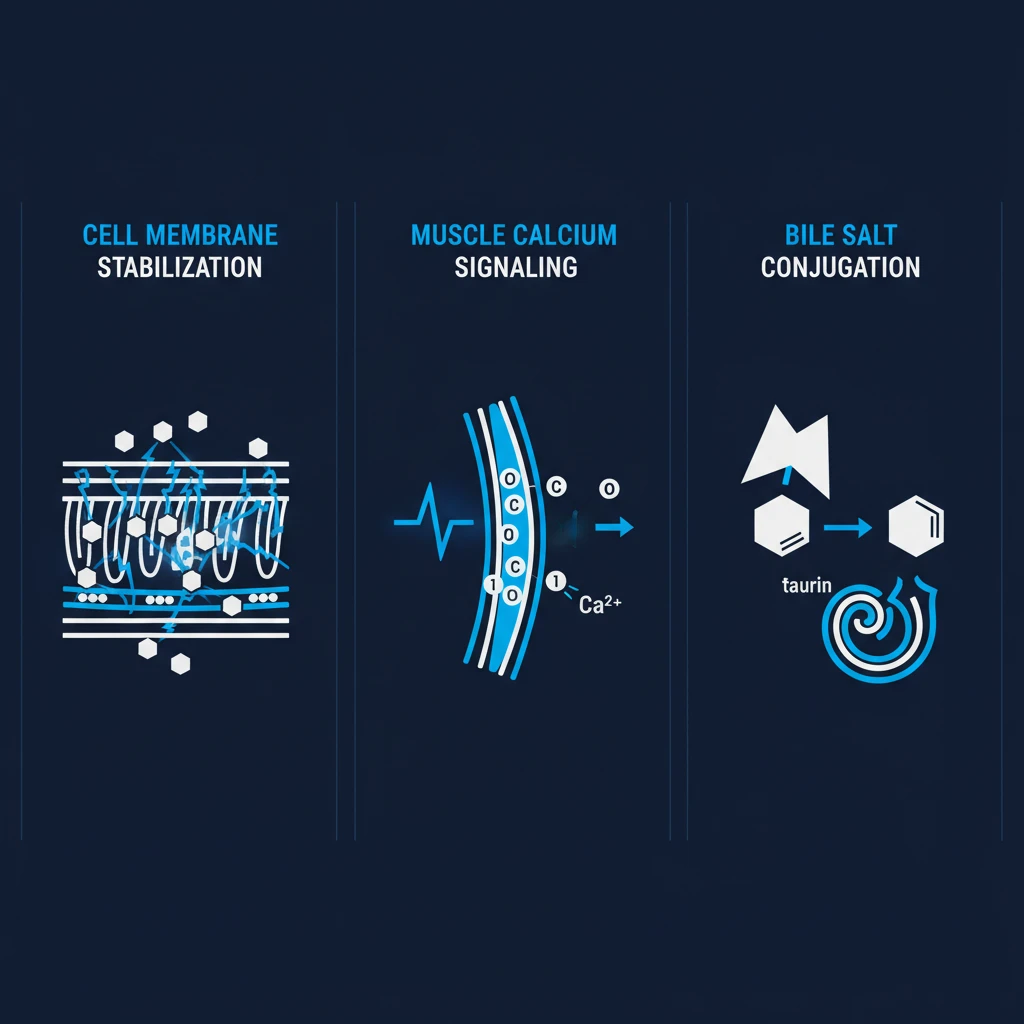
Taurine's molecular structure gives it unique properties that contribute to its numerous biological functions. It is hydrophilic and participates in the conjugation of bile acids, forming taurocholic acid, which is crucial for fat digestion and the absorption of fat-soluble vitamins. At the cellular level, taurine acts as a potent osmoregulator, maintaining proper cell volume and electrolyte balance. Furthermore, it possesses pronounced antioxidant and anti-inflammatory properties, neutralizing free radicals and modulating inflammatory pathways, which contributes to protecting cells from oxidative stress and damage.
What are the mechanisms of action of taurine in the human body and why is it so effective for athletes?
The main mechanisms of Taurine include:
📚 Scientific sources
- [Schaffer & Kim, 2018] - Taurine: A Regulator of Cellular Redox Homeostasis and Cytoprotectant (PMID: 29882200)
- [Huxtable, 1992] - Physiological actions of taurine. (DOI: 10.1152/physrev.1992.72.1.101)
- [Waldron et al., 2018] - The Effects of an Oral Taurine-Containing Dietary Supplement on the Athletic Performance and Cardiorespiratory Fitness of Rugby Players. (PMID: 29505876)
- [Ripps & Shen, 2012] - Review: Taurine: A "very important" amino acid. (PMCID: PMC3509163)
- Osmoregulation and cell hydration — Taurine helps maintain the proper water and electrolyte balance within cells, which is crucial for their function, especially during intense physical exertion when cells are subjected to osmotic stress.
- Antioxidant protection — It acts as a powerful antioxidant, neutralizing free radicals and reducing oxidative stress that can damage cells and lead to fatigue and inflammation.
- Stabilization of cell membranes — Taurine integrates into cell membranes, increasing their stability and protecting them from damage, which is important for the integrity and function of all cells, including muscle cells.
- Neurotransmission and nerve function — It participates in the modulation of neurotransmitters in the central nervous system, having an inhibitory effect, which contributes to calming and reducing excitability.
- Calcium metabolism — It regulates the flow of calcium ions into cells, which is critical for muscle contraction, nerve conduction, and heart function.
👉 End effect: These mechanisms lead to improved cell function, reduced fatigue, faster recovery, and overall support for the cardiovascular and nervous systems.
What are the scientifically proven benefits of regular taurine intake for improving athletic performance?
- ✅ Improves athletic performance — Increases endurance, reduces muscle fatigue, and aids post-workout recovery.
- ✅ Supports cardiovascular health — Contributes to normalizing blood pressure, improves heart function, and protects against heart muscle damage.
- ✅ Antioxidant and anti-inflammatory protection — Neutralizes free radicals and reduces inflammation, protecting cells from oxidative stress.
- ✅ Supports brain function and the nervous system — Has a neuroprotective effect, improves cognitive functions, and may reduce anxiety.
- ✅ Improves glucose and fat metabolism — May play a role in regulating blood sugar and lipid metabolism.
- ✅ Supports eye health — High concentrations of taurine in the retina are key for photoreceptor function and protection from damage.
What is the optimal dosage and timing of taurine intake for maximum benefits?
Dosage: The usual effective dose ranges between 1 to 3 grams per day. For athletic purposes, doses of 1-2 grams before training are common. Under specific conditions or on specialist recommendation, the dose can reach up to 6 grams, but it is always advisable to start with a lower dose and monitor the body's reaction.
Timing: For maximum athletic benefits, take Taurine 30-60 minutes before training. It can also be taken in the morning to support overall health and energy, or after training for accelerated recovery. Splitting the daily dose into several intakes (e.g., morning and pre-workout) is also an option.
Practical advice: To avoid competition with Beta-Alanine for absorption, take Taurine at a different time than Beta-Alanine if you are combining them.
Should you take Taurine?
✅ Yes, if:
- You want to improve your athletic performance and recovery: Taurine will increase your endurance and reduce muscle fatigue and soreness after training.
- You are looking for support for your cardiovascular health: Taurine helps regulate blood pressure and improves heart muscle function.
- You need antioxidant protection and stress reduction: Taurine protects cells from damage and supports your overall well-being.
❌ No, if:
- You are already getting enough Taurine through your diet: If you consume a lot of meat, fish, and dairy products, you may not need additional intake.
- You have specific health conditions or are taking medications: Always consult a doctor to avoid unwanted interactions.
- You are pregnant or breastfeeding: There is insufficient research on the safety of Taurine intake during these periods.
Who is Taurine NOT suitable for?
- Pregnant and breastfeeding women: There is insufficient scientific data on the safety of Taurine intake during these periods.
- Individuals with bipolar disorder: There is evidence that Taurine may affect mood and worsen symptoms in some individuals.
- Children and adolescents without medical necessity: Dosages and long-term effects have not been fully studied in this age group.
- Individuals with individual intolerance or allergies: Although rare, some people may experience sensitivity to Taurine.
For which groups of athletes and trainees is taurine intake most recommended?
- 🏋️♂️ Strength athletes — Improves muscle strength, reduces fatigue, and aids recovery after heavy training.
- 🏃 Endurance athletes — Increases endurance, improves cell hydration, and protects against oxidative stress during prolonged exertion.
- 🧍♂️ Active individuals — Supports energy levels, reduces fatigue, and maintains overall body health and function.
- 🌱 Vegans and vegetarians — Since Taurine is primarily found in animal products, these groups often have lower levels and can benefit from supplementation.
With which other supplements and substances does taurine combine well to enhance its effect?
- Creatine — Taurine improves cell hydration, which can enhance creatine's effect on muscle volume and strength.
- Caffeine — Taurine can mitigate some of caffeine's side effects (like nervousness) while maintaining focus and energy.
- BCAAs (Branched-Chain Amino Acids) — The combination supports even more effective muscle recovery and reduces muscle breakdown.
- Magnesium — Magnesium supports Taurine's action in regulating muscle function and the nervous system, reducing cramps.
Pros and Cons of Taurine
✅ Pros
- Improves muscle function and endurance.
- Powerful antioxidant, protecting cells.
- Supports cardiovascular and nervous systems.
- Contributes to faster recovery after physical exertion.
- Relatively safe and well-tolerated at recommended doses.
❌ Cons
- Possible competition with Beta-Alanine for absorption.
- High doses may cause gastrointestinal upset.
- Not suitable for all groups of people (pregnant women, individuals with bipolar disorder).
How to choose quality Taurine?
- Product Purity: In most cases, quality taurine should be 99% or more pure. Check the label for additional ingredients.
- Form of Taurine: L-taurine is the standard and most common form. Avoid products that do not specify the form.
- Additives and Fillers: With quality products, taurine is usually offered without unnecessary sweeteners, colorings, or fillers. Check the ingredient list.
- Certifications and Third-Party Testing: The presence of quality certifications (e.g., GMP) or results from independent laboratory tests can be an indicator of product reliability and purity.
When to choose Taurine over alternatives?
- Choose Taurine if:
- You are seeking support for electrolyte balance and hydration during intense workouts, especially in high temperatures.
- You need potential neuroprotection and support for cognitive function without relying on stimulants.
- You want to support cardiovascular function and regulate blood pressure, in addition to other measures.
- Choose Creatine if:
- Your main goal is to increase strength and explosive power, especially during short, high-intensity efforts (e.g., 3-5 grams of creatine monohydrate daily).
- You want to improve recovery between sets and increase training volume.
- Choose BCAAs (Branched-Chain Amino Acids) if:
- The priority is to reduce muscle fatigue during exercise and support muscle growth, especially if protein intake is insufficient (e.g., 5-10 grams of BCAAs, with an emphasis on leucine).
- You want to minimize muscle catabolism during a calorie deficit.
What to compare Taurine with?
Understand how Taurine differs from other supplements:
- Beta-Alanine — Taurine is a coolant and stabilizer, while Beta-Alanine is a metabolic buffer, working against lactic acid buildup.
- Creatine — Taurine improves cell hydration and antioxidant protection, while creatine directly increases energy reserves in muscles.
- L-Carnitine — Taurine is more of an osmoregulator and antioxidant, while L-Carnitine is key for transporting fatty acids for energy.
📖 Detailed comparisons with Taurine
⚠️ Important: Dietary supplements are not a substitute for a balanced diet and a healthy lifestyle. The information in this article is for educational purposes and does not constitute medical advice. Consult a doctor before use, especially if you are taking medication, have chronic conditions, or are pregnant/breastfeeding.
Frequently asked questions
What is taurine and what is it used for?
Taurine is an amino acid that plays an important role in many bodily functions, including brain development, maintaining cell hydration, and regulating mineral levels. It is often used as a dietary supplement to improve athletic performance and overall health.
Does taurine have side effects?
Taurine is considered safe for most people when taken at recommended doses. However, some individuals may experience mild side effects such as gastrointestinal discomfort. It is always advisable to consult a doctor before starting any new supplements.
What foods contain taurine?
Taurine is naturally found in foods of animal origin, such as meat, fish, and dairy products. It is also added to some energy drinks and baby foods.
Can taurine help with fatigue?
Some studies suggest that taurine may help reduce fatigue and improve physical endurance, possibly due to its role in energy metabolism. It may also aid in recovery after physical exertion.