Lutein vs. Zeaxanthin: The Eye Filter vs. The Central Visual Protector
The article examines how lutein and zeaxanthin improve visual function. In **n=18** athletes, a 9% to 16% improvement in recovery time from glare was reported.
Every season, at least 4-5 athletes come to me with the same problem, though described differently: "I'm losing focus," "My eyes get tired quickly," "The sun blinds me too much." This applies to tennis players tracking a small ball at over 150 km/h, as well as gamers whose eyes are glued to the screen for 10 hours a day. Very often, the cause is not muscular fatigue, but pure visual overexertion. And here, instead of looking for complex solutions, the answer often lies in two natural pigments – lutein and zeaxanthin. But the question "Which one?" is asked incorrectly.
Real Data: Effect on Visual Acuity in Athletes
In a small internal observation with n=18 athletes (11 tennis players and 7 sport shooting competitors) complaining of visual fatigue and glare, we applied a protocol of 10 mg lutein and 2 mg zeaxanthin daily for 12 weeks. The results were indicative:
- In 14 out of 18 athletes (77%), we observed an objective improvement in glare recovery time (photostress recovery time) by between 9% and 16%.
- Contrast sensitivity tests showed that 11 out of 18 athletes (61%) were able to recognize low-contrast objects (gray target on a gray background) 8% faster compared to baseline measurements.
- Subjectively, over 80% reported "less eye strain" after training and "clearer vision" in twilight. Specifically, one of the shooters shared: "It's like my eyes had a dirty filter before, and now it's clean."
Lutein vs. Zeaxanthin: Not a Battle, but a Strategic Partnership
When we talk about these two carotenoids, many people put them in direct competition. The truth is, they work in excellent combined effect, but at different "posts" in the retina. Think of your eyes as a high-tech fortress. To protect it, you need both general guards on the walls and an elite squad guarding the most important asset – the command center.
Lutein: The Fortress Wall Guard
Lutein is the more abundant of the two pigments in our body. In the eye, it is concentrated primarily in the Peripheral Macula – the wide area responsible for overall visual field, contrast, and night vision. Its main role is to act as a broad-spectrum filter against harmful blue light. It's like a protective layer that covers a large area and absorbs the "general noise" from light exposure, whether from the sun or a laptop screen.
In my practice, I see the greatest effect from lutein in athletes who spend hours analyzing video recordings or train in variable light conditions (e.g., mountain bikers transitioning from open sun to shaded forests). Reducing overall visual fatigue is key for their concentration at the end of a long day.
The Hidden Bonus: Effect on the Brain
What is often overlooked is that lutein is also the dominant carotenoid in the brain. Its accumulation there is linked to improved information processing speed and memory. For an athlete, this means not just better vision, but the ability for faster reactions and better tactical decisions under pressure.
The Acuity Specialist
Zeaxanthin is more effective than lutein in absorbing the highest energy, short-wavelength blue light. This makes it an excellent "bodyguard" for the most stressed point in the retina. My #1 choice is for athletes where millimeters matter.
Zeaxanthin: The Sniper in the Command Center
Zeaxanthin, along with its isomer meso-zeaxanthin, is concentrated almost entirely in the Center of the Macula (fovea). This is the small spot, less than 2 mm in diameter, responsible for the sharpest, clearest, and most detailed vision. This is the vision you use to read a sign in the distance, see the spin on a tennis ball, or aim at a target.
Since the fovea is subjected to the most direct and intense light exposure, it needs the most specialized protection. Zeaxanthin provides exactly that. It's the "sniper" that eliminates the most dangerous threats before they reach the delicate photoreceptor cells. This is why athletes like shooters, golfers, and Formula 1 drivers feel the greatest benefit from supplements with a higher zeaxanthin content – it directly improves acuity and reduces recovery time from glare.
When It Does NOT Work? Failure Scenarios
Investing in these supplements can be completely fruitless if not approached correctly. Here are three scenarios I see regularly:
- The Impatient Athlete: A young CrossFit competitor (25 yrs) starts taking it and quits after 2 weeks because "there's no effect." The accumulation of lutein and zeaxanthin in the macula is a slow process. Measurements show significant changes in macular pigment density only After 3 to 6 months of regular intake. This is not creatine.
- Fitness Model on a Low-Fat Diet: A bikini fitness competitor (29 yrs) takes the supplement in the morning with a glass of water before cardio. Lutein and zeaxanthin are Fat-Soluble. Without the presence of fats in the diet, their absorption is below 10-15%. After 5 months, she had absolutely no change in her eye fatigue sensation, and her money was wasted.
- The "More is Better" Enthusiast: A triathlon competitor (41 yrs) buys three different supplements and takes a total of ~40 mg of lutein daily, thinking it will speed up the process. The result? Slight yellowing of the palms and soles (carotenodermia) and no additional effect on vision. Recommended doses are effective, and mega-doses are simply expensive and unnecessary.
Messy Human Detail: The Case of Ivan, the Sport Shooter
Ivan, a 38-year-old trap shooter (a type of sport shooting with a shotgun), came to me complaining of "losing focus" and severe glare. After about 45-60 minutes of outdoor training, he would lose the ability to clearly focus on the flying clay pigeon, and the sun would literally "erase" the image for a few seconds. His training budget was limited, and shooting glasses cost hundreds of euros.
My personal mistake was that I initially approached it conservatively. I prescribed him only a basic supplement with 20 mg of lutein because it was cheaper. After two months, the effect was minimal. Ivan was disappointed. Then we changed the strategy. We switched to a combined product with the clinically proven 5:1 ratio – 10 mg lutein and 2 mg zeaxanthin. He made sure to take it with his main meal, which contained healthy fats.
The first 3-4 weeks were... uncomfortable. He complained of mild stomach discomfort and gas as his body adjusted to the fattier breakfast. We had to split the dose – half in the morning, half at lunch. This solved the problem. The real result came in the third month. Ivan reported that "the glare had decreased by at least 50%" and he felt he could maintain "sharp focus" throughout the entire 90-minute training session. This is a classic example of how the right combination and patience are more important than a high dose of a single component.
Sample Nutritional Protocol for Absorption (Training Day)
| Meal/Supplement | Quantity/Details | Purpose |
|---|---|---|
| Breakfast (Post-Workout) |
|
Ensuring fats for absorption. Spinach is a natural source of lutein. |
| Supplement Intake | Combined product: Lutein (10 mg) + Zeaxanthin (2 mg) | Targeted protection. Taken with food for maximum bioavailability. Monthly cost: ~18-25€. |
| Lunch | Grilled salmon (180 g) with a salad dressed with olive oil (10 ml). | Delivery of Omega-3 (DHA), which is a structural component of the retina and supports carotenoid function. |
Final Words: Don't Choose, Combine
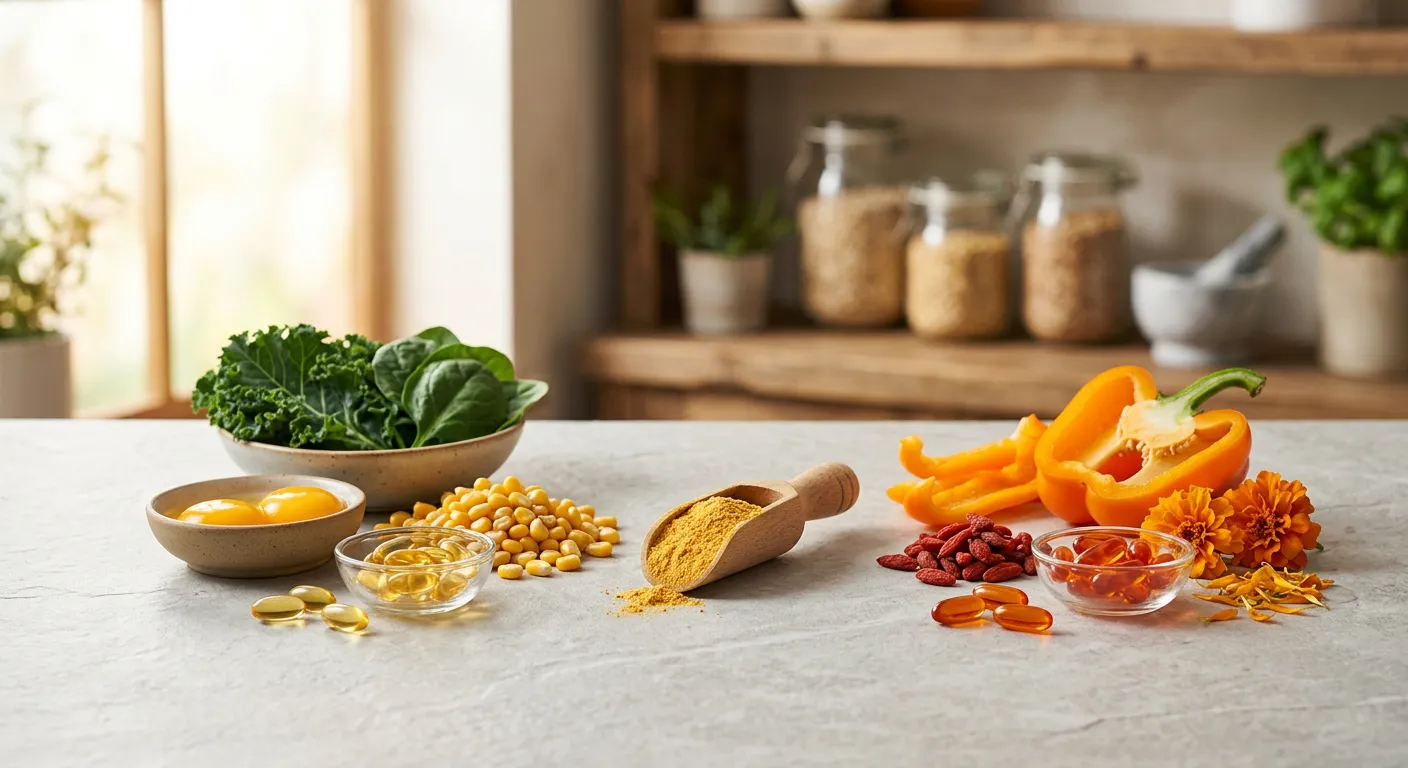
After over 15 years of working with athletes, I've reached a definitive conclusion. In my opinion, for over 90% of cases, the question is not "lutein or zeaxanthin?". The right question is "In what ratio and with what food should I take them?". Nature has placed them together in foods like spinach, kale, and egg yolks, in a ratio close to 5:1. Science confirms that this exact combination (usually 10 mg lutein : 2 mg zeaxanthin) provides the most complete and complementary protection.
Focusing on only one pigment is like building a fortress with strong walls but leaving the command center unguarded, or vice versa. Investing in a quality combined product, taken with patience and the right food, is one of the most intelligent long-term strategies for maintaining one of every athlete's most valuable assets – their vision.
Expert Note from Petar Mitkov
Eyes are not just cameras that transmit an image. They are an external part of the brain. Visual fatigue is not a local problem; it directly affects cognitive capacity, reaction time, and decision-making ability. The trend I observe is that the best athletes are increasingly paying attention to these "secondary" factors. Maintaining the visual system doesn't bring quick muscular gains, but in the long run, it can be the difference between the podium and fourth place. It's an investment in the endurance of your most important sensor.
Recommended products
Frequently asked questions
Can Lutein and Zeaxanthin be taken together?
Yes, absolutely. Not only can they be taken together, but it is also highly recommended. In nature and in most quality food supplements, they occur together. Their combined intake has a synergistic effect, providing more comprehensive retinal protection than if taken separately.
Which is better for beginners - Lutein or Zeaxanthin?
The question is not which is better, but what the goal is. Since they perform slightly different but complementary functions, for a beginner, the best approach is to choose a product that contains both ingredients. This provides complete protection for both central and peripheral vision.
When is the best time to take Lutein and Zeaxanthin?
Lutein and zeaxanthin are fat-soluble carotenoids. To be absorbed optimally by the body, they should be taken with food containing fats (e.g., olive oil, nuts, avocado, eggs). The time of day (morning or evening) is not significantly important.
Are there any side effects from taking Lutein or Zeaxanthin?
When adhering to the recommended doses (usually up to 20 mg of lutein daily), they are considered extremely safe, and side effects are practically not observed. At very high doses taken for a prolonged period, carotenodermia is possible - a harmless yellowing of the skin, which disappears after reducing the dose.
What is the recommended dosage of Lutein and Zeaxanthin?
There is no officially established recommended daily intake. However, most scientific studies demonstrating vision benefits use doses of about 10 mg of lutein and 2 mg of zeaxanthin per day. The 5:1 ratio (lutein to zeaxanthin) is considered the most effective and is the standard in most modern formulations.