Mind-Muscle Connection
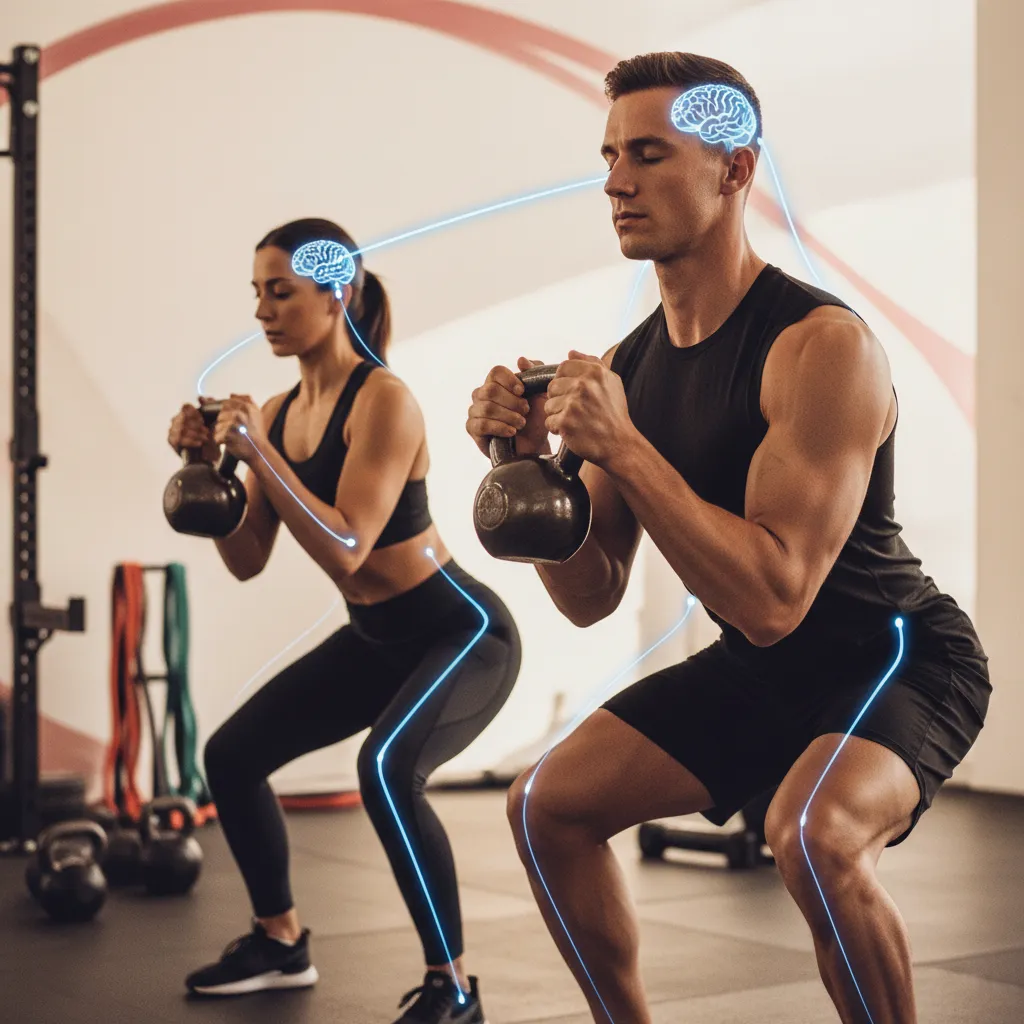
Mind-Muscle Connection is the ability to consciously focus your attention on the muscle you are training, improving its activation. This technique is particularly useful for isolation exercises for hypertrophy, but less so for heavy compound movements.
The mind-muscle connection is the conscious ability to focus your mental attention and intention on a specific muscle during exercise to maximize its activation and feel it contracting and working. It's not just a physical action, but a cognitive process aimed at optimizing the neuromuscular connection and improving training efficiency.
The concept of the mind-muscle connection is not new, but its scientific research has been advancing in recent years. The goal is to increase the motor unit recruitment of muscle fibers in the target muscle, potentially leading to greater hypertrophy (muscle growth). Instead of just moving the weight from point A to point B, you concentrate on the sensation of contraction and stretching in the working muscle.
How Does the Mind-Muscle Connection Work?
💬 Simply put: The mind-muscle connection means consciously focusing on the muscle you are training to activate it better and feel it working. This helps for more effective training and better results.
When you train, your brain sends signals to your muscles to make them contract. The goal of the mind-muscle connection is to improve the quality and intensity of these signals to a specific muscle. This is achieved through an internal focus of attention, where you consciously think about the muscle contracting. Studies like those by Schoenfeld and Contreras (2018) show that practicing internal focus can lead to greater EMG activity (electromyographic activity), which is an indicator of increased muscle activation.
For example, when performing a bicep curl, instead of just lifting the dumbbell, you focus on the sensation of your bicep shortening and tightening as your arm bends, and stretching as you lower it. This conscious thought increases the neuromuscular impulse and activates more muscle fibers in the target muscle.
When is the Mind-Muscle Connection Most Beneficial?
The mind-muscle connection demonstrates its greatest effectiveness in isolation exercises and in training aimed at hypertrophy. Here are a few scenarios where it is particularly useful:
- Isolation Exercises: Exercises like bicep curls, tricep extensions, lateral raises for the shoulders, or chest flyes are ideal. In these, a specific muscle can be easily isolated, and focus can be placed on its contraction without other muscles taking on a significant portion of the work.
- High Reps and Moderate Weight: When the goal is hypertrophy, training is often done with moderate weight and a higher number of reps (usually 8-15). In this range, focusing on the sensation becomes easier and more effective for inducing metabolic stress and muscle damage, which are key for growth.
- Beginners: For beginners who are still learning to feel and control their muscles, practicing the mind-muscle connection can significantly improve body awareness and accelerate the mastery of proper form.
When is the Mind-Muscle Connection Not a Priority?
Despite its benefits, the mind-muscle connection is not a panacea for every workout. There are situations where it can even be counterproductive or simply not the most effective focus:
- Heavy Compound Exercises: For movements like squats, deadlifts, leg presses, or overhead presses, the primary focus should be on executing the movement as a whole, stability, and safety. Here, the goal is to lift the maximum possible weight correctly. Cognitive capacity should be directed towards coordinating multiple muscle groups, maintaining biomechanics, and avoiding injury. Trying to focus on an individual muscle (e.g., only the quadriceps during a squat) can distract from the overall movement and compromise form. Research, including that by Brad Schoenfeld, emphasizes that for heavy lifts, external focus (e.g., "push the floor away," "drive the bar up") is more effective.
- Strength Training (Powerlifting): In strength training, where the goal is maximum weight for one repetition (1RM), the central nervous system is highly engaged in coordinating the maximum possible number of muscle fibers from different muscle groups simultaneously. In this case, external focus is generally more effective as it allows for greater force production.
- When You Are Fatigued: As you approach failure or at the end of a heavy workout, cognitive resources are limited. Trying to maintain a strong mind-muscle connection may be ineffective and hinder the maintenance of good form.
Practical Aspects and Integration
To get the most benefit from the mind-muscle connection, integrate it strategically into your training program. You don't need to apply it throughout the entire workout or for every exercise.
| Exercise Type | Recommended Focus | Example Exercises |
|---|---|---|
| Isolation | Internal Focus (mind-muscle connection) | Bicep curl, tricep extension, flyes, lateral raises |
| Compound (moderate weight, hypertrophy) | Mixed or Internal Focus (habituation) | Lunges, push-ups, dumbbell rows |
| Compound (heavy, strength/power) | External Focus (movement, weight) | Squat, deadlift, leg press, overhead press |
- Increases muscle activation.
- Potentially leads to greater hypertrophy, especially in isolation exercises.
- Helps with better body awareness and muscle control.
- Can improve technique for beginners.
- Increases the feeling of "pump" and workout satisfaction.
- May limit the weight lifted in heavy exercises.
- Not optimal for developing maximal strength and power.
- Can lead to excessive focus on sensation at the expense of proper form in heavy movements.
- Requires more mental energy and concentration.
- Can be difficult for beginners without sufficient experience.
Integrating the mind-muscle connection is a process that requires practice. Start with lighter weights so you can concentrate on the sensation before increasing the load. Deep breathing and slowing down the tempo of repetitions can also help.
See more in the fitness guides of Sport Zona Academy.
📚 Scientific Sources
- Differential effects of attentional focus strategies during long-term resistance training, 2018
- The Muscle-Mind Connection: The Role of Attentional Focus on Muscle Development, 2016
- The Importance of the Mind-Muscle Connection During Progressive Resistance Training, 2016
- The Effects of Internal and External Attentional Focus on Muscle Activity: A Systematic Review, 2022
🔬 Expert Note from Sport Zona
From my experience with Bulgarian athletes over the past 12+ years, the mind-muscle connection is key to achieving optimal results and avoiding injuries. By focusing on the sensation rather than the weight, I see them activate their muscles better and progress more effectively. This is not just theory – it is a fundamental element of successful training.
See more in the fitness guides of Sport Zona Academy.
Frequently asked questions
How long does it take to develop a good Mind-Muscle Connection?
Developing a strong Mind-Muscle Connection is an individual process. For some, it takes a few weeks of focused practice, while for others it may take months. Consistency, slowing down movements, and consciously focusing on each repetition are key.
Can Mind-Muscle Connection help overcome a training plateau?
Yes, it can. If you are in a plateau and not feeling the target muscle working well, applying the Mind-Muscle Connection can increase its activation, introduce new stimulation, and potentially help you break through the plateau by utilizing muscle fibers more effectively.
Should I apply Mind-Muscle Connection to every exercise?
It is not recommended. As explained in the article, Mind-Muscle Connection is most effective with isolation exercises and moderate weights. For heavy compound movements like squats or deadlifts, the focus should be on the overall movement, the weight, and safety.
What is the difference between internal and external focus?
Internal focus is on feeling your own body and muscles (e.g., 'squeeze your biceps'). External focus is on the effect of the movement on an external object or environment (e.g., 'push the floor away', 'push the bar towards the ceiling'). Studies show that external focus is more effective for strength and power, while internal focus is better for hypertrophy in isolation movements.