Multivitamins vs. Individual Vitamins: The Orchestra of Health vs. The Targeted Specialists

The head of "Academia" decided to write an article about multivitamins and individual vitamins. Analysis of the approach.
Short Answer: Multivitamins are a convenient "insurance" against general nutritional gaps, but often with suboptimal doses. Individual vitamins allow precise correction of actual deficiencies, confirmed by blood tests. Practical advice: Start with a quality multivitamin complex. After 3-6 months, get a blood test (Vitamin D, B12, Iron, Magnesium) and add only the necessary individual nutrients, e.g., Vitamin D3 (2000-4000 IU) and Magnesium (250-400 mg).
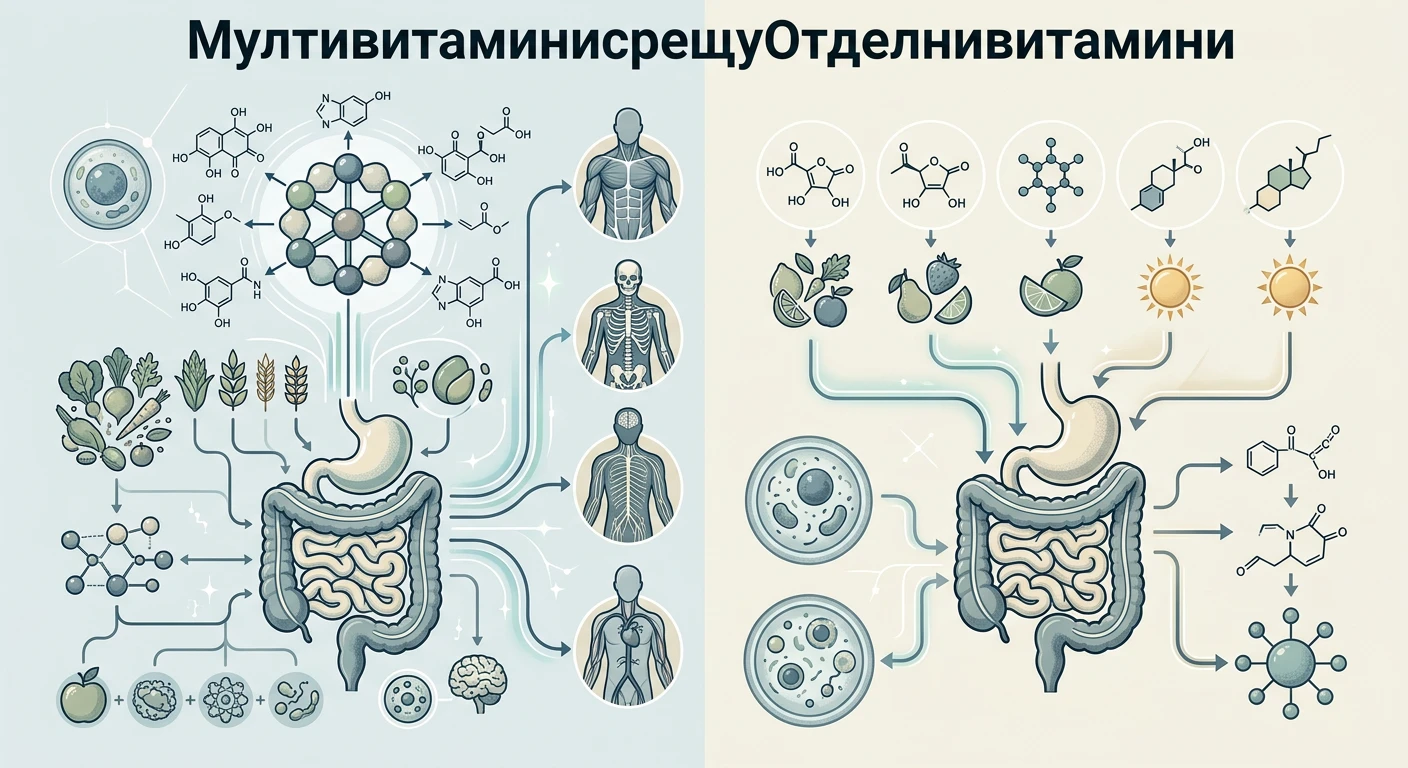
Choosing the right vitamins often seems confusing, especially for athletes whose needs are usually higher. One option is multivitamins – a convenient, "all-in-one" approach. The other is individual vitamins – a precise method for targeting specific needs. Which is better? In nutrition, the answer is: it depends.
Multivitamins provide basic daily support. They are convenient and cover essential needs. Individual vitamins, on the other hand, are like specialized tools – each is designed for a specific purpose and provides maximum effectiveness, but requires knowledge of when and how to use it.
This article examines both approaches. We will discuss when multivitamins are sufficient and when it is better to opt for individual vitamins to optimize an athlete's recovery, energy, and overall performance.
This article is part of the Expert Hub for Nutritional Supplements — over 270 expert-verified articles by Petar Mitkov and the Sport Zona team.
What is the Comparative Matrix for Approach Analysis?
The comparative matrix for approach analysis is a tool for systematically evaluating multivitamins and individual vitamins based on criteria such as biological status, primary focus, dosage, personalization, and risks.
| Criterion | Multivitamins | Individual Vitamins |
|---|---|---|
| Biological Status | General support, prevention | Targeted correction of deficiency or optimization |
| Primary Focus | Prevention of general nutritional gaps | Optimization of specific biochemical pathways |
| Dosage | Low to moderate (often ~100% of RDI) | High, therapeutic, or optimizing dose |
| Personalization | Unpersonalized, fixed formula | Full, according to individual needs and goals |
| Risk | Absorption competition (e.g., Zinc and copper), low potency | Risk of toxicity with incorrect dosage, imbalance |
| Price | Lower for basic coverage | Higher total cost when combining several |
What are Multivitamins?
1. Multivitamins: A Strategy for General Support
Multivitamin complexes are dietary supplements that are a combination of various micronutrients (vitamins and minerals) in doses close to the Recommended Daily Intake (RDI), designed to fill nutritional gaps and act as insurance against deficiencies.
Simply put: Multivitamins provide a little bit of everything so the body doesn't lack basic elements, but they don't solve specific problems.
2. Individual Vitamins: A Precise Approach
Taking individual vitamins allows for precise control over dosage, form, and timing of intake. This is important for athletes who want to influence specific physiological processes. For example:
- Vitamin D3: A daily intake of 4000-5000 IU (International Units), especially during winter, can significantly improve immune function, testosterone levels, and bone health – effects that cannot be achieved with the typical 400-800 IU in a multivitamin.
- Magnesium (bisglycinate): A dose of 400-500 mg before bed specifically improves sleep quality and muscle relaxation by regulating GABA receptors. This is key for recovery. In multivitamins, magnesium is often in a less absorbable form (oxide) and in a much lower dose.
- Vitamin B12 (methylcobalamin): For vegans or athletes with absorption issues, targeted intake of high doses of B12 is important for maintaining energy metabolism and nervous system health.
This method requires more information and is best based on blood tests. However, it ensures maximum effectiveness and avoids unnecessary ingredients.
Scientific Sources
- Kantor ED, et al. Do Multivitamin-Multimineral Supplements Work?. JAMA Intern Med, 2013 — Analysis of the efficacy of multivitamins for chronic disease prevention.
- Office of Dietary Supplements - NIH. Multivitamin/mineral Supplements: Fact Sheet for Health Professionals — Comprehensive review of the composition and application of multivitamin complexes.
- Linus Pauling Institute at Oregon State University. Vitamin D — Detailed information on the role and appropriate intake of Vitamin D.
- Examine.com. Magnesium - Health benefits, dosage, side effects — Independent analysis of different forms and effects of magnesium.
- Harvard T.H. Chan School of Public Health. The Nutrition Source: Vitamins — Practical guidelines for vitamins and their role in nutrition.
Why is there a synergistic effect between vitamins?
Synergistic effect is a strategy that often involves combination and occurs when multivitamins and individual supplements do not exclude each other but can work in a combined effect. A quality multivitamin represents a solid foundation, providing baseline levels of all essential micronutrients and protecting against unforeseen dietary gaps.
On this foundation, an athlete can build with individual, targeted supplements to optimize their performance. This combination provides both the broad-spectrum security of a multivitamin and the precision of individual nutrients.
Example: An athlete takes a multivitamin in the morning, which provides 100% of the RDI for B vitamins and 15 mg of zinc. In the evening, after a hard workout, they add 400 mg of magnesium bisglycinate for better recovery and another 15 mg of zinc picolinate to support the immune system and hormonal balance, reaching an appropriate daily dose of 30 mg of zinc.
What is the best algorithm for choosing multivitamins and supplements?
Choose Multivitamins if:
- You are starting with supplementation and looking for an easy start.
- Your diet is relatively balanced, but you want extra security.
- Convenience and maintaining overall good health are priorities.
- Your budget is limited and you are looking for the best price/coverage ratio.
🔵 Choose Individual Vitamins if:
- You have a diagnosed deficiency (via blood test) and need a therapeutic dose.
- You have a specific goal (e.g., improving sleep, boosting immunity).
- You follow a restrictive diet (vegan, keto) and need specific nutrients (B12, D).
- You are an advanced athlete aiming for peak optimization.
Recommended Stack: Foundation + Optimization
The most balanced approach involves using a high-quality multivitamin as a foundation, supplemented with 2-3 optimizing individual supplements based on individual needs, seasonality, and training cycle (e.g., Vitamin D3, Magnesium, Zinc).
What protocol can we use in 2026 that is both a "Foundation and Performance Stack"?
A modern and effective protocol is a combination of multivitamins and individual vitamins, aiming for maximum effect in seriously training athletes.
- Daily Foundation (morning with food): 1 dose of a quality multivitamin complex containing bioactive forms of B vitamins (e.g., Methylcobalamin, P-5-P) and chelated trace minerals.
- Recovery Optimization (evening, 30-60 min before sleep):
- Magnesium (bisglycinate or malate): 400–500 mg
- Zinc (picolinate or gluconate): 20–30 mg
- Seasonal/Targeted Optimization (with the fattiest meal of the day):
- Vitamin D3: 2000–5000 IU (from October to April or year-round if there is no sun).
- Vitamin K2 (MK-7): 100-200 mcg (always in combination with D3 for better calcium absorption).
Expert Note
I often see blind adherence to protocols. A blood test is your "GPS". I recommend testing your Vitamin D, B12, iron, and ferritin levels at least once a year. This makes supplementation precise, not guesswork, and saves money in the long run.
🧭 When to Choose What?
- Choose Multivitamins if your goal is convenient and affordable prevention of nutritional deficiencies.
- Choose Individual Vitamins if you have a specific deficiency, a specific goal, or want maximum control and potency.
- Combine Both for the best results: use a multivitamin as a foundation and add individual nutrients for targeted optimization.
📖 What is a Multivitamin or an Individual Vitamin?
Multivitamins: These are dietary supplements that contain a combination of various vitamins and minerals in one tablet, capsule, or powder. Their purpose is to provide a variety of micronutrients in a single dose.
Individual Vitamins: These are supplements that contain only one specific vitamin or mineral (e.g., Vitamin C, Magnesium, Zinc). They allow for the intake of higher, targeted doses of a specific nutrient.
What are the Pros and Cons?
Multivitamins offer convenience, lower cost, and prevention of multiple deficiencies simultaneously, but they contain low doses, possible competition between minerals for absorption, and more often contain cheaper forms. Individual vitamins allow for high dosage for a specific purpose, full control, and selection of the best bioavailable form without absorption competition, but they have a higher overall cost and require more knowledge.
| Multivitamins |
|---|
| Pros: Convenience (one dose), lower cost, prevention of multiple deficiencies simultaneously. |
| Cons: Low doses, possible competition between minerals for absorption, more often contain cheaper and less absorbable forms. |
| Individual Vitamins |
|---|
| Pros: High dosage for a specific purpose, full control, ability to choose the best bioavailable form, no absorption competition. |
| Cons: Higher overall cost, more complex intake (multiple pills), requires more knowledge, risk of overdose or imbalance. |
What are Multivitamins?
Multivitamins are a convenient way to get all the necessary vitamins and minerals. They are like a buffet at an all-inclusive hotel – there's a little bit of everything, it's convenient, and you won't go hungry.
| Criterion | Multivitamins | Individual Vitamins |
|---|---|---|
| Metaphor | Multi-tool | Specialized tools |
| Approach | Broad coverage | Targeted action |
| Who uses it? | Anyone, for general support | Athlete with a specific goal |
| Main Goal | Security against deficiencies | Optimization of processes |
How to Choose the Right Product for Our Goal?
Combined Protocol for Maximum Effect:
- Morning: Start the day with a high-quality multivitamin as a foundation.
- Post-Workout: Add amino acids for muscle recovery.
- Evening: Take magnesium and omega-3 to support sleep and reduce inflammation.
⚖ When to Choose Multivitamins
- When you value convenience and simplicity.
- When budget is a primary factor.
- When your diet is good but may have gaps.
- When you are a beginner and unsure where to start.
⚖ When to Choose Individual Vitamins
- When you have a specific deficiency confirmed by testing.
- When you are pursuing a specific goal (more energy, better sleep).
- When you are an advanced athlete striving for peak performance.
- When you want full control over the dosage and form of the nutrient.
Expert Note from Sport Zona
Choosing the right product is a strategic decision, where a high-quality multivitamin complex from a sports brand, avoiding poorly absorbed forms like magnesium oxide or cyanocobalamin (B12), serves as a stable foundation, built upon with 2-3 targeted nutrients based on blood tests to achieve optimal results.
Frequently asked questions
Can multivitamins and individual vitamins be taken together?
Yes, this is a common and effective strategy. Multivitamins serve as a foundation, and individual vitamins are added to address a specific, research-proven deficiency. It is important to monitor the total intake of each nutrient to avoid exceeding the tolerable upper intake level (UL).
Which is better for beginners - multivitamins or individual vitamins?
For beginners, multivitamins are a better and safer starting option. They provide a wide spectrum of micronutrients without the need for in-depth knowledge or prior research, thus helping to build a basic good health.
When is the best time to take multivitamins and individual vitamins?
Multivitamins are best taken with a meal containing fat (e.g., with breakfast or lunch) to improve the absorption of fat-soluble vitamins (A, D, E, K). The timing for taking individual vitamins depends on the nutrient: B-complex vitamins in the morning for energy, and magnesium in the evening for better sleep and recovery.
Are there side effects from taking multivitamins or individual vitamins?
Yes, if recommended doses are exceeded. The most common problem with multivitamins is stomach discomfort. With individual vitamins, especially fat-soluble ones and minerals like iron, high doses can lead to toxicity. Always follow the label's recommendations and consult a specialist.
What is the recommended dosage for multivitamins and individual vitamins?
For multivitamins, the dosage is indicated on the label, usually one dose daily. For individual vitamins, it is strictly individual and should be determined based on blood tests and goals. Common dosages for athletes are: Vitamin D3 (2000-5000 IU), Magnesium (250-500 mg), Zinc (15-30 mg).