Myofascial release and foam rolling
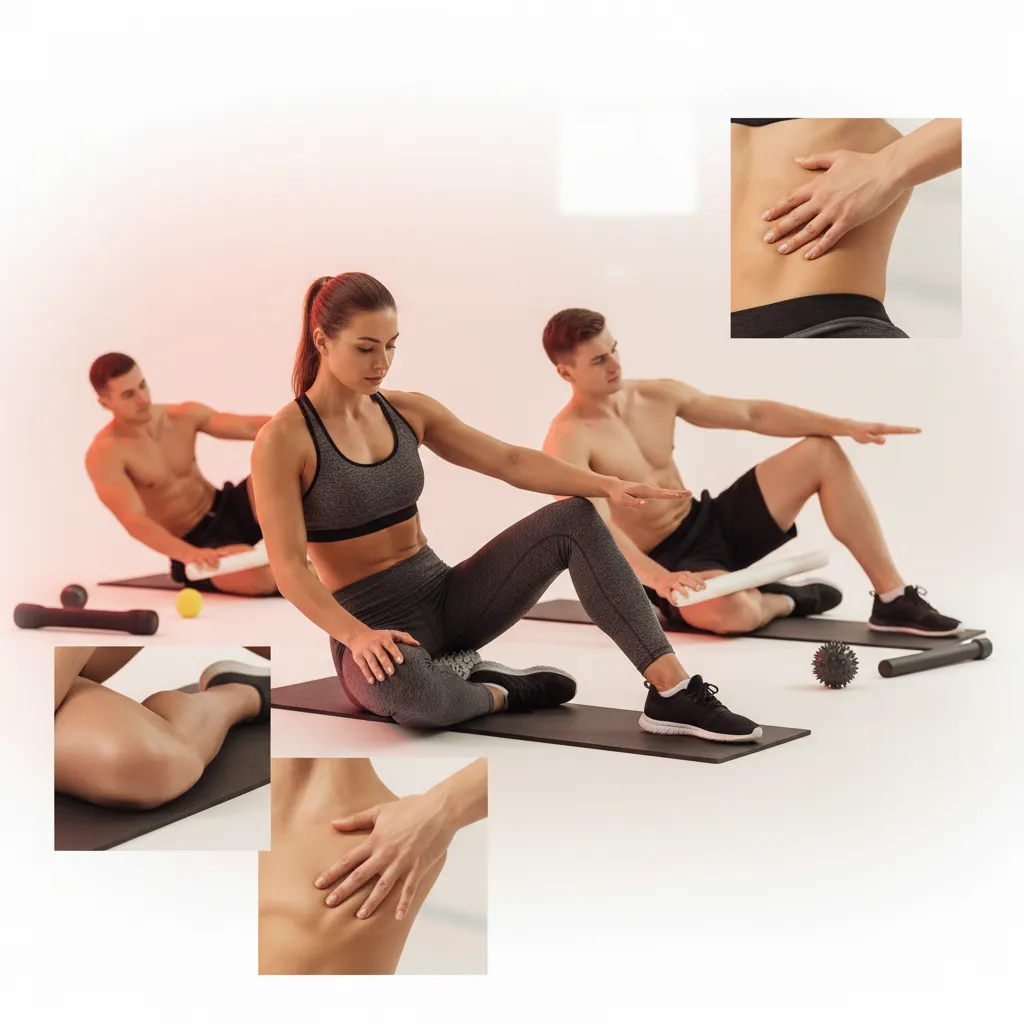
mechanism (not fascia release, but neural inhibition), 30–90s per group
Myofascial Release (MFR) is a self-massage technique that applies pressure to muscles and connective tissue to temporarily reduce muscle tension and improve range of motion.
📌 3 Key Takeaways
- Self-massage with a roller does not "break up" knots or "unstick" fascia; instead, it sends signals to the nervous system that lead to a temporary reduction in muscle tone and pain perception.
- Apply pressure to one muscle group for 30 to 90 seconds; longer rolling does not provide additional benefits and can cause irritation or bruising.
- It is most effective as part of a warm-up to temporarily increase range of motion, or after a workout to aid recovery by stimulating blood circulation.
What Exactly is Myofascial Release
💬 Simply put: Myofascial release is a self-massage technique that helps relax muscles and improve flexibility by pressing on problem areas.
How It Works in Practice
For foam rolling to be effective, it must be applied correctly. The key variables are duration, pressure, and tempo. Duration: Scientific consensus and practice indicate that the optimal duration for treating one muscle group is between 30 and 90 seconds.- Under 30 seconds: The time is insufficient for a full neurological response to be triggered.
- Over 90 seconds: There is no evidence of additional benefits. On the contrary, rolling too long (2-3+ minutes) in one spot can lead to nerve compression, tissue irritation, and even bruising.
🔬 From Practice
I have worked with many athletes who complain about limited squat depth. A common reason is insufficient ankle dorsiflexion. Instead of static stretching, we often apply MFR with a massage ball to the calves (gastrocnemius and soleus) for 60-90 seconds per leg immediately before squat sets. In 8 out of 10 cases, there is an immediate, albeit temporary, improvement in range of motion. This allows the athlete to perform the squat with better technique during the workout itself, which is the main goal of a warm-up. The roller does not "lengthen" the muscle; it "unlocks" it for the specific session.
When and How to Use It
The application of myofascial release depends on the goal. There are three main scenarios: 1. Before a Workout (Part of the Warm-up):- Goal: To temporarily increase range of motion and improve movement quality.
- How: Focus on the muscle groups that will be primary for the workout. For example, before squats, roll the calves, quadriceps, adductors, and glutes. Before upper body pushing movements – target the lats, chest, and triceps.
- Duration: 30-60 seconds per muscle group.
- Important: MFR is not a complete warm-up. After it, be sure to perform dynamic stretches (lunges, arm circles, etc.) and activation exercises (push-ups, glute bridges) to prepare the nervous system and muscles for work.
- Goal: To reduce sympathetic nervous system activity ("fight or flight") and stimulate the parasympathetic system ("rest and digest"). This can aid recovery and reduce the sensation of muscle soreness (DOMS).
- How: Use slower and smoother movements on the worked muscles.
- Duration: 60-90 seconds per muscle group.
- Goal: General tissue maintenance, improving body awareness (proprioception), and relieving accumulated tension from daily life.
- How: A more thorough 10-15 minute session covering the entire body can be performed.
Comparison of MFR Tools
| Tool | Firmness/Density | Suitable For |
|---|---|---|
| Standard Foam Roller (Smooth) | Low to Medium | Beginners, large muscle groups (legs, back). |
| Textured Foam Roller | Medium to High | Advanced users, mimics finger massage feel. |
| Massage Ball (Lacrosse, Tennis) | High | Precise treatment of trigger points (glutes, shoulders, feet). |
| Massage Gun | Variable (depending on attachment and speed) | Rapid percussion therapy, warm-up, hard-to-reach areas. |
Common Mistakes and Misconceptions
Proper technique is crucial for the effectiveness and safety of myofascial release. Many people make mistakes that either reduce the benefits or even pose a risk of injury.⚠️ Common Mistakes
- Rolling directly over a joint or bone: The foam roller is intended for soft tissues. Rolling over the kneecap, spine, or pelvic bones is pointless and painful.
- Rolling the lower back: The spinal muscles in the lumbar region are deep and not designed to withstand direct pressure. Rolling there can trigger a protective spasm of the muscles around the vertebrae. Instead, roll the glutes and lats, which often contribute to lower back pain.
- Rolling too fast: As mentioned, fast rolling does not give the nervous system time to respond. Move at a pace of about 2-3 centimeters per second.
- Holding your breath: Holding your breath while experiencing discomfort increases tension throughout the body. Breathe slowly and deeply to aid relaxation.
- Believing in a lasting effect: Improved range of motion after MFR is temporary. If you do not "cement" it through strength exercises in the new, larger range, the body will quickly return to its old state.
Should it hurt when I roll?
You should feel discomfort, but not sharp, stabbing, or numbing pain. If the pain is severe, reduce the pressure or switch to a softer roller. If the pain is sharp, stop and consult a specialist, as it may indicate an injury.
Can foam rolling replace stretching?
No, they are two different but complementary tools. MFR primarily affects the nervous system and tissue quality, while static stretching aims to influence the mechanical length of the muscle in the long term. A good strategy is to first use MFR to reduce tone, and then apply stretching.
Does foam rolling really help against cellulite?
There is no scientific evidence that foam rolling can reduce or eliminate cellulite. Cellulite is related to the structure of subcutaneous fat tissue and connective tissue. Rolling can temporarily improve circulation and reduce fluid retention, which may lead to an illusory, short-term improvement in skin appearance, but it does not address the root cause.
See more in the fitness guides of Sport Zona Academy.
🔬 Expert Note from Sport Zona
In our many years of experience, we have observed that regular, but moderate, use of a self-massage roller before training significantly improves movement quality. However, it is important not to overdo it, as excessive and aggressive myofascial release can have the opposite effect. The goal is to support recovery, not to cause discomfort.
See more in the fitness guides of Sport Zona Academy.
Recommended products
Frequently asked questions
How exactly does foam rolling work?
Foam rolling does not "break up" muscle knots, but stimulates the nervous system. This leads to a temporary reduction in muscle tone and the sensation of pain.
How long should pressure be applied to one muscle group?
The optimal duration is between 30 and 90 seconds. Longer rolling does not provide additional benefits and can cause irritation or bruising.
When is foam rolling most effective?
The best results are achieved as part of a warm-up to temporarily increase range of motion. It can also be used after training to aid recovery.
Are there any risks associated with improper use of a foam roller?
Yes, rolling for too long or applying too much pressure can lead to nerve compression, tissue irritation, or bruising.