Neuromuscular adaptation — motor unit recruitment

Neuromuscular adaptation is a key process that explains how beginners in strength training become stronger before significant muscle hypertrophy occurs. It involves improving the coordination between the nervous system and muscles, as well as more efficient recruitment of motor units.
Neuromuscular adaptation is a complex set of changes occurring in the nervous system and muscles, leading to improved muscle strength and control, without necessarily significant hypertrophy (increase in muscle size). This process is particularly pronounced in beginner athletes and explains the rapid improvements in their strength during the first weeks and months of starting a training program. At the core of neuromuscular adaptation lies the nervous system's ability to activate and coordinate motor units more effectively.
What is a Motor Unit?
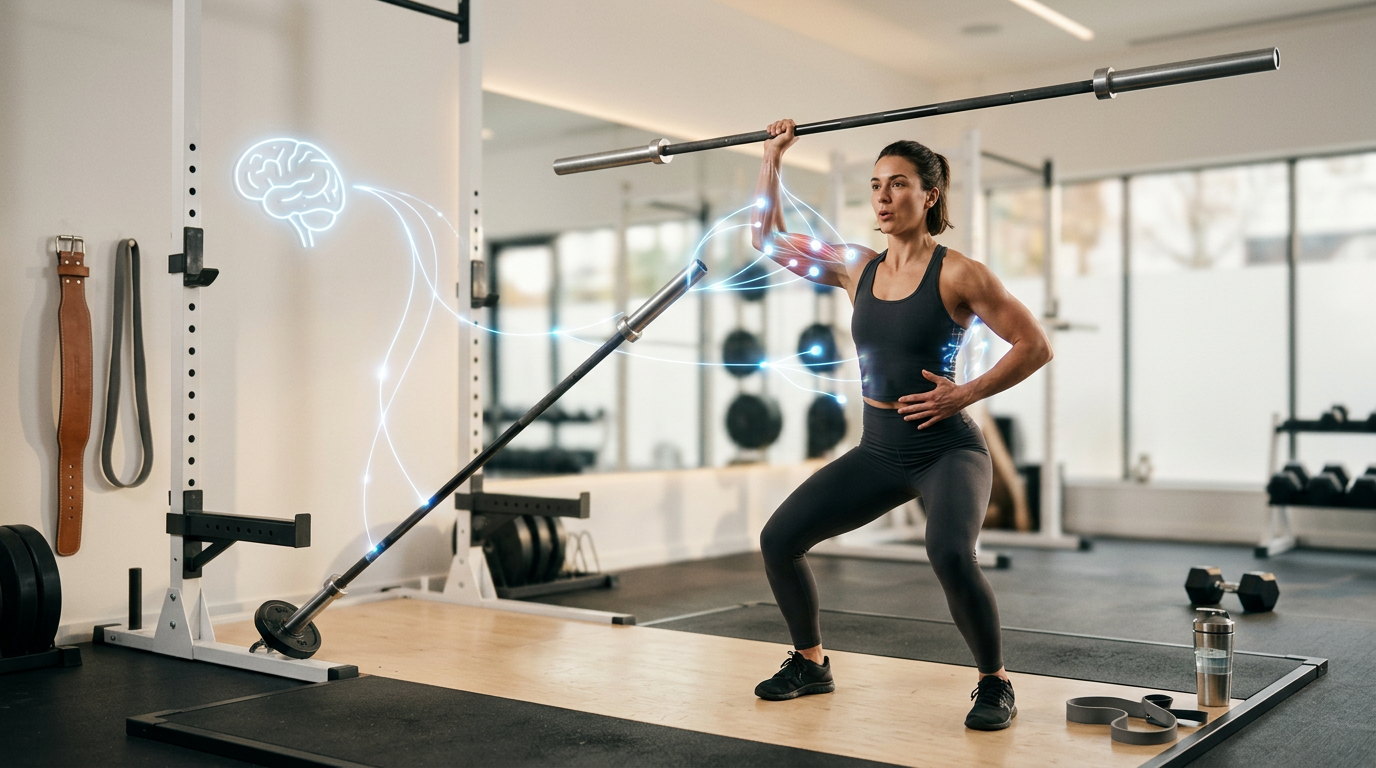
💬 Simply put: Neuromuscular adaptation is how the brain and muscles learn to work better together to make you stronger, without necessarily making your muscles grow much.
A motor unit is the basic functional unit of the neuromuscular system. It consists of a single alpha-motoneuron and all the muscle fibers it innervates. When the motoneuron sends an electrical impulse, all the muscle fibers it controls contract simultaneously. The number of muscle fibers in a motor unit varies significantly – from a few in muscles responsible for fine movements (like those of the eyes) to thousands in large muscles responsible for gross strength (like the quadriceps).
Henneman's Size Principle
One of the foundational principles in understanding neuromuscular adaptation is Henneman's Size Principle, formulated by Dr. Elwood Henneman in 1957. This principle states that as the force exerted by the nervous system on the muscle gradually increases, smaller motor units (innervating fewer muscle fibers and having a lower threshold of excitability) are activated first, followed sequentially by the recruitment of larger motor units (with more muscle fibers and a higher threshold of excitability). This ensures a smooth and controlled increase in force production, starting from fine movements and progressing to maximal explosive power.
How Neuromuscular Adaptation Leads to Strength Without Hypertrophy?
In the initial stage of strength training (usually the first 4-8 weeks), the primary driver of increased strength is not muscle growth, but neuromuscular adaptation. It involves several key mechanisms:
- Improved Motor Unit Recruitment: A greater number of motor units can be activated simultaneously, especially high-threshold ones that innervate the largest and strongest muscle fibers (Type II).
- Increased Firing Rate: Motoneurons begin to send impulses to muscle fibers at a higher frequency, leading to a stronger and more sustained muscle contraction.
- Improved Motor Unit Synchronization: Muscle units begin to work more coordinatedly and synchronously, increasing the overall force of contraction.
- Reduced Co-activation of Antagonists: The simultaneous contraction of antagonistic muscles (those that perform the opposite movement), which would hinder the primary movement and reduce strength, is decreased.
- Enhanced Intramuscular and Intermuscular Coordination: Intramuscular coordination refers to the ability of an individual muscle to generate force, while intermuscular coordination relates to the interaction between different muscles during complex movement execution.
- Rapid strength gains in beginners.
- Does not lead to significant body weight increase.
- Improves muscle control and performance.
- Foundation for future hypertrophy and longer training progression.
- Reduces injury risk through better movement control.
- Strength progress may slow down after the initial period.
- Without adequate volume and intensity, hypertrophy is not sufficiently stimulated.
- If the focus is solely on neuromuscular adaptation, muscle mass growth may lag.
- Overtraining if nervous system recovery is neglected.
Significance for the Training Process
Understanding neuromuscular adaptation is crucial for building effective training programs, especially for beginners. During the first few months, the focus should be on mastering technique, building endurance, and gradually increasing weight, rather than on training volume for hypertrophy. Research, such as that by Brad Schoenfeld, emphasizes that early strength changes are primarily neurological, not morphological. This means that even with lower volume but adequate intensity and a focus on complex movements, beginners will achieve significant progress.
| Training Stage | Primary Strength Driver | Characteristic Adaptations | Approximate Period |
|---|---|---|---|
| Beginner | Neuromuscular Adaptation | Improved MU recruitment, coordination, firing rate | First 4-12 weeks |
| Intermediate | Neuromuscular Adaptation and Hypertrophy | Continued improvement in neurological factors and onset of hypertrophy | From 3 months to 1 year |
| Advanced | Hypertrophy and Structural Changes | Primary focus on muscle growth, neurological adaptations are already at a high level | After 1 year of training |
Conclusion
Neuromuscular adaptation is the phenomenon that allows beginner athletes to become stronger quickly without needing to significantly increase their muscle mass. It is based on the effective recruitment and coordination of motor units, controlled by the nervous system, in accordance with Henneman's principle. Understanding these mechanisms helps optimize training programs by emphasizing the development of motor control and movement efficiency in the initial stages, before focusing primarily on muscle hypertrophy at a more advanced stage of the training process.
See more in the fitness guides of Sport Zona Academy.
📚 Scientific Sources
🔬 Expert Note from Sport Zona
From my observation over the years, even minimal training initiation – like 2-3 exercises with light weights, leads to visible strength progress within the first 1-2 weeks for any beginner. This is always neuromuscular adaptation, not hypertrophy. Only after 3-4 weeks of work do we start seeing actual physical transformations.
See more in the fitness guides of Sport Zona Academy.
Recommended products


Frequently asked questions
How quickly can progress from neuromuscular adaptation be noticed?
Usually, strength improvements due to neuromuscular adaptation can be noticed as early as the first 2-4 weeks of regular training and continue intensely during the first 4-12 weeks.
Can neuromuscular adaptation also occur in advanced athletes?
Yes, but to a lesser extent and at a slower pace. In advanced athletes, neuromuscular adaptations are already at a very high level, so further progress in strength is mainly due to hypertrophy and structural changes in the muscles.
What type of training is most effective for neuromuscular adaptation?
Training with higher intensity (heavier weights), complex compound exercises, and a focus on proper technique are extremely effective. Plyometric training and speed and power exercises also stimulate neuromuscular adaptation.
What is the difference between hypertrophy and neuromuscular adaptation?
Hypertrophy is the increase in the size of muscle fibers, while neuromuscular adaptation is the improvement of the nervous system's ability to activate and coordinate these muscle fibers. The former leads to larger muscles, the latter to more efficient use of existing muscles.