Omega-3 vs. Vitamin D: Cellular Lubricant vs. Sunshine Hormone

Omega-3 reduces inflammation and improves flexibility, while Vitamin D controls muscle strength, immunity, and bones. Both are important for athletes.
Short answer: Omega-3 fights inflammation and supports cell membranes, while Vitamin D acts as a hormone for bone density and immunity. They are not interchangeable but complementary. Practical advice: Take them with a fat-containing meal. Combine 1-3 grams of EPA/DHA (Omega-3) with 2000-4000 IU of Vitamin D3 daily, especially during autumn and winter.
Omega-3 and Vitamin D are often mentioned together – as important supplements for health. For athletes, however, these two substances have different but complementary roles. It's not about which is better, but what each is for and when it's needed. The wrong choice can lead to slower recovery, a higher risk of injury, or simply a lack of results in the gym.
Omega-3 fatty acids work like fine motor oil – they reduce inflammation in joints and muscles, ensure cell membrane flexibility, and keep the heart and brain in good condition. Without them, everything wears out faster.
Vitamin D controls key systems. It doesn't lubricate directly, but it manages: muscle contraction, the immune system, and bone strength. If Vitamin D isn't doing its job, the body cannot reach its full potential. Understanding these functions is important for an intelligent approach to supplements.
This article is part of the Expert Hub for Nutritional Supplements — over 270 expertly verified articles by Petar Mitkov and the Sport Zona team.
What is a Comparative Matrix for System Analysis?
A comparative matrix for system analysis provides a detailed overview of Omega-3 (EPA/DHA) and Vitamin D (D3) across various criteria such as biological status, primary focus, mechanism of action, and time horizon for effect on the human body.
| Criterion | Omega-3 (EPA/DHA) | Vitamin D (D3) |
|---|---|---|
| Biological Status | Essential Fatty Acids | Fat-soluble Vitamin and Prohormone |
| Primary Focus | Inflammation Control, Cell Membranes | Immunity, Bone Density, Muscle Function |
| Mechanism of Action | Incorporation into cell membranes, production of resolvins and anti-inflammatory eicosanoids | Binding to the Vitamin D Receptor (VDR), regulating gene expression |
| Time Horizon | Cumulative effect (weeks to months) | Medium-term effect (several weeks) |
| Effect on Muscles | Indirect: improves recovery and reduces muscle soreness (DOMS) | Direct: improves strength and power, especially in deficient individuals |
| Specific Bonus | Improves cognitive function and heart health | Key for calcium and phosphorus absorption |
How Do Omega-3 Fatty Acids Work?
1. Omega-3: A Structural Element Against Inflammation
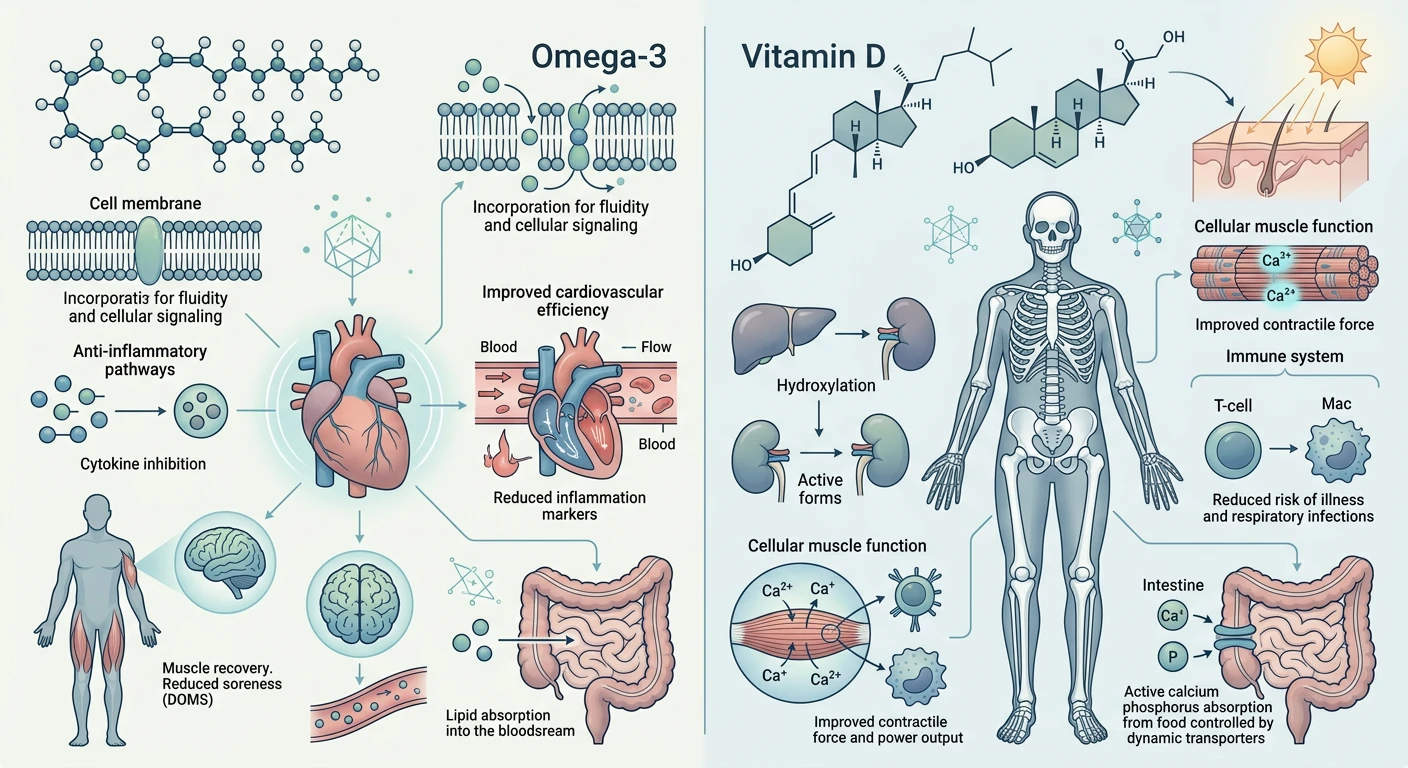
Omega-3 fatty acids, particularly EPA and DHA, are structural components of cell membranes that improve their flexibility and communication, while EPA competes with the pro-inflammatory Omega-6 arachidonic acid for the production of less inflammatory molecules and resolvins.
Simply put: Omega-3 acts like a "fire extinguisher." Instead of letting the inflammatory "fire" from workouts smolder and cause damage (muscle soreness, joint pain), Omega-3 limits it and helps to extinguish it faster.
2. Vitamin D: A Hormonal Regulator of Strength and Immunity
Vitamin D is unique because it acts more like a steroid hormone than a regular vitamin. After being synthesized in the skin from sunlight or taken through food/supplements, it converts to its active form – calcitriol. Calcitriol binds to specific receptors (Vitamin D Receptors, VDR) found in the nuclei of almost all cells, including muscle and immune cells. Binding to VDR "unlocks" or "locks" the expression of hundreds of genes. In muscle cells, VDR regulates genes responsible for protein synthesis, calcium metabolism (important for contraction strength), and muscle fiber growth. In immune cells, Vitamin D modulates the production of antimicrobial peptides and regulates T-cell activity, which is crucial for protection against infections, especially in highly trained athletes.
Scientific Sources
- Omega-3 Fatty Acids and Inflammatory Processes, Calder PC. 2017
- Omega-3 Fatty Acids Fact Sheet for Health Professionals — NIH Office of Dietary Supplements
- Vitamin D — The Linus Pauling Institute at Oregon State University
- Vitamin D and the Athlete: Current Perspectives and New Challenges, Owens DJ et al. 2018
- Vitamin D — The Nutrition Source, Harvard T.H. Chan School of Public Health
- Vitamin D Supplement — Health Benefits, Dosage, Side Effects on Examine.com
The Synergistic Effect: Why Do They Work Better Together?
Omega-3 and Vitamin D are examples of synergy, where the effect is greater than the sum of its parts. Each of these substances plays a role in modulating the immune system and inflammation, but in different ways. Omega-3 works by changing the raw materials for inflammatory mediators, while Vitamin D regulates the gene expression of immune cells. When combined, they provide a two-way control over the inflammatory response, which is faster and more effective. Furthermore, both are fat-soluble, meaning taking them with fat improves the absorption of each. For an athlete, this means faster recovery from intense workouts, fewer missed days due to illness, and a lower risk of chronic inflammation that can lead to injuries.
What is the Selection Algorithm?
Choose Omega-3 if:
- The goal is to reduce muscle soreness and speed up recovery.
- You have a high training volume (e.g., marathon preparation, CrossFit competition).
- You experience joint pain, stiffness, or discomfort.
- You want to support your cognitive function, focus, and mood.
🔵 Choose Vitamin D if:
- You live in northern latitudes with little sun (like Bulgaria in winter).
- You get sick often or recover slowly from infections.
- The goal is to increase maximum strength and power.
- You have concerns about your bone density or have experienced stress fractures.
Recommended Stack for Maximum Results
The practical algorithm for choosing Omega-3 and Vitamin D for training athletes is a combination of both, not an "either/or" choice. An effective starting protocol is: Omega-3: 2-3 grams of combined EPA/DHA daily, taken with food, and Vitamin D3: 2000-4000 IU (international units) daily, taken with a fat-containing meal.
What is the Protocol for 2026: "Foundation and Performance Stack"?
"Foundation and Performance Stack" is a modern protocol for taking Omega-3 and Vitamin D that allows for maximum effectiveness by separating and synchronizing intake with the training process.
- Daily (Morning): 2000-5000 IU Vitamin D3, taken with a fat-rich breakfast (eggs, avocado, nuts). This ensures baseline levels for immune and hormonal support throughout the day. In summer, the dose can be reduced, and in winter, increased, preferably after a blood test.
- Post-Workout: 2-3 grams of high-quality Omega-3 (with an emphasis on EPA), taken with food after training. This positions its anti-inflammatory properties exactly when the body needs them most to begin the recovery process.
Expert Note: Quantities and Quality
For Omega-3, look at the label for the content of EPA and DHA, not the total amount of fish oil. The goal is to consume a total of 2-3 grams of these two acids. For Vitamin D, always choose the D3 form (cholecalciferol), as it is more bioavailable than D2 (ergocalciferol). I recommend testing your 25-hydroxyvitamin D levels at least once a year (at the end of winter) to precisely adjust the dose.
🧭 When to Choose Which?
- Priority Omega-3 if: The main problem is muscle soreness, joint pain, and slow recovery between workouts.
- Priority Vitamin D if: You live in a place with little sun, get sick often, or feel a lack of strength and energy that isn't explained by training.
- Combine both if: You are a serious athlete who wants to optimize every aspect of your performance, health, and longevity in sports.
📖 What are Omega-3 and Vitamin D?
Omega-3 are essential polyunsaturated fatty acids that the body cannot produce. The most important are EPA (eicosapentaenoic acid) and DHA (docosahexaenoic acid), found mainly in fatty fish.
Vitamin D is a fat-soluble vitamin that the body synthesizes upon exposure to sunlight. It acts as a prohormone and regulates hundreds of genes related to immunity, bones, and muscle function. The best form for supplementation is D3 (cholecalciferol).
⚖ Pros and Cons
| Omega-3 | Vitamin D |
|---|---|
| Pros: Strong anti-inflammatory effect, supports brain and heart, reduces muscle soreness, safe in recommended doses. | Pros: Vital for immunity and strength, affordable, easy to dose, very effective in deficiency. |
| Cons: Requires higher doses for athletic purposes, quality varies, can thin the blood (caution with anticoagulants), higher cost. | Cons: Risk of toxicity at very high doses, requires blood test for optimization, needs fat for absorption. |
🗣 Explained Simply
If you had to explain the difference to a friend at the gym:
| Criterion | Omega-3 | Vitamin D |
|---|---|---|
| Role | Lubricant and Fire Extinguisher | Master Switch |
| Main Problem Solved | Inflammation and Stiffness | Weak Immunity and Lack of Strength |
| Metaphor | "Changing the engine oil" | "Turning on the car's computer" |
Omega-3 helps the body deal with damage after hard work. Vitamin D ensures the body is healthy and ready enough before starting the hard work.
Choose the Right Product for Your Goal:
- For inflammation control and joint health: Check out our Omega-3 products.
- For strong immunity, bones, and hormonal balance: Browse our selection of vitamins and minerals.
- For comprehensive musculoskeletal support: Combine with joint support products.
Combined Protocol for Maximizers:
- Morning: 4000 IU Vitamin D3 with food.
- Post-Workout: 3g Omega-3 (EPA/DHA) with food.
- Before Bed: Magnesium for additional relaxation and recovery.
⚖ When to Choose Omega-3
- When recovery is a bigger problem than strength.
- When you have intense and frequent training sessions every day.
- When you feel joint pain and stiffness.
- When your diet is low in fatty fish.
⚖ When to Choose Vitamin D
- When strength and power are stagnating.
- When you get sick often during autumn and winter.
- When you spend most of your day indoors.
- When blood tests show deficiency or insufficiency.
Expert Note from Sport Zona
In my practice with athletes for over 12 years, I've stopped viewing Omega-3 and Vitamin D as an "either/or" choice. For me, they are the foundation, right after adequate intake of protein and creatine. Our process is always the same: first, we do a blood test for Vitamin D levels (25(OH)D) and adjust the dose to appropriate values (usually between 40-60 ng/mL). Then, we add high-quality Omega-3 to manage the inevitable inflammatory stress from training. Training hard and neglecting these two supplements is like buying a sports car and driving it with the cheapest gasoline and no oil – you're simply not using all its capabilities and you're damaging it sooner.
Recommended products
Frequently asked questions
Can Omega-3 and Vitamin D be taken together?
Yes, it is even recommended. Both nutrients are fat-soluble, which means their absorption is significantly improved when taken with food containing fat. Many supplements, like cod liver oil, contain them combined. Their effects on the immune system and inflammatory processes are synergistic.
Which is better for beginners - Omega-3 or Vitamin D?
Both are fundamental for health. However, Vitamin D deficiency is extremely common, especially in regions with fewer sunny days like Bulgaria. If a choice must be made without prior testing, Vitamin D is often more of a priority. Omega-3 is critically important if your diet is low in fatty fish. Ideally, beginners should consider both.
When is the best time to take Omega-3 and Vitamin D?
The best time to take them is during one of your main meals (lunch or dinner) that contains fat. This ensures their optimal absorption. Taking them at the same time every day helps maintain stable levels in the body.
Are there side effects from taking Omega-3 or Vitamin D?
Side effects are possible at very high doses. For Omega-3, doses above 5 grams daily can thin the blood and cause stomach discomfort. For Vitamin D, toxicity is rare but possible with chronic intake of over 10,000 IU daily, which can lead to hypercalcemia (high blood calcium levels). Stick to the recommended dosages.
What is the recommended dosage for Omega-3 and Vitamin D?
For Omega-3, the target for athletes is 1 to 3 grams of combined EPA and DHA per day – check the label for these two acids, not the total amount of fish oil. For Vitamin D, a standard maintenance dose is 2000 to 4000 IU (international units) daily, especially during the autumn-winter season. The most accurate dosage is determined after a blood test.