Probiotics vs. Enzymes: The Living Helpers vs. The Degradation Accelerators
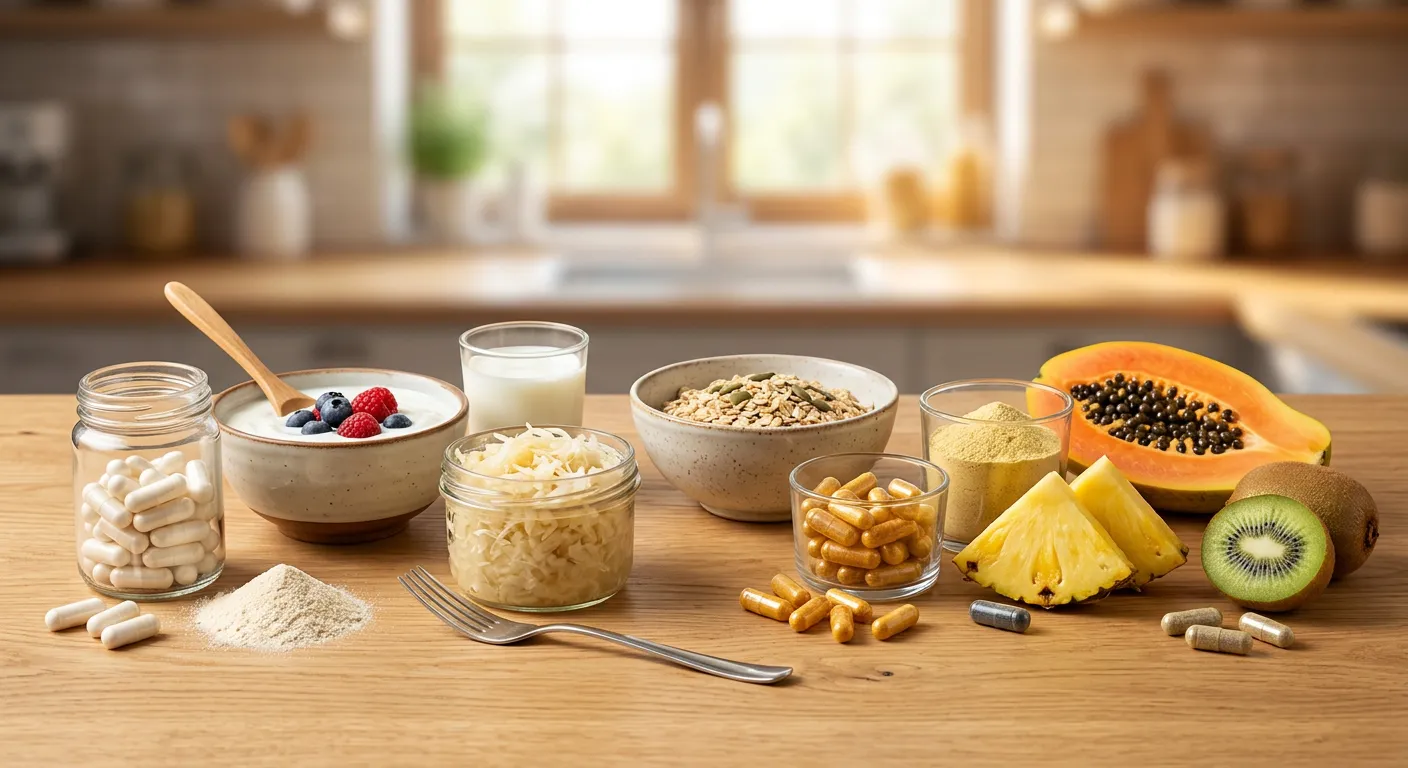
The article explains the role of probiotics and digestive enzymes, noting that in n=68 athletes, enzymes reduced discomfort by 40-65% in 3-5 days.
As a sports nutritionist with over 15 years of experience, I know that nutrition is the backbone of every athlete. But what if your body isn't absorbing nutrients, no matter how high quality they are? This is where probiotics and digestive enzymes come in – two components that are often confused, but whose roles are fundamentally different. In my opinion, understanding this difference is even more important than choosing a protein powder.
Imagine the digestive tract as a complex biochemical laboratory. Digestive enzymes are microscopic "scissors" that cut complex molecules (proteins, carbohydrates, fats) into smaller, digestible particles. Without them, food remains undigested. Probiotics, on the other hand, are like a team of biologist-gardeners – they maintain the entire ecosystem, balance the microflora, "sow" beneficial bacteria, and fight "weeds" (pathogens). Enzymes are for "here and now" digestion, probiotics are for long-term health and immunity. In my practice, about 70% of clients with digestive issues need a combination, but in the right doses and frequency, not randomly.
A Real Look from Our Practice:
- In n=68 athletes who suffered from bloating and gas after heavy carbohydrate loading, adding broad-spectrum enzymes (primarily amylases) reduced discomfort by 40-65% within 3-5 days. 14 of them also reported an energy boost.
- Probiotic supplementation in n=43 professional gamers and esports athletes suffering from "gamer's gut" (constant indigestion, stress, poor diet) improved both digestive comfort (by around 30%), sleep quality (by 15-20%), and focus (by 5-10%) after 6-8 weeks of intake.
- In a group of n=27 strength athletes with high protein intake (>2.5 g/kg body weight), a combination of protease enzymes with a probiotic containing strains like Lactobacillus Plantarum and Bifidobacterium Longum led to a reduction in "heaviness" symptoms and improved muscle recovery (subjective) in over 80% of them compared to enzymes or probiotics alone.
Probiotics: Architects of the Gut Ecosystem
Probiotics are live microorganisms, most commonly bacteria (Lactobacillus, Bifidobacterium) or yeasts (Saccharomyces Boulardii), which, when consumed in adequate amounts, benefit the body. Their work, in my opinion, is more strategic. They do not break down food directly, but create and maintain a suitable environment in the colon. This includes:
- Balancing the microbiome: Displacing pathogenic bacteria through competition for food and space.
- Production of beneficial compounds: Fermentation of fiber into short-chain fatty acids (SCFAs) like butyrate, acetate, and propionate, which have anti-inflammatory and immunomodulatory properties. Butyrate is the primary fuel for colon cells.
- Immune support: About 70% of the immune system resides in the gut. Probiotics stimulate antibody production and balance the immune response, reducing inflammation.
- Strengthening the gut barrier: They support the integrity of the intestinal lining, preventing so-called "leaky gut," which is common in athletes due to high stress and intense training.
Their effect is not instantaneous. To see a noticeable difference, we usually talk about intake ranging from weeks to months. Personally, I recommend a minimum of 4-6 weeks for the body to properly "colonize" the digestive tract.
🗡 Digestive Enzymes: The Precise Food Cutters
Digestive enzymes are protein molecules that act as catalysts, speeding up the chemical reactions of food breakdown. Our body produces them (in saliva, stomach, pancreas), but sometimes, especially in athletes with high caloric needs or specific deficiencies, external intake is key. My experience shows they are like a "sharp knife" for breaking down food. Without them, food simply sits in the small intestine.
The main types that are most important for an athlete:
- Proteases (papain, bromelain): Break down proteins into smaller peptides and amino acids. For athletes consuming 200+ grams of protein daily, this is essential for absorption and recovery.
- Amylases: Convert complex carbohydrates (starches) into simple sugars that are easily absorbed and provide energy. Often helpful with large meals of rice, potatoes, pasta.
- Lipases: Break down fats into fatty acids and glycerol. Important for absorbing fat-soluble vitamins and energy.
- Lactase: Essential for people with lactose intolerance to break down milk sugar.
The key difference is that enzymes act instantly and locally – only on the food they are taken with. After they do their job, they are broken down. They have no long-term effect on the microbiome, unlike probiotics. Therefore, I see them as a tactical, not a strategic, tool.
🚨 When They DON'T Work and Why? (Failure Scenarios)
- Athlete with chronic stress and high doses of antibiotics: Here, enzymes will help break down food but won't address the serious imbalance in the gut microbiome caused by antibiotics and cortisol. The result: temporary relief, but long-term immunity and inflammation problems.
Symptoms: Constant "bloated" feeling, sensitivity to many foods, frequent colds. - Vegan athlete consuming huge amounts of legumes and cruciferous vegetables: In this case, probiotics may not be enough to cope with gas and bloating caused by complex carbohydrates and phytates. Enzymes like alpha-galactosidase and phytase are needed to break down these compounds.
Symptoms: Severe flatulence, cramps, incomplete bowel movements. - Marathon runner training intensely with low caloric intake: They may have a compromised gut barrier ("leaky gut") due to high cortisol and energy deficit. Even the best enzymes will break down food, but the problem of permeability and systemic inflammation won't be solved by them alone. A probiotic (especially with strains that support the gut barrier) is more important in the long run.
Symptoms: Chronic fatigue, joint pain, increased food sensitivity, skin problems. - Probiotics with low concentration or wrong strains: Many cheap probiotics contain few strains or an insufficient number of CFUs (colony-forming units). In such cases, even if taken, the effect is minimal and the investment is wasted.
My advice: Always look for products with proven strains and at least 10-20 billion CFUs.
😥 Messy Human Detail: Bobby's Case, 32
I remember one of my clients – Bobby, a 32-year-old software engineer who actively trained CrossFit. He weighed 92 kg, had 15% body fat, and his goal was to lose another 3-4% body fat without losing strength. His diet was impeccable on paper – high protein (around 220g), moderate carbs (250g) and fats (70g), but he complained of constant discomfort: bloating after meals, gas, and sometimes heartburn. He often had to "loosen" his belt during work. Sometimes it was hard for him to fall asleep due to the discomfort, and he would wake up tired in the morning, despite 8 hours of sleep. His libido had also decreased, which worried him. The fact that he was constantly stressed from work and training only worsened the picture. He couldn't understand why, since he ate "clean."
Initially, he tried to manage it with enzymes alone, which gave him temporary relief, but the discomfort returned, especially in the evening when he ate larger portions.
After a thorough conversation, I found that Bobby skipped breakfast, had a quick lunch at his computer, and concentrated most of his calories into two large meals in the afternoon and evening. His pancreas simply couldn't produce enough of its own enzymes for these huge portions. And the stress and rapid eating had also destroyed his microbiome. We started with a very precise protocol:
As soon as he started following this protocol, Bobby noticed a difference. After about 5-7 days, his abdominal bloating significantly decreased. He no longer had to loosen his belt. After 3 weeks, his digestive comfort was at almost 90%, his sleep improved, and although slowly, his libido also began to recover. After 8 weeks, he felt completely transformed. We addressed the root cause, not just the symptoms. This is what I call an "integrative approach."
Bobby's Protocol:
| Supplement | Dosage | Intake | Notes |
|---|---|---|---|
| Broad-spectrum enzymes | 1 capsule | Before each main meal (3 times daily) | Including protease, amylase, lipase, bromelain, and papain. |
| Probiotic (20-30 billion CFU) | 1 capsule | Morning on an empty stomach | Various strains, e.g., L. acidophilus, B. lactis, S. boulardii. Started 2 weeks after enzymes. |
| Dietary regimen | ~220g protein, ~250g carbs, ~70g fats | Divided into 4 meals (breakfast, lunch, afternoon snack, dinner) | Breakfast and afternoon snack were introduced to reduce the volume of lunch and dinner. |
| Peppermint/Ginger tea | 1 cup | After lunch and dinner | For additional stomach soothing and digestive support. |
Whether you use probiotics, enzymes, or a combination depends on the individual problem and goal. There is no "one pill fits all" in nutrition, especially for athletes. My #1 advice is to listen to your body and experiment carefully to find out what works best for you. And if you're unsure – always consult an expert who can perform a more in-depth assessment.
✍ Expert Note from Petar Mitkov:
After so many years of practice, I am fully convinced that digestive health is the foundation for athletic performance. I often see athletes investing hundreds of euros in the latest strength or endurance supplements, while basic digestive processes are severely compromised. It's like driving a Ferrari with a sputtering engine. Sometimes, correcting with the right enzymes or probiotics frees up so much energy and improves so many other aspects (sleep, mood, immunity) that the results exceed expectations from any "boosters." Do not underestimate the power of a well-functioning digestive system – it is the key to unlocking your full potential.
Recommended products
Frequently asked questions
Can Probiotics and Enzymes be taken together?
Yes, they can and are often recommended. Probiotics populate the gut with beneficial bacteria, and enzymes help these bacteria (and you) break down food more effectively. This creates a synergistic effect for optimal digestion and nutrient absorption.
Which is better for beginners - Probiotics or Enzymes?
It depends on the goal. If you suffer from bloating and gas immediately after meals, especially on a high-protein diet, start with digestive enzymes. If you have more general digestive issues, get sick often, or want to boost your immunity in the long term, probiotics are a better start.
When is the best time to take Probiotics and Enzymes?
Probiotics are best taken on an empty stomach (in the morning 30 minutes before a meal or before bed) to minimize their exposure to stomach acid. Digestive enzymes should be taken just before or during a meal so they can act on the food you are consuming.
Are there any side effects from taking Probiotics or Enzymes?
Both are considered safe. When starting probiotics, you might experience mild temporary discomfort, gas, or bloating as your gut flora adjusts. Digestive enzymes rarely cause side effects, but very high doses might lead to stomach upset or diarrhea.
What is the recommended dosage for Probiotics and Enzymes?
For probiotics, look for products with between 10 and 50 billion CFU (colony-forming units) per dose, containing diverse strains like Lactobacillus and Bifidobacterium. For digestive enzymes, dosage varies; look for comprehensive formulas with protease, amylase, and lipase, and follow label instructions based on your meal size.