Whole Fruits vs. Juices: The Fiber Barrier and Fructose Speed
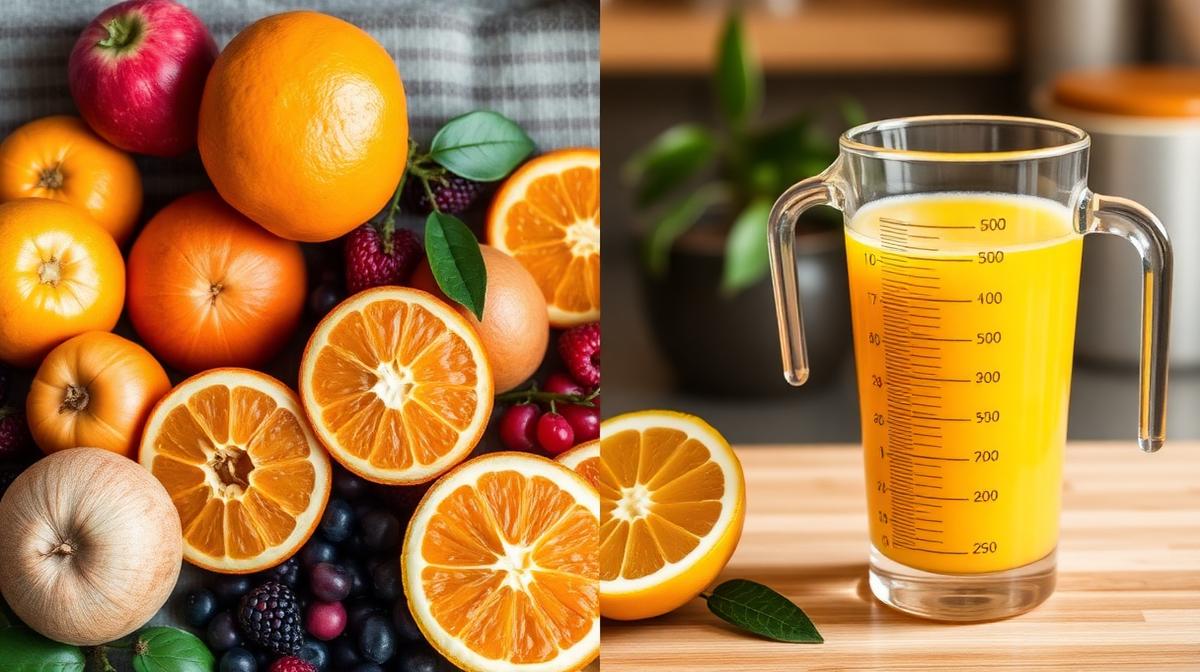
The difference between juice and fruit is not in taste, but in the kinetics of absorption. While with whole fruit your body has to work to extract energy, with juice you are giving it an "insulin bomb" that bypasses the natural defense mechanisms of digestion.
Why "Liquid Calories" Trick Your Metabolism and Brain
The conflict between whole fruits and juices is not cosmetic – it's fundamental to how your body processes energy. Whole fruit is a "controlled release," while juice is an "insulin bomb" that bypasses the natural digestive defenses.
📊 Comparative Matrix: System Analysis
| Characteristic | Whole Fruits | Freshly Squeezed Juice | Smoothie (Homemade) |
|---|---|---|---|
| Fiber (Pectin) | Full content | Lacking (0%) | Present (mechanically processed) |
| Sugar Absorption | Slow and steady | Extremely fast | Moderately fast |
| Satiety Signals | Maximum (chewing) | None | Low/Medium |
| Effect on Liver | Gentle | Taxing (fructose) | Moderate |
| Vitamin Density | Maximum | High (oxidizes quickly) | High |
🧬 In-depth Analysis of Mechanisms
1. Fructose and the Liver: The Concentration Problem
Unlike glucose, which every cell in the body can use, fructose is processed almost entirely by the liver.
💬 Simply put: This section looks at exactly how our body processes food at a cellular level. Imagine it like taking apart a clock to see how each gear works.
💬 Simply put: This explains why too much fructose at once is like flooding the liver with work – it can't cope and starts storing fat.
- Whole Fruit: Fiber slows down the influx of fructose. The liver has time to process it without stress.
- Juice: A huge amount of fructose hits the liver simultaneously. When its capacity is exceeded, it starts converting this sugar directly into triglycerides (fats), leading to fatty liver disease (steatosis).
2. Psychophysiology of Satiety
The brain doesn't "count" liquid calories the same way it does solid ones.
💬 Simply put: This section explores how our brain and body "understand" that we are full. It's like having sensors that say: "Enough, I'm full!"
- Cephalic Phase: The act of chewing activates hormones in the stomach and small intestine (like CCK and GLP-1) that tell the hypothalamus: "Stop, we're full."
- The Liquid Trap: Juice passes through the stomach almost instantly. By the time the brain registers that you've consumed 200 calories (from 3-4 oranges), you're already ready for your next meal.
🛡️ The Smoothie: A Technological Compromise
Recommended products
Frequently asked questions
Is freshly squeezed juice healthy?
Freshly squeezed juice contains vitamins but lacks fiber. Without fiber, fructose reaches the liver instantly, which can lead to elevated triglycerides and strain on the pancreas. It is better than packaged juices but significantly worse than whole fruit.
Is a smoothie healthier than juice?
Smoothies retain fiber, but mechanical breakdown ruptures cell walls, making sugar more accessible for rapid absorption. The high speed of the blender also oxidizes vitamin C. A smoothie is a compromise – better than juice, but less effective than whole fruit.
How much fruit per day is healthy?
Between 2 and 4 servings of whole fruit per day are considered optimal. The key rule is: do not drink more fruit than you could eat whole. If you cannot eat 4 oranges, do not drink the juice of 4 oranges.
When is it acceptable to drink juice instead of whole fruit?
Juice is justified immediately after strenuous exercise when you need fast carbohydrates to replenish glycogen. Also, in cases of temporary digestive problems when fiber is contraindicated. In all other cases, whole fruit is the better choice.