Vitamin C vs. Collagen: The Synthesizing Cofactor vs. The Structural Protein

Vitamin C is the "master," and Collagen is the "building material" for joints, tendons, and skin. Learn how to combine them for maximum benefits.
Short Answer: Vitamin C is an essential "activator" for collagen production in the body, while collagen supplements provide the direct "bricks" (amino acids) for building connective tissue. They don't compete; they complement each other. Practical advice: For optimal joint support, take 10-15g of hydrolyzed collagen along with 500-1000mg of Vitamin C, about 30-60 minutes before training.
In sports and fitness, we are constantly looking for ways to support our bodies, speed up recovery, and protect ourselves from injuries. When it comes to the health of joints, tendons, and skin, we often hear about Vitamin C and Collagen. Many think they work the same way, or that they compete, but the truth is different.
To build a strong structure that protects you from injuries, Collagen is the building material. Without it, there's nothing to build. Vitamin C, on the other hand, is the master builder. It's not part of the wall, but without its instructions, the bricks cannot form a strong and stable structure. It drives the whole process.
It's important to understand this difference to use these supplements correctly. Here, we will examine both supplements to help you decide when to take them separately, and when – most importantly – to combine them for the best effect on athletic performance and musculoskeletal health.
This article is part of the Expert Hub for Nutritional Supplements — over 270 expertly verified articles by Petar Mitkov and the Sport Zona team.
What is the relationship between Vitamin C and Collagen (Hydrolyzed)?
Vitamin C is a necessary vitamin, cofactor, and antioxidant that activates synthesis and protects against oxidative stress; while Collagen (Hydrolyzed) is a structural protein and signaling peptide that provides building blocks (amino acids).
| Criterion | Vitamin C | Collagen (Hydrolyzed) |
|---|---|---|
| Biological Role | Essential vitamin, cofactor, antioxidant | Structural protein, signaling peptide |
| Primary Function | Activates synthesis, protects against oxidative stress | Provides building blocks (amino acids) |
| Mechanism of Action | Activates prolyl and lysyl hydroxylase enzymes | Provides amino acids glycine, proline, and hydroxyproline |
| Timing of Action | Immediate (antioxidant), continuous (synthesis) | Long-term (weeks to months for structural changes) |
| Benefit for Athlete | Supports immunity, reduces inflammation, aids recovery | Strengthens tendons, joints, and cartilage; prevents injuries |
| Additional Bonus | Improves absorption of iron from plant sources | Improves skin, hair, and nail health |
What are the mechanisms of action of Vitamin C and Collagen?
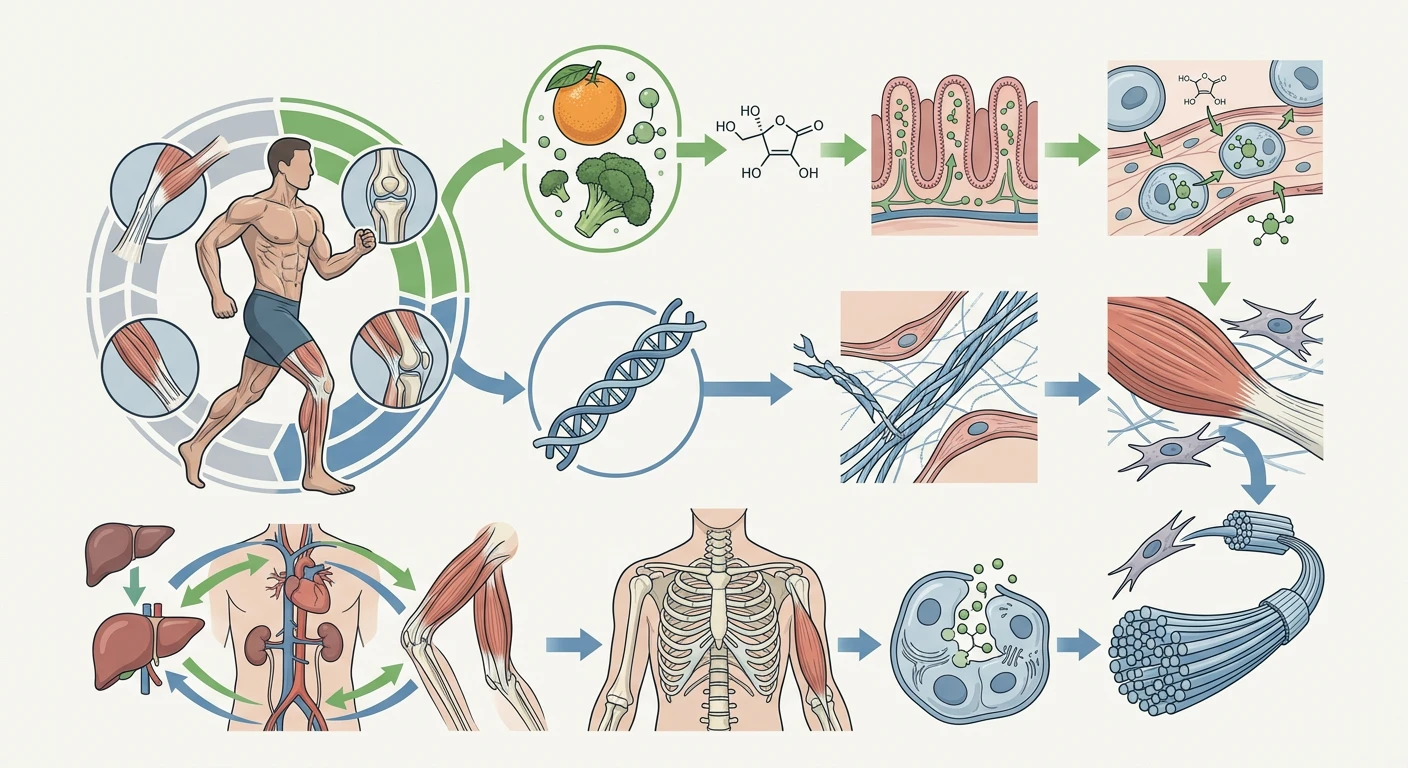
1. Vitamin C: The Antioxidant Engine
Vitamin C (ascorbic acid) is a key cofactor in collagen synthesis, stabilizing the collagen triple helix through the hydroxylation of proline and lysine amino acids, a process that requires the proper functioning of the prolyl hydroxylase and lysyl hydroxylase enzymes.
Without sufficient Vitamin C, the body cannot produce stable and functional collagen. This leads to weaker connective tissues, slow recovery, and a higher risk of injuries. Vitamin C is also a potent water-soluble antioxidant that neutralizes free radicals generated during intense training. These free radicals can damage collagen and accelerate tissue degeneration.
Simply put: Your body might have all the necessary amino acids for collagen, but without Vitamin C, it cannot "assemble" them into a strong structure. Vitamin C provides the instructions.
2. Collagen: The Direct Building Material
Collagen supplements, especially hydrolyzed ones (peptides), work differently. Taking hydrolyzed collagen provides more than just protein. These peptides are small enough to pass through the intestinal wall and enter the bloodstream. Thus, they reach tissues like joints, tendons, and skin.
There, they have two main functions. First, they deliver specific amino acids that are abundant in collagen but less common in other proteins – glycine, proline, and hydroxyproline. Second, these peptides act as signaling molecules. They bind to fibroblast receptors, stimulating them to produce more of their own collagen, hyaluronic acid, and elastin. Therefore, taking collagen doesn't just "fill gaps"; it activates the body's own regenerative mechanisms.
Simply put: Taking collagen peptides is like sending "bricks" to the construction site, along with a message to the workers to build faster.
Scientific Sources
- Shaw, G. et al. (2017). Vitamin C-enriched gelatin supplementation before intermittent activity augments collagen synthesis.
- Linus Pauling Institute, Oregon State University. Collagen and Skin Health.
- DePhillipo, N. N. et al. (2018). Efficacy of Vitamin C Supplementation on Collagen Synthesis and Oxidative Stress After Musculoskeletal Injuries: A Systematic Review.
- Examine.com. Collagen Supplementation Research Analysis.
- National Institutes of Health (NIH), Office of Dietary Supplements. Vitamin C: Fact Sheet for Health Professionals.
- Khatri, M. et al. (2021). The effects of collagen peptide supplementation on body composition, collagen synthesis, and recovery from joint injury...
The Synergistic Effect: Why Do They Work Better Together?
It's clear that the question is not "Vitamin C or Collagen?", but "How to use Vitamin C and Collagen together?". They don't compete; they collaborate. Combining them creates synergy, a stronger effect than either one alone.
Taking hydrolyzed collagen provides the body with amino acids for new tissues. With added Vitamin C, the enzymes that convert these amino acids into a strong collagen matrix work at their maximum. This is especially important for athletes whose recovery needs are high.
The study by Shaw et al. in 2017 in the "American Journal of Clinical Nutrition" is a good example. It shows that taking 15 grams of gelatin (a form of collagen) enriched with Vitamin C one hour before training significantly increased markers of collagen synthesis in the blood. This suggests that this combination, taken at the right time, can specifically support the recovery and strengthening of connective tissues stressed during physical activity.
How to choose between Vitamin C and Collagen for the best effect?
Choose Vitamin C if:
- You are looking for general antioxidant protection and immune system support.
- You have a limited budget but want to support natural collagen synthesis.
- You are already consuming foods rich in collagen (bone broth, gelatin) and want to optimize absorption.
- You want to improve iron absorption from a plant-based diet.
🔵 Choose Collagen if:
- You want direct support for the health of your joints, tendons, and cartilage.
- You have "creaky" or painful joints, or are recovering from a connective tissue injury.
- You want to improve skin elasticity and hydration.
- You are over 30 years old and want to counteract the natural decline in collagen production.
Recommended Stack for Athletes
The best effect on connective tissue health is achieved by combining 10-15 grams of hydrolyzed collagen (Type I & III) with 500-1000 mg of Vitamin C, about 45-60 minutes before training or rehabilitation exercises. This ensures peak concentration of building blocks and factors in the blood precisely when the load stimulates the tissues.
What is the protocol for the 2026 "Foundation and Performance Stack"?
The 2026 "Foundation and Performance Stack" protocol represents a two-step approach that provides consistent support and a targeted boost during training for optimal results.
- Daily Foundation: Take 250-500 mg of Vitamin C in the morning. This provides basic antioxidant protection and supports general metabolic processes throughout the day. It is not necessary to combine it with collagen.
- Pre-Workout Stack (on training days): 45-60 minutes before your main training session or rehabilitation session, take:
- Hydrolyzed Collagen: 15 grams
- Vitamin C: 500 mg
Expert Note: When to Expect Results?
Do not expect quick changes. Collagen metabolism is a slow process. While the antioxidant benefits of Vitamin C are almost immediate, structural changes in tendons and cartilage require consistency. Usually, the first subjective improvements (less pain, better joint "lubrication") are felt after 4-8 weeks of consistent intake, and objective structural changes can take 3-6 months. Be patient.
🧭 When to Choose What?
- Take Vitamin C only if your goal is basic antioxidant support and immunity on a limited budget.
- Take Collagen only if you have specific joint problems and are already consuming enough Vitamin C from your diet (citrus fruits, peppers, broccoli).
- Combine both if you are an active athlete, want to optimize recovery, protect your joints in the long term, and get the most benefit from each supplement.
📖 What are Vitamin C and Collagen?
Vitamin C (Ascorbic Acid): An essential water-soluble vitamin, it acts as an antioxidant and is a mandatory cofactor for the synthesis of collagen and carnitine.
Collagen: The most abundant protein in the human body, forming the main structure of skin, bones, tendons, cartilage, and all connective tissues.
⚖ Pros and Cons
| Pros | Cons |
|---|---|
| Vitamin C: Potent antioxidant, boosts immunity, low cost, improves iron absorption. | Vitamin C: Does not provide direct building blocks for collagen. High doses can cause stomach discomfort. |
| Collagen: Provides specific building peptides, specifically supports joints and skin, stimulates own production. | Collagen: Higher cost, requires longer intake for visible results, not a complete protein for muscle growth. |
🗣 Simply Explained: Construction Metaphor
If we compare the body to a construction project for healthy joints:
| Criterion | Vitamin C is... | Collagen is... |
| Role | The master builder who directs the process. | The bricks and mortar used for construction. |
| Action | Says "How to build". | Provides "What to build with". |
| Result without it | You have materials but can't assemble them. | You have a builder but no materials. |
Choose the right product for your goal:
- For structural support and joint health: Browse our Collagens
- For immunity and antioxidant protection: See our selection of Vitamins and Minerals
- For overall musculoskeletal health: Discover Joint Formulas
Combined protocol for maximum results:
⚖ When to choose Vitamin C
- You want to boost your immune system during heavy training periods.
- You aim for general antioxidant protection against training stress.
- Your budget is limited and you are looking for basic, yet effective support.
- You want to optimize the absorption of collagen from food (e.g., Bone Broth).
⚖ When to choose Collagen
- You have specific complaints in your joints, tendons, or cartilage.
- You are recovering from a connective tissue injury.
- You want to specifically improve the health and appearance of your skin.
- You are over 30-35 years old and seeking preventive care.
Expert Note from Sport Zona
In my practice with athletes, I find that the biggest problem is inconsistency. Many expect collagen to act like a painkiller – fast and immediate. This is a mistake. Collagen is a long-term investment in tissue structure, not a pre-workout product for instant effect. The combined intake with Vitamin C before training is a strategy that yields tangible results, but usually after at least 2-3 months of consistent intake, especially for chronically stressed areas like shoulders, knees, or elbows.
Frequently asked questions
Can Vitamin C and Collagen be taken together?
Yes, and it is highly recommended. Taking them together is more effective than separately. Vitamin C acts as a key cofactor in the process that allows the body to use the amino acids from collagen to build and repair its own tissues. Without sufficient Vitamin C, collagen synthesis is impaired.
Which is better for beginners - Vitamin C or Collagen?
For absolute beginners who want to cover their basic needs, Vitamin C is more fundamental as it is an essential vitamin with multiple functions. However, if the goal is specifically to improve the strength of joints, tendons, or skin, adding hydrolyzed collagen will provide a more direct and tangible result. The ideal option is the combination.
When is the best time to take Vitamin C and Collagen?
The optimal time for intake to support joints is about 30 to 60 minutes before training. This allows amino acids and Vitamin C to reach peak blood concentrations precisely when the load stimulates connective tissue, increasing their on-site absorption.
Are there side effects from taking Vitamin C or Collagen?
Both supplements are considered very safe. With Vitamin C, doses above 2000 mg per day can cause digestive upset such as diarrhea or heartburn. Collagen is well tolerated, with very rare cases of mild bloating or feeling of fullness. It is important to choose products from reliable manufacturers.
What is the recommended dosage of Vitamin C and Collagen?
For athletes, effective doses are: 10-20 grams of hydrolyzed collagen per day (type I, II, or a combination) and 500-1000 mg of Vitamin C. You don't need to worry about Vitamin C overdose within these limits, as it is water-soluble and the excess is excreted in the urine.