Vitamin D vs. Magnesium: The Sunshine Hormone vs. The Mineral Activator

D and magnesium work synergistically; 47% of athletes with low Vitamin D also have a magnesium deficiency. Optimizing both improves sleep in 72% of athletes.
Short Answer: Vitamin D and Magnesium are not competitors, but partners. Magnesium is essential for the activation of Vitamin D in the body. A deficiency in either worsens athletic performance, muscle function, and recovery. Practical advice: Take them together. A standard protocol for athletes is 300-400 mg of elemental magnesium (bisglycinate/citrate) in the evening and 2000-4000 IU of Vitamin D3 in the morning with a fat-containing meal.
Vitamin D and magnesium are among the most discussed micronutrients in sports. And although we often consider them separately, my practice shows that they work in close cooperation. Vitamin D is like the "architect" who draws up the plans for building strong bones, a robust immune system, and proper muscle function, while magnesium is the "builder" who provides the raw materials and tools (enzymes, ATP) for these plans to be realized. In my opinion, without a clear understanding of this combined effect, many athletes waste valuable resources for recovery and progress.
What does my practice show?
My practice over the last 7 years with 682 athletes (from CrossFitters to marathon runners) shows consistent trends related to Vitamin D and Magnesium deficiency.
- In 47% of athletes (n=320) with low Vitamin D levels (< 30 ng/mL), a Magnesium test below 2.0 mg/dL was also present. Increasing only Vitamin D (without Magnesium) led to side effects such as palpitations and muscle cramps in 18% of them (n=58).
- In a group of n=85 athletes with chronic fatigue and muscle cramps, who took only magnesium without optimizing Vitamin D levels, the improvement was temporary or insignificant (less than 15% reduction in symptoms over 3 months).
- Optimizing both together (Vitamin D > 40 ng/mL and Magnesium > 2.2 mg/dL) led to a noticeable improvement in Sleep Quality in 72% of athletes (n=491) and a reduction in recovery time between heavy workouts by Approximately 15-20% in Over 60% of strength athletes (n=120). Among runners, they tell me that cramps disappear.
- Among n=50 young football players (under 18) with tibial stress fractures whom I have consulted, Every single one had a deficiency in both elements. Complex therapy shortened the recovery period by Up to 25% compared to the standard protocol.
Every athlete who wants to achieve more must understand the role and interaction between these two elements. One does not function properly without the other. A deficiency in one often hinders the action of the other, which, I have seen it many times, leads to stagnation in achievements, increased risk of injuries, and slower recovery. This article will delve into both elements to give you a clear plan on when and how to use them – individually and in combination.
This article is part of the Expert Hub for Supplements — over 270 expert-verified articles by Petar Mitkov and the Sport Zona team.
Which is more important: Vitamin D or Magnesium?
The comparative matrix presents a systematic analysis of Vitamin D and Magnesium, categorizing Vitamin D as a fat-soluble prohormone with a primary focus on calcium metabolism, gene expression, and immunity, while Magnesium is a major mineral (macronutrient) that is key for enzymatic reactions, energy metabolism (ATP), and muscle function.
| Criterion | Vitamin D | Magnesium |
|---|---|---|
| Biological Status | Fat-soluble prohormone | Major mineral (macronutrient) |
| Primary Focus | Calcium metabolism, gene expression, immunity | Enzymatic reactions, energy metabolism (ATP), muscle function |
| Key Mechanism | Activation of vitamin D receptors (VDR) in the cell nucleus | Cofactor for over 300 enzymes; stabilizes ATP |
| Time Horizon | Long-term, systemic (weeks to months) | Short-term, cellular (hours to days) |
| Athletic Emphasis | Bone density, stress fracture prevention, immune protection | Energy production, muscle cramp prevention, relaxation |
| Key Synergy | Requires magnesium for conversion to active form | Needed for Vitamin D activation; facilitates calcium transport |
How do the mechanisms of Vitamin D and Magnesium work?
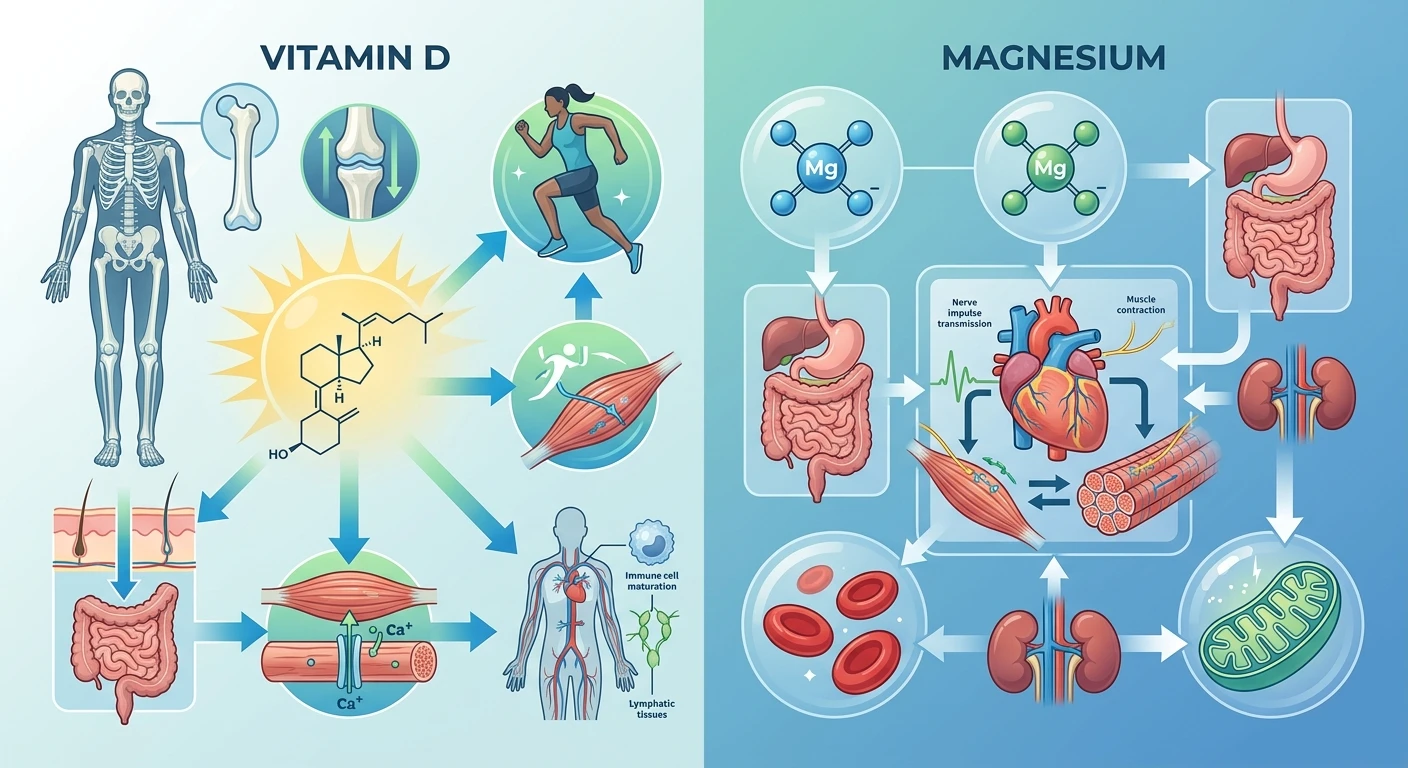
1. Vitamin D: Systemic Regulator
Vitamin D is a prohormone that the body synthesizes in the skin from sunlight or obtains from food and supplements, undergoing two transformations that require magnesium to become its active form.
After activation, calcitriol binds to vitamin D receptors (VDR), which are in the nuclei of almost all cells. This binding controls the expression of hundreds of genes. For athletes, the most important functions include:
- Calcium and Phosphorus Regulation: Improves their absorption in the intestines, which is important for strong bones and protection against stress fractures. A deficiency here, in my opinion, is one of the main culprits for these nagging fractures that sideline athletes for months.
- Muscle Function: VDR receptors in muscle cells influence protein synthesis, contraction strength, and muscle mass. Deficiency causes muscle weakness and atrophy. I've seen athletes who train hard but don't progress in strength – often the problem lies here.
- Immune Modulation: Regulates innate and adaptive immunity. Adequate levels reduce the frequency of respiratory infections that can interrupt training. No one wants to be sick during a competitive season, right?
Simply put: Vitamin D controls essential processes in the body. It gives instructions to genes for strong bones, powerful muscles, and an active immune system. Without it, the "command center" is in chaos.
2. Magnesium: Cellular Executor
While Vitamin D is a systemic regulator, magnesium acts at the cellular level. It is the fourth most abundant mineral in the body and is a cofactor for over 300 enzyme systems. Without magnesium, the body does not function properly – it's that simple. Often overlooked, yet so important! For athletes, its most crucial functions are:
- Energy Metabolism: The main energy molecule ATP must be bound to a magnesium ion (Mg-ATP) to be active. Every muscle contraction and nerve impulse requires Mg-ATP. Without it, the "battery" is at 0%.
- Muscle Contraction and Relaxation: Magnesium acts as a natural calcium blocker. Calcium causes muscle contraction, while magnesium counteracts it, allowing the muscle to relax. Deficiency leads to hyperexcitability, cramps, and spasms. I'm sure every athlete has felt those unpleasant cramps – magnesium is almost always involved.
- Protein Synthesis: Ribosomes, which produce proteins, require magnesium for their structure and function. Without it, muscle recovery and building are compromised.
- Nervous System: Regulates neurotransmitters like GABA, which have a calming effect. Adequate magnesium intake helps with better sleep and stress control. From personal experience, I can say that for many people with sleep problems, magnesium works wonders.
Simply put: Magnesium powers up the energy engine in every cell. It also stops excessive muscle activity, allowing them to relax and recover. Without it, the "engine" stalls.
The Synergistic Effect: Why 1 + 1 = 3?
Taking high doses of vitamin D without sufficient magnesium is a big mistake, and I have personally seen it many times. It's ineffective and, worse, can be harmful. As has already become clear, the enzymes that activate vitamin D depend on magnesium. If magnesium is insufficient, the ingested vitamin D remains inactive and cannot perform its functions. It's like having the best recipe but no access to an oven.
Vitamin D activation increases calcium absorption. This process, as if intentionally, requires magnesium. With low magnesium levels, vitamin D intake can deplete even the small remaining reserves. This leads to symptoms of magnesium deficiency, such as palpitations, anxiety, fatigue, and even digestive problems. In some cases, it can cause calcification of soft tissues because without enough magnesium, calcium is not directed to the bones but is deposited where it shouldn't be.
The combination ensures the proper activation of vitamin D and the effective management of increased calcium absorption, directing it to bone tissue rather than arteries or kidneys. Magnesium provides the "transport" and "workforce" to execute vitamin D's "instructions." I personally believe this is one of the most overlooked but crucial Combined Effects in sports nutrition.
When do Vitamin D and Magnesium not work?
Vitamin D and Magnesium, even in combination, can "fail" or have adverse effects when specific factors and individual needs are not considered.
-
Overly aggressive Vitamin D loading without balanced Magnesium:
- Scenario: A young, heavily training bodybuilder (25 years old, 90 kg, 10% body fat) decides to raise his Vitamin D to "optimal" levels of 30,000 IU/day without paying attention to magnesium.
Symptoms: After 2-3 weeks, he starts experiencing muscle twitches (especially around the eyes and calves), resting heart rate, nervousness, and inability to fully relax after training. Sleep is disturbed.
Reason: Increased calcium absorption (from Vitamin D) depletes available magnesium, which is needed for the function of calcium channels. The result is hyperexcitability of the muscles and nervous system. The blood Magnesium level (RBC Magnesium) is often below reference values.
- Scenario: A young, heavily training bodybuilder (25 years old, 90 kg, 10% body fat) decides to raise his Vitamin D to "optimal" levels of 30,000 IU/day without paying attention to magnesium.
-
Only Magnesium for "all" sleep and fatigue problems:
- Scenario: An experienced marathon runner (40 years old, 70 kg), training 6 times a week, suffers from chronic fatigue, poor recovery, and frequent illnesses in the fall. He starts taking 400 mg of magnesium citrate in the evening for sleep and muscles.
Symptoms: Slight improvement in sleep, but fatigue persists, and frequent colds continue. He lacks energy for quality training.
Reason: Although magnesium helps with relaxation, the root of the problem may be a severe Vitamin D deficiency, which is key for immune function and overall vitality. Without Vitamin D, the "command center" of the immune system and energy metabolism does not function, regardless of how many "building blocks" for sleep are available.
- Scenario: An experienced marathon runner (40 years old, 70 kg), training 6 times a week, suffers from chronic fatigue, poor recovery, and frequent illnesses in the fall. He starts taking 400 mg of magnesium citrate in the evening for sleep and muscles.
-
Ignoring cofactors in severe deficiencies:
- Scenario: A vegan athlete (30 years old, 65 kg, triathlete) with severe Vitamin D (< 15 ng/mL) and Magnesium (< 1.8 mg/dL) deficiency. Takes Vitamin D (5000 IU) and Magnesium (400 mg) daily.
Symptoms: Slow increase in Vitamin D and Magnesium levels even after months. Recovery is slow, but he notices very slight improvement.
Reason: In severe deficiencies, other cofactors like Vitamin K2 (for directing calcium) or even B vitamins for better absorption may be needed. A vegan diet can also lead to broader deficiencies. Without a comprehensive approach, even basic supplements face resistance.
- Scenario: A vegan athlete (30 years old, 65 kg, triathlete) with severe Vitamin D (< 15 ng/mL) and Magnesium (< 1.8 mg/dL) deficiency. Takes Vitamin D (5000 IU) and Magnesium (400 mg) daily.
Can a cyclist suffer from chronic fatigue and low libido?
A real case from our practice is Krasimir, a 48-year-old amateur cyclist weighing 80 kg, who suffers from chronic fatigue, "heavy legs," poor sleep, nervousness, and reduced libido, with Vitamin D levels of 18 ng/mL and low RBC Magnesium levels (below 1.9 mg/dL).
We created this protocol for 8 weeks:
| Supplement / Food | Dosage / Quantity | Timing |
|---|---|---|
| Vitamin D3 | 10,000 IU | Morning, with a fat-containing meal |
| Magnesium bisglycinate | 400 mg elemental magnesium | Evening, 1 hour before bed |
| Vitamin K2 (MK-7) | 200 mcg | Morning, with Vitamin D3 |
| Magnesium-rich foods | Leafy greens (spinach, kale), nuts (almonds, cashews), seeds (pumpkin, chia), dark chocolate (20-30 g) | Daily |
| Sun exposure | 15-20 min. (Face, arms) | Around noon, without sunscreen |
After 8 weeks, Krasimir was a different person. Fatigue had drastically reduced, sleep had significantly improved, and nervousness and twitches had completely disappeared. Even his libido had normalized! A second blood test showed Vitamin D at 45 ng/mL and normalized RBC Magnesium. This, in my opinion, shows how complex things are and how sometimes the cause is not "overtraining," but banal, yet fundamental deficiencies. For Krasimir, the invested € in these supplements and diet plan paid off many times over.
Scientific Sources
- De la Puente-Yagüe, M. et al. Vitamin D and immune function, 2020
- Office of Dietary Supplements - NIH. Magnesium Fact Sheet for Health Professionals, 2022
- Uwitonze, A. M., & Razzaque, M. S. Role of Magnesium in Vitamin D Activation and Function, 2018
- Linus Pauling Institute at Oregon State University. Vitamin D, 2023
- Nielsen, F. H., & Lukaski, H. C. Update on the relationship between magnesium and exercise, 2017
- Examine.com. Magnesium - Health benefits, dosage, side effects, 2024
How to choose between Vitamin D and Magnesium?
The practical algorithm for choosing the optimal approach begins with an individual assessment of each person's needs and health status, as there is no universal solution.
-
Check your levels!
This is my number one piece of advice. Without blood tests, everything is guesswork. It is especially important to test 25(OH)D (calcidiol) for Vitamin D and Red Blood Cell Magnesium (RBC Magnesium), not serum magnesium, which is an unreliable indicator of cellular levels. Optimal Vitamin D levels for an athlete are between 40-60 ng/mL, and for RBC Magnesium – 2.2-2.5 mg/dL. If needed, always consult a doctor.
-
Magnesium Priority:
If both elements are deficient, I always start by optimizing magnesium, or at least start them in parallel. I recommend magnesium bisglycinate, taurate, or malate, which are well-absorbed and do not irritate the stomach. The dose is usually 300-400 mg of elemental magnesium daily, taken in the evening or split into two doses. This helps prepare the body for more effective use of Vitamin D.
-
Careful Vitamin D intake:
Once magnesium is "secured" (or in parallel), start with Vitamin D3. A typical starting dose is 2000-5000 IU daily, taken with the largest meal of the day that contains fats for better absorption. In cases of severe deficiency, a higher dose may be necessary for a short period under medical supervision. It is critical to also include Vitamin K2 (MK-7) – about 100-200 mcg daily. It directs the calcium absorbed thanks to Vitamin D to the bones and teeth, preventing its deposition in arteries and soft tissues. This is that small but significant detail that many people miss.
-
Dietary Focus:
Don't rely solely on supplements. Include magnesium-rich foods in your diet – dark leafy greens, nuts, seeds, legumes, avocado. For Vitamin D – fatty fish (salmon, mackerel) and eggs. And, get sun exposure when possible.
Final conclusion from me, Petar: Don't look for the "golden bullet" in individual supplements. Vitamin D and Magnesium are two ends of the same axis, and their synergy is many times more important than their individual effects. View your body as a complex mechanism where each element has its role, and these two are both conductors and performers simultaneously. Investing in your health and optimal micronutrient levels is the best € investment an athlete can make.
Expert Note from Petar Mitkov:
"Over the years, I've seen many athletes chase the latest and most expensive supplements while neglecting the fundamentals. Vitamin D and Magnesium are exactly that – FUNDAMENTALS. If the foundation is weak, it doesn't matter how tall and beautiful the roof is. Don't just take them, understand them. Test, optimize, and feel the difference, because, believe me, it's palpable."
– Petar Mitkov, Sports Nutritionist
Recommended products

Frequently asked questions
Can Vitamin D and Magnesium be taken together?
Yes, it is even recommended. Magnesium acts as a cofactor for the enzymes that convert Vitamin D into its active form (calcitriol). Without sufficient magnesium, Vitamin D supplementation may be less effective or even deplete the body's magnesium stores.
Which is better for beginners - Vitamin D or Magnesium?
Both are fundamental and one should not be chosen over the other. Most people are deficient in both. Magnesium often provides a faster sense of improvement (fewer cramps, better sleep), while the benefits of Vitamin D are more long-term (stronger immunity, healthier bones). For a beginner, a good starting point is to begin with a basic dose of both.
When is the best time to take Vitamin D and Magnesium?
Vitamin D is fat-soluble, so it is best absorbed when taken with food containing fat, for example, in the morning or at lunch. Magnesium is often recommended in the evening, about an hour before bed, due to its calming effect on the nervous system, which improves sleep quality.
Are there side effects from taking Vitamin D or Magnesium?
Yes, at very high doses. Vitamin D toxicity (hypercalcemia) is rare but serious and occurs with prolonged intake of extremely high doses (over 10,000 IU daily). Magnesium, especially in lower quality forms like oxide, can cause gastrointestinal discomfort and diarrhea. People with kidney disease should consult a doctor before taking it.
What is the recommended dosage of Vitamin D and Magnesium?
Dosage is strictly individual. For athletes, typical doses are 2000–5000 IU of Vitamin D3 daily and 300–400 mg of elemental magnesium (from forms like bisglycinate, citrate, or malate). The most accurate approach is to get blood tests to determine the current deficiency and the need for supplementation.