Vitamin D vs. Vitamin K2: The Calcium Absorber vs. The Calcium Distributor

Vitamin D aids calcium absorption, and K2 directs it to the bones, preventing its deposition in arteries.
Short answer: Vitamin D is responsible for calcium absorption from food, and Vitamin K2 "directs" it to bones and teeth, preventing its accumulation in the arteries. They are not competitors, but an essential team. Taking high doses of Vitamin D without K2 can be risky. Practical advice: For optimal health and athletic performance, take 2000–4000 IU of Vitamin D3 daily along with 100–200 mcg of Vitamin K2 (in MK-7 form) with a fat-rich meal.
Vitamin D and vitamin K2 are two fat-soluble nutrients that often go hand in hand, especially when talking about bone and joint health. Although they work as a team, they have different functions. Many athletes take vitamin D for immunity and bone density, but often forget K2. It is K2 that ensures the benefits of vitamin D are directed correctly and safely in the body.
Vitamin D delivers calcium from the intestines into the blood. Without it, calcium cannot enter the system. Vitamin K2 takes this calcium from the blood and precisely directs it to bones and teeth, preventing its accumulation in soft tissues like arteries. Without K2, calcium can harm rather than help.
This article is part of the Expert Hub for Food Supplements — over 270 expertly verified articles by Petar Mitkov and the Sport Zona team.
Which is More Important: Vitamin D or Vitamin K2?
The comparative matrix represents a systematic analysis of Vitamin D and Vitamin K2, exploring their biological statuses, mechanisms of action, and influence on calcium, to understand their complex interaction.
| Criterion | Vitamin D | Vitamin K2 |
|---|---|---|
| Biological Status | Prohormone (steroid hormone) | Vitamin (cofactor for enzymes) |
| Main Focus | Calcium and Phosphorus Absorption | Calcium Distribution and Utilization |
| Mechanism | Binds to VDR receptors to increase intestinal calcium absorption. | Activates (carboxylates) proteins like osteocalcin and MGP. |
| Effect on Calcium | Increases blood calcium levels. | Directs calcium from the blood to bones and teeth. |
| Specific Bonus | Modulates the immune system and affects muscle function. | Protects against arterial calcification. |
| Primary Source | Synthesis in the skin upon sun exposure (UVB). | Fermented foods (natto), pasture-raised animal products. |
How Do the Mechanisms of Vitamin D and K2 Work?
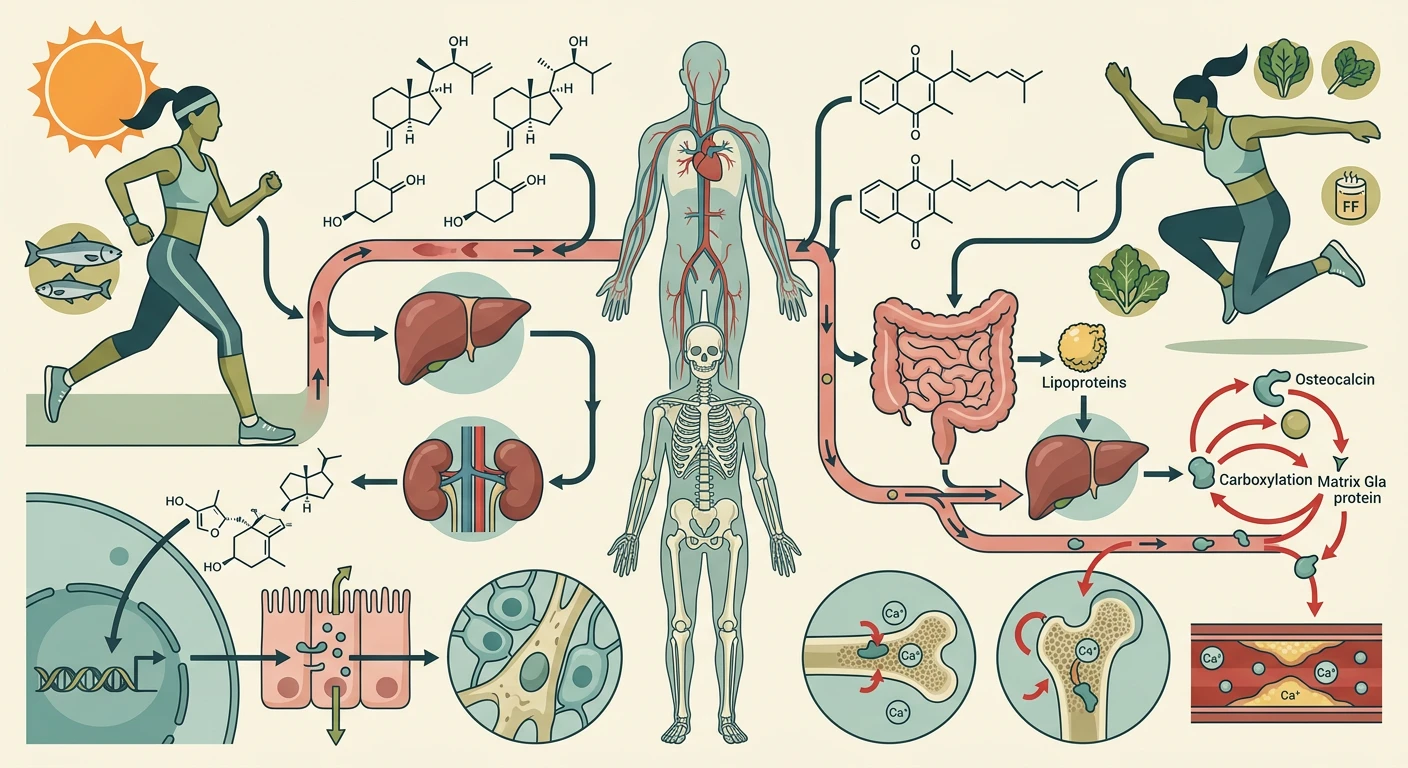
1. Vitamin D: The Calcium "Dispatcher"
Vitamin D, in its active form calcitriol, is a steroid hormone that maintains calcium balance. When calcium levels are low, it binds to vitamin D receptors in the small intestine, increasing the synthesis of calcium-binding proteins that transport calcium from food into the bloodstream.
Vitamin D modulates the immune system by affecting the activity of T-cells and macrophages. For athletes, this is important for reducing inflammation and rapid recovery. Some studies suggest a link between vitamin D levels and testosterone production, as well as muscle strength, but the mechanisms are still being clarified.
Simply put: Vitamin D opens the door through which calcium enters the bloodstream from food. Without it, calcium remains "outside" and the body cannot use it effectively.
2. Vitamin K2: The Calcium "Navigator"
Vitamin K2 (specifically the menaquinone-7 or MK-7 form) is a cofactor for the enzyme gamma-glutamyl carboxylase. This enzyme has one primary role: to "activate" certain proteins through a process called carboxylation. Two of the most important such proteins are:
- Osteocalcin: Produced by osteoblasts (bone-building cells). In its inactive form, it cannot bind calcium. After activation by vitamin K2, osteocalcin becomes a "glue" that incorporates calcium into the bone matrix, making bones dense and strong.
- Matrix Gla Protein (MGP): Found in the walls of blood vessels. When activated by vitamin K2, MGP binds to free calcium in the blood and actively prevents its deposition in the arteries, which would lead to their hardening (atherosclerosis).
Simply put: Vitamin K2 is the GPS system for calcium. It tells it: "Go to your bones and teeth!" and "Stay away from arteries and soft tissues!".
Scientific Sources
- The Synergistic Interplay between Vitamins D and K for Bone and Cardiovascular Health, 2017
- Vitamin D – Linus Pauling Institute, Oregon State University
- Vitamin K Fact Sheet for Health Professionals – National Institutes of Health (NIH)
- Vitamin K Research Analysis – Examine.com
- Proper Calcium Use: Vitamin K2 as a Promoter of Bone and Cardiovascular Health, 2015
- Vitamin D – The Nutrition Source, Harvard T.H. Chan School of Public Health
The Synergistic Effect: Why Do They Work Better Together?
Vitamin D and K2 work in combination – this is one of the clearest examples of nutrient synergy. High doses of vitamin D increase blood calcium levels. This helps bones, but only if the calcium reaches them. Without sufficient K2, this calcium can remain in the bloodstream and deposit in inappropriate places – most commonly in the arteries and kidneys. This creates the so-called "Calcium Paradox": osteoporosis (lack of calcium in bones) and atherosclerosis (excess calcium in arteries) can coexist.
When taken together, vitamin D provides the calcium, and vitamin K2 ensures it is used correctly by directing it to the bone matrix and keeping it away from the vascular system. This makes the D3+K2 combination both more effective and safer in the long run, especially for athletes who stress their musculoskeletal system.
What is the Optimal Ratio of Vitamin D3 to Vitamin K2?
Choose Vitamin D if:
- You live in northern latitudes with little sun in winter.
- You have a confirmed deficiency through a blood test (25-hydroxyvitamin D).
- You aim to support your immune system and overall health.
- You are looking for a foundational supplement for healthy bones and muscle function.
🔵 Choose Vitamin K2 if:
- You are already taking vitamin D (especially over 2000 IU/day) or calcium supplements.
- You have concerns about cardiovascular health or a family history.
- You want to optimize bone strength, not just density.
- Your diet is low in fermented foods and pasture-raised animal products.
Combined Intake for Maximum Results
For most active people and athletes, the optimal approach is the combined intake of Vitamin D3 (2000-5000 IU) to Vitamin K2 (MK-7, 100-200 mcg), which ensures both absorption and proper distribution of calcium in the body.
Should We Take Vitamin D and K2 Constantly?
Constant intake of vitamin D and K2, tailored to lifestyle, is necessary for better absorption and effectiveness.
- Daily (morning): 1 dose of a combined product with 4000 IU Vitamin D3 and 100-120 mcg Vitamin K2 (in MK-7 form). Take with a meal containing fats (eggs, avocado, nuts, olive oil) for better absorption.
- During winter months (October-March): The Vitamin D3 dose can be increased to 5000 IU daily, while the K2 dose remains the same.
- After intense training: No additional intake is needed immediately after training. The morning intake ensures stable levels throughout the day to support recovery processes and calcium metabolism.
Expert Note
Check your 25(OH)D blood levels at least once a year, at the end of winter. The goal is to maintain levels between 40-60 ng/mL (100-150 nmol/L). This gives you an objective baseline for dose adjustment. Vitamin D is fat-soluble and accumulates in the body, so a higher amount is not always better.
🧭 When to Choose What?
- Take Vitamin D only if you have a confirmed deficiency and want to address it as a first step, and your diet is rich in K2 sources (fermented products, organs).
- Take Vitamin K2 only if you already have adequate Vitamin D levels (confirmed by test) and are taking calcium supplements or want to focus on vascular health.
- Combine both in most cases. This is the safest and most effective approach for long-term bone and heart health, especially for athletes.
📖 What are Vitamin D and Vitamin K2?
Vitamin D is a group of fat-soluble prohormones. For humans, D3 (cholecalciferol) is the most important, synthesized in the skin under sunlight. It is responsible for calcium and phosphorus absorption in the intestines, as well as immune function.
Vitamin K is a group of fat-soluble vitamins. K1 (phylloquinone) is involved in blood clotting, while Vitamin K2 (menaquinone) is key for activating proteins that direct calcium to bones and prevent its accumulation in arteries. The most bioavailable form is MK-7.
🤔 What are the Pros and Cons of Vitamin D and Vitamin K2?
Vitamin D is easily accessible and well-researched, improves immunity and mood, and is key for muscle function. However, vitamin D carries a risk of toxicity at high doses, can lead to hypercalcemia without K2 intake, and requires consumption with fats. Vitamin K2 directs calcium correctly and protects arteries from calcification, but it interacts with anticoagulants, is less common in food, and the MK-4 form has a short half-life.
| Pros | Cons |
|---|---|
| Vitamin D | |
|
|
| Vitamin K2 | |
|
|
What is the role of Vitamin D and Vitamin K2 in building strong bones?
In building a strong bone system, Vitamin D acts as a calcium absorber, while Vitamin K2 is a calcium distributor to the bones.
- Vitamin D is the truck that brings the bricks (calcium) to the construction site. Without it, there is no material.
- Vitamin K2 is the master bricklayer who takes the bricks from the truck and builds them into the wall (bone). Without it, the bricks will remain scattered in the yard (arteries), creating chaos.
| Criterion | Vitamin D | Vitamin K2 |
|---|---|---|
| Metaphor | Construction Manager | GPS Navigator |
| Question Answered | "Is there enough calcium in the blood?" | "Where should this calcium go?" |
| Primary Action | Absorbs | Activates and Distributes |
What is the right product for your goal?
- For healthy bones and joints: D3+K2 Combination is essential.
- For a strong immune system: Quality Vitamin D3 is the foundation.
- ❤ For cardiovascular health: Combine K2 with Omega-3 for vascular protection.
Combined Protocol for Athletes
- Foundation (morning): Take Combined D3+K2 with food.
- Recovery: Post-workout protein shake with added calcium and magnesium.
- Synergy: Add Omega-3 to your evening meal for inflammation control.
⚖ When to Choose Vitamin D
- Your goal is to increase your levels from a confirmed deficiency.
- You want to boost your immune system during the winter season.
- You are looking for a foundational supplement for general health.
- Your diet is already rich in K2 (natto, foie gras, hard cheeses).
⚖ When to Choose Vitamin K2
- You are taking high doses of vitamin D (over 4000 IU) or calcium.
- You have concerns about calcium buildup in your arteries.
- You want to optimize your bone and teeth health.
- Your diet is predominantly plant-based or low in fermented foods.
Expert Note from Sport Zona
"The right product" is a D3+K2 combination (in a ratio of about 1000 IU D3 to 25 mcg K2), which ensures that the investment in vitamin D leads to absorption and prevents future health problems, especially when vitamin D levels remain low despite taking high doses due to a lack of cofactors like magnesium or K2.
Recommended products

Frequently asked questions
Can Vitamin D and Vitamin K2 be taken together?
Yes, it is not only safe but also highly recommended. They work in synergy – Vitamin D increases calcium absorption, and Vitamin K2 directs this calcium to the bones and teeth, instead of soft tissues like arteries. One without the other can lead to imbalance.
Which is better for beginners - Vitamin D or Vitamin K2?
Considering that Vitamin D deficiency is extremely common in Bulgaria, especially during the autumn-winter season, starting with Vitamin D3 is a priority. However, the best and safest approach is to take them together in a combined formula, even for beginners, to avoid potential risks of high blood calcium levels.
When is the best time to take Vitamin D and Vitamin K2?
Both vitamins are fat-soluble. For maximum absorption, take them with food containing healthy fats (e.g., with a breakfast of avocado, nuts, eggs, or lunch with olive oil). They can be taken at any time of the day, but it's good to take them at the same time every day to build a habit.
Are there any side effects from taking Vitamin D or Vitamin K2?
When following the recommended doses, side effects are extremely rare. Very high doses of Vitamin D (over 10,000 IU daily for a prolonged period) without adequate K2 intake can lead to hypercalcemia (high blood calcium levels). Vitamin K2 is considered practically non-toxic in recommended doses. People on anticoagulants (like warfarin) must consult a doctor before taking K2.
What is the recommended dosage of Vitamin D and Vitamin K2?
The general maintenance recommendation for active people and athletes is 2000–5000 IU of Vitamin D3 daily and 100–200 mcg of Vitamin K2 (preferably the MK-7 form due to its longer half-life). The exact dose depends on blood levels (test 25-OH Vitamin D), weight, and sun exposure. Always consult a specialist.