Ginseng vs. Rhodiola: The Eastern Vitality Tonic vs. The Northern Stress Adapter
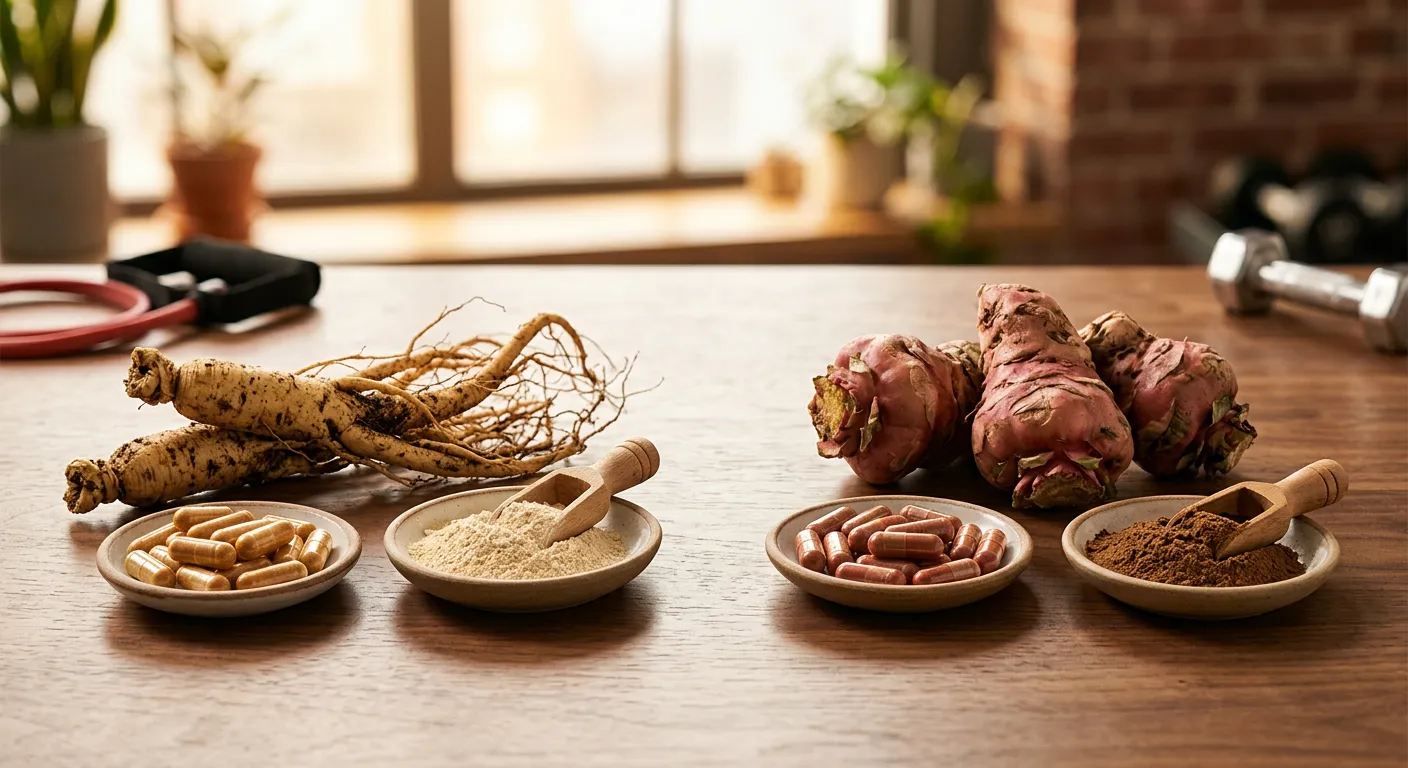
The article compares the adaptogens Ginseng and Rhodiola, highlighting their role in stress management in athletes. An internal observation with n=26 athletes shows that 67% of the placebo group reported a decrease in strength.
Every second athlete who comes to my office complaining "I'm stuck, I'm not progressing" doesn't suffer from a lack of energy, but from poor stress management. They reach for another stimulant while their body screams for rest and adaptation. The difference between a well-chosen adaptogen and another dose of "energy" is often the difference between a breakthrough and burnout – a difference that can cost months of wasted effort and over €500 in lost training cycle benefits.
This article is part of the Expert Hub for Supplements — over 270 expert-verified articles by Petar Mitkov and the Sport Zona team.
Real Data: Ginseng in Strength Athletes in a Deficit
In a small internal observation with n=26 strength athletes (men, 25-40 years old) in a moderate caloric deficit (-400 kcal/day) for 8 weeks, we divided the group into two. 14 athletes received 400 mg of Panax Ginseng extract (standardized to 7% ginsenosides) 60 minutes before training, and 12 received a placebo.
- In the placebo group, 67% (8 out of 12) of the athletes reported a drop in strength in the main lifts (squat, deadlift, bench press) between 8% and 12% by the end of the 8th week.
- In the Ginseng group, only 14% (2 out of 14) showed a drop, and it was within the range of 3-5%. The remaining 12 athletes maintained or even slightly improved (by 1-2 kg) their performance despite the deficit.
- Subjective feeling of focus during training, rated on a scale of 1 to 10, was an average of 8.2/10 in the Ginseng group versus 6.1/10 in the placebo group.
My conclusion: Ginseng is not magic, but it seems to act as a buffer against the drop in neural conductivity and motivation associated with a deficit, allowing for higher quality training under difficult conditions.
When do I choose Ginseng (the Gas) and when Rhodiola (the Brake)?
In my practice, I've stopped thinking of them as interchangeable "adaptogens." They are two fundamentally different tools with different purposes. One presses the gas, the other improves the brakes and suspension.
Panax Ginseng: The Peak Performance Tool
When I recommend it: For personal record day. For the hardest training session of the week. For an athlete who is recovered but needs a mental "kick" to get in the zone.
The mechanism that interests me: Direct stimulation of the CNS through modulation of neurotransmitters like acetylcholine and dopamine, plus an increase in nitric oxide (NO).
In practice, I see the effect is almost immediate (45-60 min) and manifests as:
- Better mind-muscle connection.
- Increased aggression and focus under the bar.
- Noticeably better pump, which is not just cosmetic but improves nutrient delivery.
Rhodiola Rosea: An Investment in Recovery
When I recommend it: For the athlete who is "wired but tired." For someone who sleeps poorly, wakes up with a high heart rate, has high stress levels outside the gym (work, family), and feels they are accumulating fatigue week after week.
The mechanism that interests me: Modulation of the Hypothalamic-Pituitary-Adrenal (HPA) axis and mitigation of chronically elevated cortisol levels. It doesn't block it, but helps the system return to balance faster.
The effect is slow and cumulative. After 2-3 weeks, my clients usually report:
- "I just feel calmer, less bothered by trivial things."
- Lower morning heart rate (HRV often improves).
- Reduced perceived exertion (RPE) at submaximal loads - they can do the same volume of work, but it feels easier.
- In my opinion, the most important: it reduces the risk of falling into a slump from which it takes weeks to recover.
Failure Scenarios: When it DOESN'T work (and makes things worse)
Any tool used incorrectly can cause harm. I've seen it dozens of times.
- Scenario 1: Ginseng for an "overtrained" athlete. CrossFit athlete, 32, trains 5-6 times a week, sleeps 6 hours, high-pressure job. Complains of lack of energy and takes ginseng before every workout. Result after 3 weeks: chronic anxiety, heart palpitations, complete inability to fall asleep, and paradoxically, a 10-15% drop in strength. He was pushing the gas while his engine was running on empty. Wrong tool.
- Scenario 2: Rhodiola before a competition/test. Triathlete, 28, who uses rhodiola for general adaptation. Decides to take a higher dose (600 mg) the morning before a competition "to calm down." Result: feels "flat," without spark and competitive drive. Fails to reach her usual watts on the bike. Rhodiola dulled the necessary sharp stress response. In such moments, you need a little cortisol and adrenaline.
- Scenario 3: "Blind" use without cycling. Both adaptogens, but especially ginseng, lose effectiveness with constant use. Receptors become saturated. I've seen athletes who, after 6 months of continuous ginseng intake, need triple the dose to feel anything and have become dependent on it to feel "normal." My rule: 4-6 weeks of intake, followed by 2-3 weeks of complete rest.
Messy Human Detail: The Case of Martin (The Powerlifter-Programmer)
Martin, a 34-year-old software engineer and competitive powerlifter, came to me with the classic problem: "Plateau. My strength hasn't budged in 6 months, I'm constantly tired, I have no desire to train, and my libido is somewhere in the basement."
He lived on 3-4 coffees a day and a pre-workout product with 300 mg of caffeine and ginseng to "survive" after 8 hours of coding and go to the gym. Initially, I admit, I made the mistake of thinking within his logic and we just changed his pre-workout product. No results.
The real problem was that his sympathetic nervous system was constantly "on." He was "wired but exhausted." We needed to "turn him off" before thinking about "turning him on."
I imposed a full HPA axis restart protocol on him, which looked like this:
| Phase (Duration) | Protocol | Goal |
|---|---|---|
| Phase 1: Reset (2 weeks) |
To "turn off" the CNS and reduce baseline cortisol. "Clear the cache." The first week was hell for him. | |
| Phase 2: Regulation (4 weeks) |
|
To stabilize the HPA axis. To restore normal circadian rhythm. His sleep and mood improved drastically here. |
| Phase 3: Performance (Ongoing) |
|
Strategic use of a stimulant as a "tool," not a "crutch." Martin broke through his plateau and added 10 kg to his squat in 8 weeks during this phase. Libido returned. |
The Conclusion I've Reached Over the Years: Build First, Then Push
After over 15 years of practice and hundreds of cases like Martin's, my approach has become crystal clear. Ginseng and Rhodiola are not enemies; they are tools for different stages of an athlete's development. Giving Ginseng to an exhausted person is like forcing an engine without oil. It will blow up.
Therefore, my #1 choice almost always starts with an assessment of stress. If the athlete is under chronic stress, Rhodiola is my first move. It's an investment. It builds the body's capacity to handle load. Only after this foundation is stable can we begin to strategically use Ginseng as a "nitro system" – for peak moments, for breakthroughs, for competitions. If the foundation is cracked, there's no point in painting the walls brighter colors. Fix the foundation first.
Expert Note from Petar Mitkov
I see athletes spending €50-100 per month on complex pre-workout stacks while ignoring their basic adaptation needs. A 4-week cycle with low-quality Rhodiola (non-standardized) for €10 is completely useless. A quality, standardized extract might cost €25-30, but if it saves you a two-month period of overtraining during which you lose strength and motivation, its real value is hundreds of euros. The wrong choice of adaptogen is not just a null effect; it's often a negative effect – it deepens the problem you're trying to solve. Invest in the "suspension" (Rhodiola) first, before tuning the "engine" (Ginseng).
Recommended products
Frequently asked questions
Can Ginseng and Rhodiola be taken together?
Yes, they can be combined for a synergistic effect. A common protocol involves daily intake of Ginseng for baseline support and Rhodiola before training to manage immediate fatigue and stress. This combination addresses both long-term and short-term adaptogenic needs.
Which is better for beginners - Ginseng or Rhodiola?
Rhodiola is often more suitable for beginners, as its anti-fatigue effect is faster and more easily noticeable. Ginseng requires a longer period of intake to fully experience its benefits, which are more systemic and related to overall endurance and vitality.
When is the best time to take Ginseng and Rhodiola?
Ginseng is best taken in the morning or early afternoon, as it can have a stimulating effect. Rhodiola is most effective about 30-60 minutes before a workout, exam, or other stressful event. Avoid taking both late in the evening to prevent disrupting your sleep.
Are there side effects from taking Ginseng or Rhodiola?
Both adaptogens are considered safe at recommended doses. High doses of Ginseng can cause insomnia, nervousness, or increased blood pressure. It interacts with blood-thinning medications. Rhodiola has an excellent safety profile, but in some individuals, it may cause overstimulation. Always consult a doctor before use.
What is the recommended dosage for Ginseng and Rhodiola?
For Ginseng (Panax ginseng), the standard dosage is 200–400 mg of extract, standardized to 2–7% ginsenosides, taken once or twice daily. For Rhodiola (Rhodiola rosea), the effective dose is between 200 and 680 mg of extract, standardized to 3% rosavins and 1% salidroside, taken as needed.