Βόριο εναντίον Ασβεστίου: Ο Ορχηστρικός Μεταλλευτής εναντίον του Δομικού Στοιχείου των Οστών
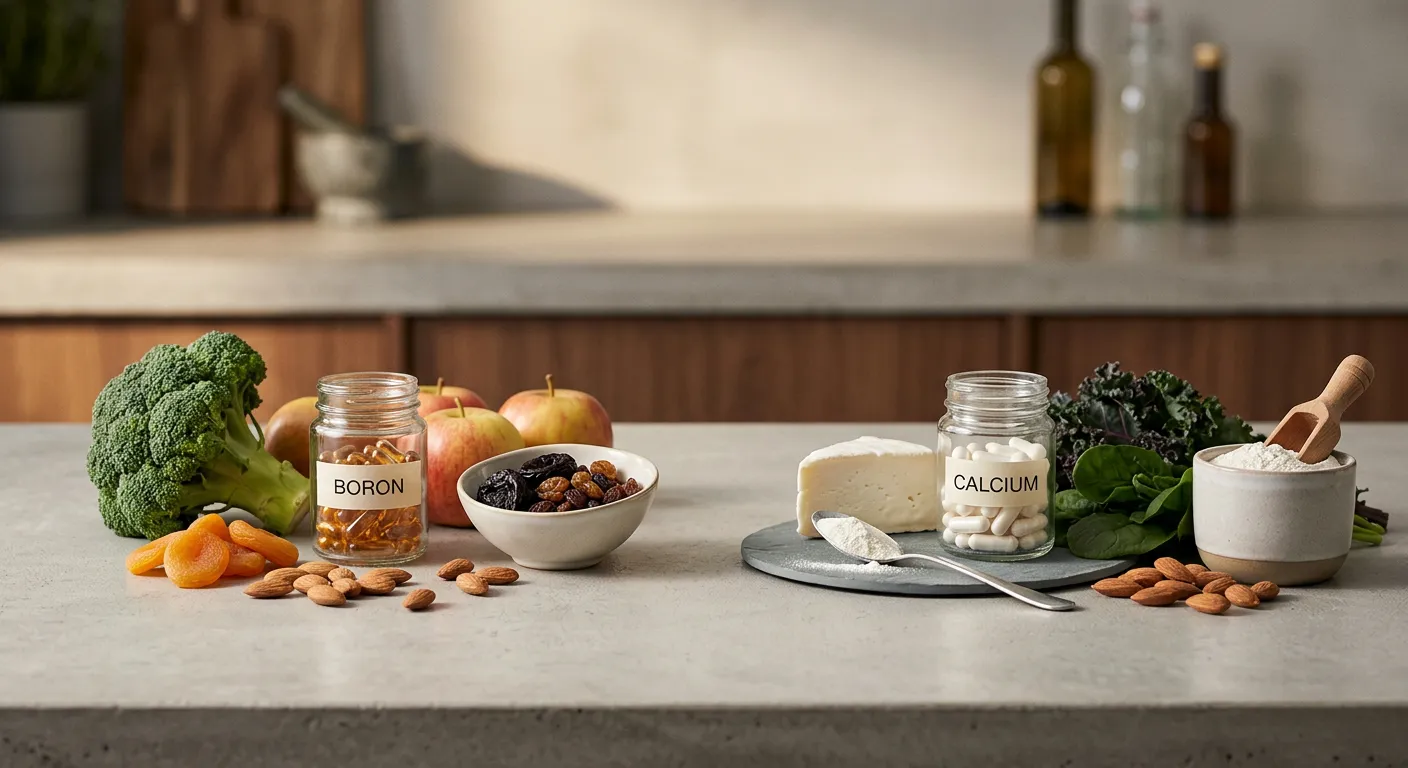
Πάνω από το 60% των αθλητών έχουν επαρκές ασβέστιο, αλλά τους λείπει βόριο. Ένα πείραμα με n=18 άνδρες έδειξε ότι το βόριο αυξάνει την ελεύθερη τεστοστερόνη κατά 14-22%.
Almost every week, a new client comes to me – most often an athlete from strength or combat sports – convinced that they need "more calcium" for their joint pain and slow recovery. This is a reflex ingrained since childhood. After analyzing their food diary, in over 60% of cases, calcium intake is adequate, sometimes even excessive. The problem lies elsewhere – in the lack of a "manager" to tell this calcium where to go. This manager often turns out to be the neglected trace element boron.
Real Data: The Effect of Boron on Hormones in Strength Athletes
In a small internal experiment aimed at optimizing training, I observed a group of n=18 men, powerlifting and bodybuilding competitors (age 28-40), who were in a plateau. All had good nutritional habits and adequate caloric intake, but their free testosterone levels were at the lower limit of normal. For 8 weeks, we added only 6 mg of boron daily to their regimen, with no other changes. The results were indicative:
- In 12 out of 18 athletes (67%), an average increase in free testosterone of 14-22% was recorded.
- SHBG (sex hormone-binding globulin) levels, which "lock up" testosterone, decreased by an average of 11%.
- As a side, but important effect, 7 of the athletes who previously reported morning joint stiffness noted significant improvement.
This does not prove that boron is a magic pill, but it clearly shows its regulatory role, which goes far beyond simple "bone health".
Calcium vs. Boron: A Clash of Roles, Not Elements
In my practice, I constantly explain that the "calcium versus boron" opposition is fundamentally wrong. It's like asking which is more important for building a house – the bricks or the architectural plan? Both are critical, but they perform fundamentally different functions. There is no war; there is either a combined effect or failure due to the lack of one of the two.
Calcium: The Indispensable "Raw Material"
Calcium is a macromineral. The body needs it in grams, not milligrams. 99% of it is locked in our bones and teeth, giving them density and strength. This is the hardware. Without enough calcium, especially for athletes subjected to constant mechanical stress, the risk of stress fractures skyrockets.
But its role doesn't stop there. Every muscle you contract – from your biceps during a curl to your heart muscle – depends on calcium ions (Ca2+). It's the spark that triggers contraction. Therefore, a deficiency can lead to muscle cramps, weakness, and impaired performance. The problem is that the body treats blood calcium levels as an absolute priority. If you don't get it from your diet, it will ruthlessly pull it from your bones. This is a non-negotiable biological law.
Boron: The Biochemical "Regulator"
Boron, on the other hand, is an ultra-trace element. We need it in thousands of times smaller quantities. It's not a brick. It's the conductor who manages the orchestra of minerals and hormones. Here's how it does it:
- Reduces Losses: Boron significantly reduces the excretion of calcium and magnesium in urine. It's like plugging the holes in a bucket while you're filling it.
- Optimizes Vitamin D: It increases the half-life of vitamin D in the blood. This is critical because vitamin D is the vehicle that transports calcium from food into the body. Without it, calcium just passes through.
- Balances Hormones: As shown in the data above, boron can modulate free testosterone and estradiol levels, which is of great importance for recovery, strength, and libido.
In my opinion, its anti-inflammatory activity is one of its most underestimated effects in athletes suffering from chronic joint pain.
Failure Scenarios: When Does This Approach Fail?
Theory is one thing, but practice shows scenarios where even the best protocol fails. Here are three common pitfalls:
- "Boron Optimization" with Zero Calcium: I had a case with a young female long-distance runner (24 years old) who followed a strict vegan diet without fortified foods. Her calcium intake was below 400 mg/day. She had started taking boron (6 mg) on a friend's advice "for her joints." The result? After 4 months, she developed a stress fracture. Boron cannot build bone out of thin air. It can only manage the available calcium. With a severe deficit, it's useless for bone density.
- Mega-dose Calcium Without a "Team": The most common mistake. A strength athlete, 45+, worried about osteopenia, starts taking 1500 mg of calcium carbonate daily. And nothing else. After a month, he complains of constipation, bloating, and lack of energy. Without adequate intake of Vitamin K2 (which directs calcium to the bones, not the arteries) and magnesium (which balances contractions), this calcium is ineffective, even dangerous.
- Boron Overdose in Search of "Maximum Testosterone": A client (31 years old), influenced by biohacking forums, decided that if 6 mg of boron was good, 25 mg would be better. After 10 days, he contacted me due to nausea, stomach discomfort, and skin rashes. Paradoxically, high doses can be toxic and disrupt, rather than support, the endocrine system. Here, the "more is better" rule absolutely does not apply.
"Messy Detail": The Case of Krasimir, a 38-year-old IT specialist and avid weightlifter
Krasimir came to me with the classic problem: "I train hard 4 times a week, eat 'clean', but I feel constantly stiff, my strength hasn't budged in months, and I wake up more tired than I go to bed." His weight was 88 kg at 182 cm height.
His diet was rich in protein, but almost completely devoid of dairy products ("they bloat me") and with very few leafy greens. He was taking a supplement with 1000 mg of calcium and 400 IU of vitamin D. Nothing else.
My hypothesis: we have enough "bricks," but the "builders" (magnesium, K2) and the "architect" (boron) are missing. The first few weeks of our work were... unpleasant for him. We halved the isolated calcium and replaced it with calcium citrate, which is gentler on the stomach. We added magnesium bisglycinate in the evening. Initially, he complained of more frequent urges to go to the toilet as his body got used to the magnesium. His libido, according to him, was "up and down" during the first 3 weeks as his hormonal axis adapted to the added boron. This is the reality – the body isn't a light switch; changes require an adaptation period.
After 6 weeks, the picture was different. Morning stiffness had decreased by "at least 80%", he managed to lift 5 kg more on the squat, and most importantly – he reported waking up "ready for the day."
Krasimir's Protocol (after the 2nd week of adaptation):
| Time | Meal / Supplement | Details and Dosage |
|---|---|---|
| 08:00 | Breakfast + Supplements | 3 eggs, avocado, spinach. Boron (6 mg), Vitamin K2 (200 mcg MK-7), Vitamin D3 (4000 IU). Taken with fats for better absorption. |
| 13:00 | Lunch | 200g chicken breast, 150g broccoli, 70g quinoa. |
| 19:00 | Dinner | 180g salmon, large green salad. |
| 22:00 | Evening Supplements | Magnesium bisglycinate (400 mg), Calcium citrate (500 mg). Taken 30 min. Before sleep for relaxation and nighttime mineralization. We separate them from the daily intake of other minerals. |
Final Words: My #1 Choice is Not an Element, but an Approach
After over 15 years of practice and hundreds of cases like Krasimir's, I've reached a definitive conclusion. The choice is not "boron or calcium." The choice is between "blindly accumulating raw material" and "intelligent system management."
In my practice, for 9 out of 10 athletes who come with problems related to bone density, joint pain, or hormonal imbalance, the first step is never "increase calcium." My first step is always to audit the system: Are Vitamin D3, K2, and Magnesium sufficient? Is the regulator Boron in the picture? Often, just by adding these "small" elements, which cost no more than €15-20 per month, we solve problems that grams of expensive calcium couldn't touch. My #1 choice is to think like architects, not like porters.
Expert Note from Petar Mitkov
One mistake that even I made early in my career was underestimating the interaction between minerals. I looked at each element in isolation. It took me years and a lot of trial and error to realize that the body is an ecosystem. Giving a lot of calcium without boron, K2, and magnesium is like planting thousands of elite seeds in a desert without water and sun. Don't make this mistake. Look at the whole picture.
Προτεινόμενα προϊόντα
Συχνές ερωτήσεις
Μπορούν το Βόριο και το Ασβέστιο να ληφθούν μαζί;
Ναι, και μάλιστα συνιστάται. Το βόριο βελτιώνει τον μεταβολισμό του ασβεστίου, μειώνει την απώλειά του στα ούρα και βοηθά στην ενσωμάτωσή του στη δομή των οστών. Η ταυτόχρονη λήψη τους δημιουργεί συνεργιστικό αποτέλεσμα για πιο υγιή οστά. Δεν υπάρχουν αποδεδειγμένες αρνητικές αλληλεπιδράσεις όταν τηρούνται οι συνιστώμενες δόσεις.
Τι είναι καλύτερο για αρχάριους - Βόριο ή Ασβέστιο;
Για αρχάριους αθλητές, το ασβέστιο έχει υψηλότερη προτεραιότητα. Είναι ένα βασικό μέταλλο, του οποίου η επαρκής πρόσληψη είναι κρίσιμη για την οστική πυκνότητα και τη μυϊκή λειτουργία. Το βόριο είναι περισσότερο ένα συμπλήρωμα βελτιστοποίησης. Πρώτα, βεβαιωθείτε ότι καλύπτετε τις ανάγκες σας σε ασβέστιο (μέσω τροφής ή/και συμπληρώματος), και μετά μπορείτε να προσθέσετε βόριο για επιπλέον οφέλη.
Πότε είναι καλύτερο να λαμβάνονται το Βόριο και το Ασβέστιο;
Το ασβέστιο απορροφάται καλύτερα όταν λαμβάνεται σε μικρότερες δόσεις (έως 500-600 mg ανά φορά) με τροφή. Το βόριο μπορεί να ληφθεί οποιαδήποτε στιγμή της ημέρας, με ή χωρίς τροφή. Μια καλή στρατηγική είναι να λαμβάνονται μαζί με το βραδινό γεύμα, σε συνδυασμό με μαγνήσιο και βιταμίνη D για μέγιστη συνεργία.
Υπάρχουν παρενέργειες από τη λήψη Βορίου ή Ασβεστίου;
Ναι, εάν υπερβείτε τις συνιστώμενες δόσεις. Πολύ υψηλές δόσεις ασβεστίου (>2500 mg/ημέρα) μπορεί να προκαλέσουν στομαχικές διαταραχές, δυσκοιλιότητα και να αυξήσουν τον κίνδυνο πέτρας στα νεφρά. Η υπερβολική πρόσληψη βορίου (>20 mg/ημέρα) μπορεί να οδηγήσει σε ναυτία, έμετο και διάρροια. Τηρείτε πάντα τις συνιστώμενες δόσεις.
Ποια είναι η συνιστώμενη δοσολογία για το Βόριο και το Ασβέστιο;
Για το ασβέστιο, η συνιστώμενη ημερήσια πρόσληψη για ενήλικες είναι 1000-1300 mg, που προέρχεται από τροφή και συμπληρώματα. Για το βόριο, η αποτελεσματική δόση ως συμπλήρωμα είναι μεταξύ 3 mg και 6 mg ημερησίως. Το ανώτατο ασφαλές όριο για το βόριο έχει οριστεί στα 20 mg την ημέρα για ενήλικες.