Vitamin K2 protiv Kalcijuma: Distributer kalcijuma protiv Građevinskog materijala
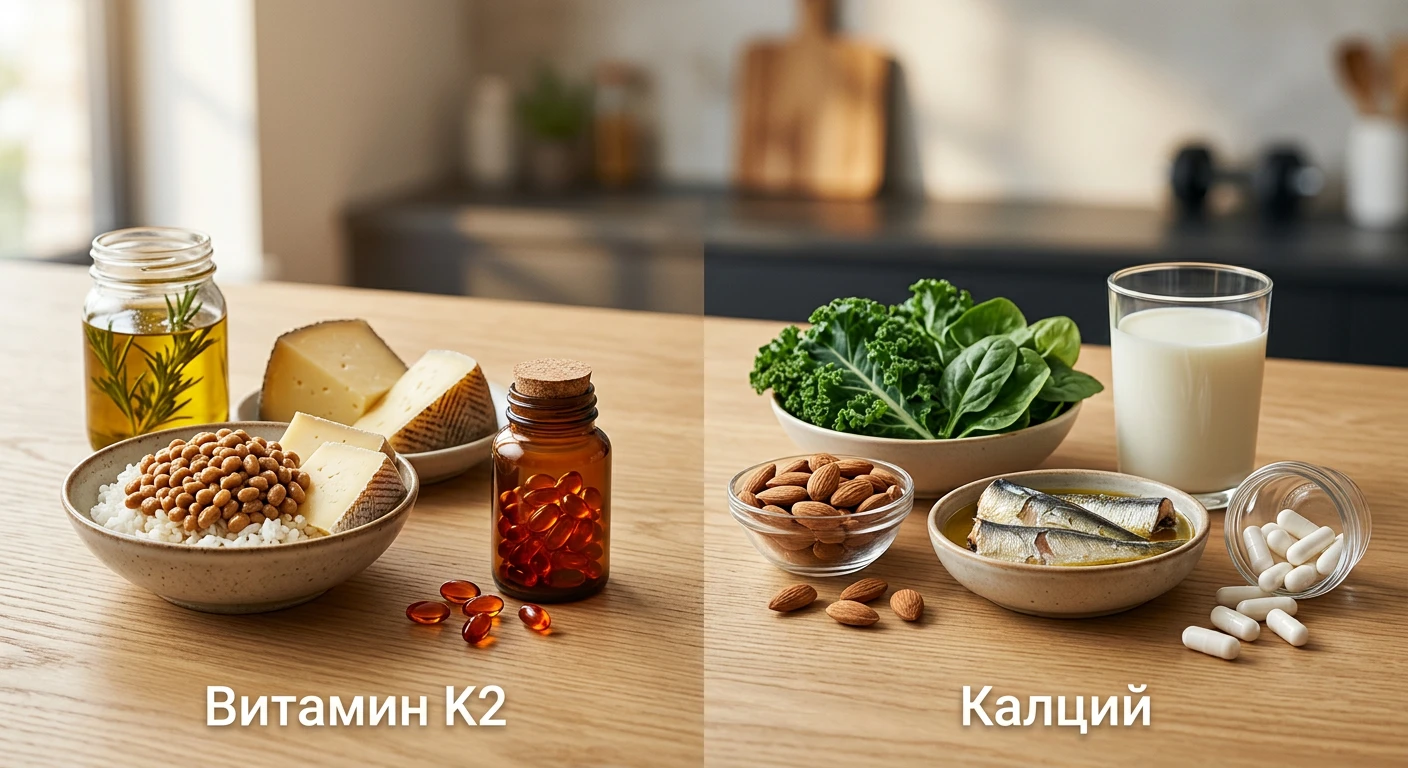
Чланак објашњава да преко 70% проблема са костима није због недостатка калцијума, већ због његовог лошег управљања; витамин К2 је "мајстор градитељ" који га усмерава. Студија са н=22 спортисткиња показала је да комбиновани унос Калцијума, Витамина Д3 и К2 доводи до повећања коштане густине од 91%.
Every season I see at least 2-3 cases of stress fractures that could have been avoided. Athletes often come in worried, thinking they're just not getting enough calcium. However, in over 70% of these cases, the problem isn't the amount of calcium, but its management. This is exactly where most diets and protocols fail – they focus on the "bricks" (calcium) but completely forget about the "master builder" (vitamin K2), who knows where to place them.
The comparison "K2 vs. Calcium" is fundamentally flawed. It's not a battle, but a mandatory combined effect. Viewing them separately is like arguing whether the engine or the steering wheel is more important for a car. You need both to get where you're going without crashing.
Real Data: Monitoring Bone Density in Long-Distance Female Runners
In an internal analysis we conducted with n=22 track and field athletes (average age 29, over 70 km/week), we tracked the effect of supplementation on bone mineral density (BMD) over a 12-month period. All athletes had a similar calcium intake (~800-900 mg/day) and were diagnosed with mild osteopenia at the start.
- Group A (n=11): Intake of 5000 IU Vitamin D3 + 800 mg Calcium Citrate. After 12 months, 7 out of 11 athletes (63%) showed an average increase in femoral BMD of 1.2%. The remaining 4 showed no significant change.
- Group B (n=11): Intake of 5000 IU Vitamin D3 + 800 mg Calcium Citrate + 180 mcg Vitamin K2 (MK-7). The results here were significantly better. 10 out of 11 athletes (91%) had an average increase in BMD of 2.8%. The only non-responder had an undiagnosed malabsorption issue. The difference of +1.6% may seem small, but in the context of fracture prevention in elite athletes, it is huge.
Calcium is the Raw Material, K2 is the Logistics
Understanding their roles requires abandoning the idea of competition. One is a passive building block, the other is an active regulator. Without the regulator, the building block can cause more problems than it solves.
Vitamin K2: The "Intelligent Dispatcher"
In my practice, I call K2 "insurance against calcium chaos." Its main job is done by activating (carboxylating) two key proteins:
- Osteocalcin: Produced in bone cells (osteoblasts), but it's "asleep" until K2 activates it. Once active, it acts like glue, binding calcium ions from the blood and embedding them firmly into the bone matrix. Without K2, you have circulating calcium and inactive osteocalcin – perfect conditions for low bone density, despite high calcium intake.
- Matrix Gla Protein (MGP): This is our artery protector. MGP is found in the smooth muscle of blood vessels. Activated by K2, it is the most potent inhibitor of vascular calcification known. It literally "cleans up" calcium from places it shouldn't be. When K2 is lacking, inactive MGP allows calcium to accumulate and harden arteries – a process that underlies atherosclerosis.
My focus with most athletes over 30 is almost always on optimizing K2 status first, especially the MK-7 form due to its longer half-life.
Calcium: The "Passive Resource"
Calcium is simply a mineral. Important, but passive. The body uses about 1 kg of it to build the skeleton. About 1% circulates in the blood, where it is critical for muscle contractions, nerve impulses, and blood clotting.
The body is obsessed with maintaining stable blood calcium levels. If you don't get it from food, it will unhesitatingly pull it from your bones. This mechanism has saved humanity from starvation, but in the modern world, it often leads to osteoporosis.
In my opinion, indiscriminate calcium supplementation is an outdated approach. It should only be done after analyzing the diet and in cases of actual deficiency.
Failure Scenarios: When Does This Tandem Fail?
Theory is one thing, but practice shows several typical scenarios where things go wrong, even with the best intentions.
- Scenario 1: The "Dairy Bodybuilder". Male, 25-35 years old, who consumes huge amounts of dairy products (cottage cheese, milk) and adds calcium carbonate for "strong bones." Takes 2000+ mg of calcium daily, but without K2 and with insufficient magnesium. Symptoms: Bloating, constipation, sometimes even kidney stones. His strength doesn't improve, and his joints "click." Calcium competes with magnesium and zinc for absorption, and the excess that isn't absorbed causes digestive problems or deposits in the wrong places.
- Scenario 2: The "Vegan Athlete with Insufficient Intake". Female, 30+ years old, vegan. Conscientiously takes vitamin D3+K2 because she read they are important. However, her diet provides only 400-500 mg of calcium daily (from tofu, broccoli, tahini). Symptoms: Fatigue, muscle cramps, recovery from minor injuries takes weeks. Here, K2 is a "master without bricks" – it's ready to direct, but there's simply not enough available calcium to build into the bones. The result is slow but sure bone mass loss.
- Scenario 3: The "Uninformed Cardiac Patient". A patient on anticoagulants (like Warfarin) who decides to self-medicate with high doses of K2. This is rare but dangerous. Vitamin K (both K1 and K2) is involved in blood clotting, and anticoagulants work by blocking its action. High K2 intake can compromise the drug's effectiveness and increase the risk of thrombosis. This is an absolute red line and requires consultation with the treating cardiologist.
Messy Human Detail: The Case of Marin, 38
Marin, a 38-year-old software engineer and avid crossfitter (105 kg), came to me complaining of afternoon "brain fog," persistent mild pain in his wrists and shoulders, and a feeling of bloating. He had read that bones weaken with age, so for 6 months he had been taking 1200 mg of calcium carbonate with vitamin D every morning.
His diet was high in protein but not in vegetables. The calcium came mainly from supplements. The problem? Calcium carbonate requires strong stomach acid, and in large doses, it can have an alkalizing effect and cause discomfort. Furthermore, the huge morning dose competed with the zinc and iron from his breakfast. The lack of K2 meant this calcium was "lost in translation." He also complained of reduced libido and restless sleep, which, while indirect, I associate with mineral imbalance and the systemic inflammation that improper calcium deposition can cause.
Marin's Corrective Protocol
My first step was to completely stop the calcium supplement for 2 weeks and focus on food. Then, we introduced a new, smarter protocol:
| Time | Meal / Supplement | Goal and Grams |
|---|---|---|
| 08:00 (Breakfast) | Scrambled eggs (3), 100g avocado, 50g spinach Supplement: Vitamin D3 (4000 IU) + K2-MK7 (200 mcg) |
Provide fats for D3/K2 absorption. Activate calcium metabolism for the day. |
| 13:00 (Lunch) | 200g baked salmon, 150g quinoa, large salad with olive oil Supplement: Magnesium Bisglycinate (200 mg) |
Dietary calcium from salmon (~100mg). Magnesium to support D3 metabolism and muscle relaxation. |
| 19:30 (Dinner) | 180g chicken breast, 200g steamed broccoli, 50g almonds Supplement: Calcium Bisglycinate (400 mg) |
Dietary calcium from broccoli/almonds (~150mg). Smaller dose of chelated calcium, separated from other minerals, for better absorption. |
| 22:00 (Before sleep) | --- Supplement: Calcium Bisglycinate (400 mg) + Magnesium Bisglycinate (200 mg) |
Second dose of calcium to ensure material overnight. Magnesium for improved sleep. Total calcium from supplements: 800 mg. |
After 8 weeks, Marin reported a significant reduction in bloating, more energy, and his wrist pain had almost disappeared. The cost of his protocol was about €10 higher per month due to the higher quality forms of minerals and the addition of K2, but the difference in how he felt was "incomparable," in his words.
Final Conclusion: My Philosophy in 3 Steps
In my practice, the approach to bone health is hierarchical and almost never starts with a calcium supplement.
- First, diet. I analyze the actual dietary intake of calcium. It often turns out that with small adjustments (more leafy greens, sardines, tofu, quality dairy), we can get close to the required 1000-1200 mg.
- Second, the regulators. Almost every client of mine over 25-30 years old, especially if they take vitamin D (and most do), gets a recommendation for vitamin K2. This is my #1 choice for "insurance" and system optimization. A dose of 100-200 mcg MK-7 is completely safe and effective in the long term.
- Third, and only if necessary, calcium supplementation. If the diet is consistently inadequate (below 700-800 mg/day), then I add calcium. I always prefer chelated forms (bisglycinate, citrate) over carbonate, in divided doses of 400-500 mg, taken with food or in the evening, so they don't compete with other minerals.
So the question is not "K2 or Calcium?". The question is "What is my dietary base and when and how intelligently should I add the regulator (K2) and possibly the raw material (Calcium)?".
Expert Note from Petar Mitkov
Let me put it very simply: taking calcium and vitamin D without K2 is like having a fast car (vitamin D speeds up calcium absorption), full of passengers (calcium), but without a driver who knows the way. K2 is that driver. It ensures that the valuable cargo (calcium) reaches its desired destination (bones and teeth) and doesn't cause traffic jams and damage on the highways (arteries). Don't make this mistake. For me, in modern sports nutrition, the D3+K2 stack is an inseparable foundation.
Preporučeni proizvodi
Često postavljana pitanja
Могу ли се Витамин К2 и Калцијум узимати заједно?
Да, не само што могу, него је и високо препоручљиво. Витамин К2 активира протеине који помажу у правилном апсорбовању и усмеравању калцијума у кости и зубе. Ово спречава његово опасно накупљање у меким ткивима попут артерија. Њихова комбинација је кључна за максималну корист и сигурност.
Шта је боље за почетнике - Витамин К2 или Калцијум?
Питање није „шта“, већ „како“. За почетнике је најважније да прво обезбеде адекватан калцијум из исхране (млечни производи, зелено лиснато поврће). Ако је потребна суплементација калцијумом, она обавезно мора бити комбинована са Витамином К2 (облик МК-7) и Витамином Д3, како би се гарантовало да минерал доспева на право место. Никада не узимајте високе дозе калцијума самостално.
Када је најбоље узимати Витамин К2 и Калцијум?
Калцијум се најбоље апсорбује када се узима у мањим дозама (до 500-600 мг одједном) уз храну. Витамин К2 је растворљив у мастима, па се такође најбоље узима уз оброк који садржи масти, ради боље апсорпције. Многи квалитетни суплементи их комбинују у једном производу ради погодности.
Има ли нежељених ефеката од узимања Витамина К2 или Калцијума?
Витамин К2 (посебно МК-7) се сматра изузетно сигурним, без утврђене горње границе. Међутим, прекомерни унос калцијума, посебно без довољно К2 и Д3, може довести до хиперкалцемије, бубрежних каменаца и калцификације артерија. Особе које узимају антикоагулансе (попут варфарина) треба да се консултују са лекаром пре узимања К2.
Колика је препоручена доза Витамина К2 и Калцијума?
За активне спортисте препоруке су: око 100-200 микрограма (мкг) Витамина К2 (облик МК-7) дневно. За калцијум, циљ је укупан унос од 1000-1300 мг дневно (из хране + суплементи). Ако је потребна суплементација, обично је 500-600 мг сасвим довољно, увек у комбинацији са Витамином К2 и Витамином Д3.