B-Complex vs. Individual B Vitamins: The Energy Orchestra vs. The Metabolism Soloists

B-complex provides comprehensive support, while individual vitamins specifically correct deficiencies. The choice depends on personal needs and goals.
Short Answer: B-Complex is the foundation for overall energy support and stress management in athletes. Individual B vitamins are a precise tool for correcting specific deficiencies (e.g., B12 in vegans) or achieving specific goals (e.g., higher doses of B6 for the nervous system). Practical tip: Start with a quality B-Complex in the morning. If you have specific symptoms like fatigue or numbness, add a targeted 1000-2500 mcg of methylcobalamin (B12) or 50 mg of P-5-P (active B6) after consulting a specialist.
B vitamins are key for energy metabolism, nerve function, and recovery – processes that are fundamental to good athletic performance. Every athlete, regardless of their level, needs to decide whether to take a B-complex or individual B vitamins. This is not a matter of convenience, but a strategic decision that can impact your energy and either support or disrupt your body's balance.
B-complex acts like a well-coordinated team that processes various metabolic processes. It is suitable for a variety of tasks – from energy production to neurotransmitter synthesis. If you take an individual B vitamin, you are acting like a specialist dealing with a specific problem – for example, B12 for vegans or B6 for nervous system support when you know you need it. Whether the approach will be effective depends on your body's condition and your goals.
This article is part of the Expert Hub for Nutritional Supplements — over 270 expertly verified articles by Petar Mitkov and the Sport Zona team.
Which is Better: B-Complex or Individual B Vitamins for a Systemic Analysis?
The comparative matrix represents a systematic analysis of B-Complex and individual B vitamins, examining their primary focus, mechanism, applicability, time horizon, and risk of imbalance to determine their impact on metabolism.
| Criterion | B-Complex | Individual B Vitamins |
|---|---|---|
| Primary Focus | Overall Support | Targeted Deficiency Correction |
| Mechanism | Combined Cofactor Provision | High-Dose Saturation of a Specific Metabolic Pathway |
| Most Effective For | General Fatigue, High Stress, Prevention | Proven Deficiency, Veganism (B12) |
| Time Horizon | Long-term, Daily Maintenance | Short-to-Medium Term Correction |
| Risk of Imbalance | Low (with balanced formulas) | High (can deplete other B vitamins) |
Why is B-Complex Better Than Individual B Vitamins for Cellular Energy?
1. B-Complex: The Joint Orchestra for Energy
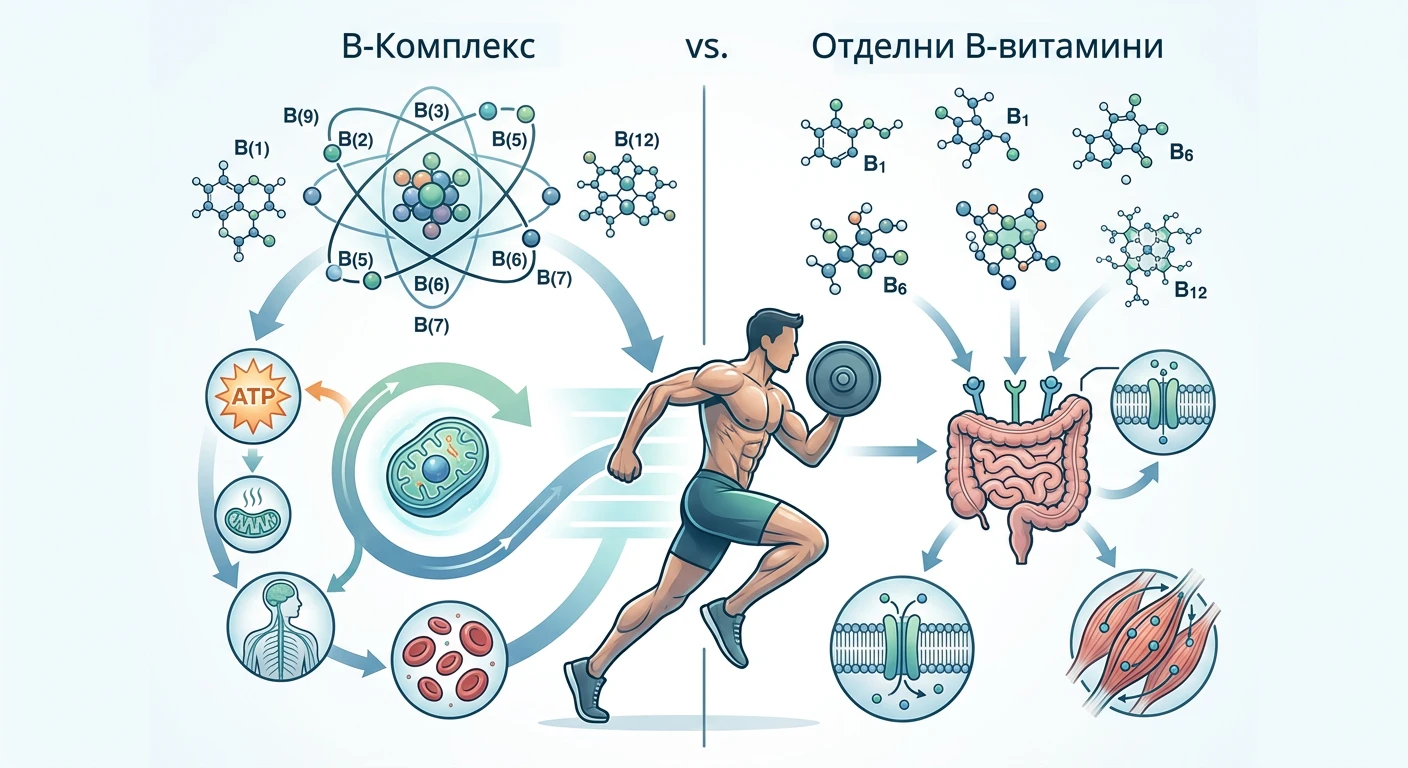
B-complex is a combination of all eight B vitamins (B1, B2, B3, B5, B6, B7, B9, B12), which together act as coenzymes for mutual enhancement in key metabolic processes like the Krebs cycle, where carbohydrates, fats, and proteins are converted into adenosine triphosphate (ATP) – the primary energy currency of cells.
Simply put: B-complex supports the entire energy system. All B vitamins work together for this process.
Scientific Sources
- Tardy, A. L., et al. (2020). Vitamins and Minerals for Energy, Fatigue and Cognition: A Narrative Review of the Biochemical and Clinical Evidence. Nutrients.
- Linus Pauling Institute at Oregon State University. B Vitamins.
- EFSA Panel on Dietetic Products, Nutrition and Allergies (NDA). (2010). Scientific Opinion on the substantiation of health claims related to various B vitamins.
2. Individual B Vitamins: Targeted Support
Taking individual B vitamins is justified for specific, clearly established needs. The mechanism is targeted saturation of a particular metabolic pathway that is compromised by deficiency or increased demand. Here are a few examples:
- Vitamin B12 (Cobalamin): Vegans or vegetarians are most at risk of deficiency, as B12 is found almost exclusively in animal products. A deficiency leads to megaloblastic anemia and neurological damage, which affects athletic performance. Taking methylcobalamin (the active form) corrects the problem.
- Vitamin B9 (Folate): Some people have a genetic mutation in the MTHFR enzyme that prevents the conversion of folic acid into its active form – methylfolate. For them, taking L-5-methyltetrahydrofolate is important for methylation processes, including DNA synthesis and neurotransmitter production.
- Vitamin B6 (Pyridoxine): In its active form, pyridoxal-5-phosphate (P-5-P), it is a cofactor for over 100 enzymatic reactions, many of which are related to the synthesis of neurotransmitters such as serotonin, dopamine, and GABA. Athletes exposed to high psychological stress can benefit from targeted intake.
The main risk with taking individual B vitamins is that high doses of one B vitamin can mask a deficiency of another or disrupt the overall balance. For example, high intake of folic acid can mask the blood symptoms of B12 deficiency while neurological damage progresses irreversibly.
Simply put: You take an individual B vitamin when you have a specific problem that you have identified. You don't need to take all B vitamins if you know exactly which one you are lacking.
Scientific Sources
The Synergistic Effect: Why Do They Work Better Together?
B vitamins are biochemically interconnected. The metabolism of one B vitamin often depends on the presence of another. One of the clearest examples is the methylation cycle – a fundamental process for DNA replication, detoxification, and neurotransmitter synthesis. For this cycle to work effectively, B9 (folate) and B12 (cobalamin) are needed. B6 (pyridoxine) also plays a supporting role. If you take high doses of B9 without sufficient B12, the cycle can become blocked and lead to a functional B12 deficiency. Therefore, B-complexes that provide balanced ratios are effective for overall health. They ensure that all coenzymes work in harmony.
What is the Optimal Ratio – B-Complex or Individual B Vitamins?
When to Choose B-Complex:
- You experience general fatigue and lack of energy without a clear cause.
- You are going through periods of intense physical or mental stress.
- Your diet is unbalanced or restrictive (but not vegan).
- You want to cover your basic needs preventatively.
🔵 When to Choose Individual B Vitamins:
- A blood test shows a specific deficiency (e.g., low B12).
- You follow a strict vegan diet (B12 is essential).
- You have a specific genetic predisposition (e.g., MTHFR mutation requiring methylfolate).
- You are working with a doctor or dietitian to achieve a specific therapeutic goal.
Recommended Stack for Foundation
For most athletes without a diagnosed deficiency, the best strategy is a B-complex as a foundation, looking for one with active forms like Methylcobalamin (B12) and Pyridoxal-5-Phosphate (P-5-P), combined with Vitamin C (500-1000 mg) and Magnesium (200-400 mg) in the evening for better synergy, nervous system support, and recovery.
What is the 2026 Protocol: "Foundation and Performance Stack"?
The 2026 Protocol: "Foundation and Performance Stack" is the most sustainable model for athletes, combining the security of complex intake with specific support when needed.
- Daily (morning with breakfast): Take a balanced B-complex (B-50 or B-100 type formula) containing active forms. This provides basic metabolic support throughout the day.
- Post-workout (if needed): During intense or prolonged training, an additional 500-1000 mcg of B12 (methylcobalamin) sublingually can accelerate nerve recovery.
- Specific Case (veganism): Daily intake of 1000-2500 mcg of B12, regardless of B-complex intake. Periodic (every 6-12 months) blood tests for B12 and homocysteine levels are recommended.
Expert Note
I anticipate a growing popularity of personalized B-complexes based on genetic testing (nutrigenomics). Until then, the rule is: use B-complex as insurance and add individual B vitamins as a "scalpel" only after an accurate "diagnosis" (blood test).
🧭 When to Choose Which?
- Choose B-Complex if you are an athlete with high workloads and seeking general support for energy and stress resilience.
- Choose an individual B vitamin if you have a specific, diagnosed deficiency through testing or if your diet leads to one (e.g., B12 for vegans).
- Combine both if you use B-complex as a base but need to "boost" a specific element due to specific needs (e.g., additional B6 for sleep support).
📖 What are B-Complex and Individual B Vitamins?
B-Complex is a dietary supplement containing all eight essential B vitamins in one tablet or capsule, usually in balanced ratios. Its purpose is to provide combined metabolic support. Individual B vitamins are supplements containing only one of the B group vitamins (e.g., only B12, only B6), typically in a higher dose. They are used to target specific deficiencies.
⚖ Pros and Cons
B-Complex
Pros:
- Combined action
- Convenience (1 tablet)
- Prevents imbalance
- For prevention
Cons:
- Fixed ratios
- May not be sufficient for severe deficiency of one vitamin
Individual B Vitamins
Pros:
- Targeted action
- High, therapeutic doses
- Rapid deficiency correction
Cons:
- High risk of imbalance
- Requires knowledge and testing
- Inconvenient intake of multiple products
🗣 Simply Explained
B-complex is a universal solution for general tasks. An individual B vitamin is a specialized tool used when you know exactly what needs to be fixed.
| Criterion | B-Complex | Individual B Vitamins |
|---|---|---|
| Purpose | General Support | Specific Correction |
| Approach | Comprehensive | Specialized |
| Safety | Safer for general use | Requires caution and testing |
Choose the Right Product for Your Goal:
- Overall Support and Energy: Opt for quality vitamins and minerals, including B-complex.
- Energy and Focus for Training: If the goal is immediate performance, consider pre-workout products, which often contain B vitamins.
- Nervous System Support: Combine B-complex with adaptogens for stress management.
Combined Protocol for Maximum Effect
- Pre-workout: Pre-workout product with caffeine and B3/B6/B12 for focus.
- Daily Foundation: B-complex in the morning for metabolic support.
- Recovery: Omega-3 and magnesium in the evening to reduce inflammation and support the nervous system.
⚖ When to Choose B-Complex
- For daily "insurance" against dietary gaps.
- When under significant stress and load.
- As a starting point for optimizing energy.
- If you haven't had blood tests and are looking for a safer option.
⚖ When to Choose Individual B Vitamins
- For diagnosed deficiency (e.g., Pernicious Anemia).
- If you are vegan or strictly vegetarian (need for B12).
- For specific therapeutic purposes (e.g., B6 for PMS).
- Under medical supervision for managing a specific condition.
Expert Note from Sport Zona
In my practice, I notice that the most common mistake is self-prescribing excessively high doses of one B vitamin, such as Biotin (B7) for hair and nails, without considering how it affects the others. A sustainable strategy is "foundation plus accent": start with a quality B-complex with active forms and only add more of a specific vitamin after blood tests, if necessary. For most athletes, the right B-complex is completely sufficient.
Frequently asked questions
Can B-Complex and Individual B-vitamins be taken together?
Yes, this is a common and effective strategy. B-Complex provides basic synergistic support, and the additional intake of a specific B-vitamin (e.g., B12 or biotin) addresses a specific need, without the risk of overdose if recommended doses are followed.
Which is better for beginners - B-Complex or Individual B-vitamins?
For beginners, B-Complex is the better and safer choice. It provides all essential B-vitamins in a balanced ratio, which is ideal for general support of energy metabolism and the nervous system, without requiring in-depth knowledge of individual needs.
When is the best time to take B-Complex and Individual B-vitamins?
B-vitamins are water-soluble and involved in energy production. Therefore, it is best to take them in the morning, with the first meal. This aids absorption and provides energy for the day. Taking them in the evening may interfere with sleep for some more sensitive individuals.
Are there side effects from taking B-Complex or Individual B-vitamins?
B-vitamins are generally safe, as excess is excreted in the urine. However, very high doses of some individual vitamins can have side effects. For example, intake above 100 mg of vitamin B6 daily for months can lead to nerve damage, and high doses of niacin (B3) can cause skin flushing.
What is the recommended dosage for B-Complex and Individual B-vitamins?
For B-Complex, follow the product label, which usually covers daily needs. For individual B-vitamins, doses vary greatly depending on the purpose: B12 can range from 500 to 5000 mcg for deficiency; biotin (B7) – 5000-10000 mcg for hair and nails; folic acid (B9) – 400-800 mcg. Always consult a specialist to determine the exact dose.