EPA vs. DHA: The Heart Protector vs. The Brain Builder

EPA reduces inflammation and supports joints, while DHA optimizes brain function and nerve signaling. Understanding their roles aids in better recovery and cognition.
Short Answer: EPA (eicosapentaenoic acid) is leading in fighting systemic inflammation and supporting cardiovascular health, while DHA (docosahexaenoic acid) is structurally important for the brain and eyes, improving cognitive function and reaction time. Practical Tip: For athletes seeking better recovery, a daily intake of 2-3 grams of combined EPA and DHA is recommended, with a ratio favoring EPA (e.g., 2:1 or 3:1). Take the dose with a fat-containing meal for maximum absorption.
Omega-3 fatty acids are an important supplement in sports nutrition, but it's good to know that "Omega-3" is a general term. Two of these acids are particularly important: EPA and DHA. We often encounter them together in fish oil, but they have different, though complementary, functions.
Our body is like a high-performance machine. EPA (eicosapentaenoic acid) controls inflammation, soothes overheated parts, and supports the joints. DHA (docosahexaenoic acid) optimizes brain function, improves reaction speed, and ensures accurate transmission of nerve signals.
Understanding the individual functions of EPA and DHA is essential for any athlete who wants to recover faster, improve their cognitive abilities, and keep their body in top shape. This analysis will help you choose when to focus on one, when on the other, and when their combination is most effective.
This article is part of the Expert Hub for Nutritional Supplements — over 270 expertly verified articles by Petar Mitkov and the Sport Zona team.
Which is More Important for Athletes: EPA or DHA?
A comparative matrix between EPA (Eicosapentaenoic Acid) and DHA (Docosahexaenoic Acid) is a systematic analysis of their key characteristics, focus, mechanisms, and effects for athletes.
| Criterion | EPA (Eicosapentaenoic Acid) | DHA (Docosahexaenoic Acid) |
|---|---|---|
| Primary Focus | Anti-inflammatory | Structural (brain, eyes, nerves) |
| Mechanism | Produces anti-inflammatory eicosanoids, competes with arachidonic acid. | Integrates into cell membranes, increasing their fluidity and function. |
| Primary Effect for Athletes | Reduces muscle soreness (DOMS), supports joint health, improves heart function. | Improves cognitive function, concentration, reaction time, and nervous system health. |
| Time Horizon | Relatively rapid effect on inflammation and pain (days to weeks). | Long-term accumulation for structural and cognitive benefits (weeks to months). |
| Analogy | "Firefighter" | "Architect" |
What are the Mechanisms?
1. EPA: The Systemic Anti-inflammatory Agent
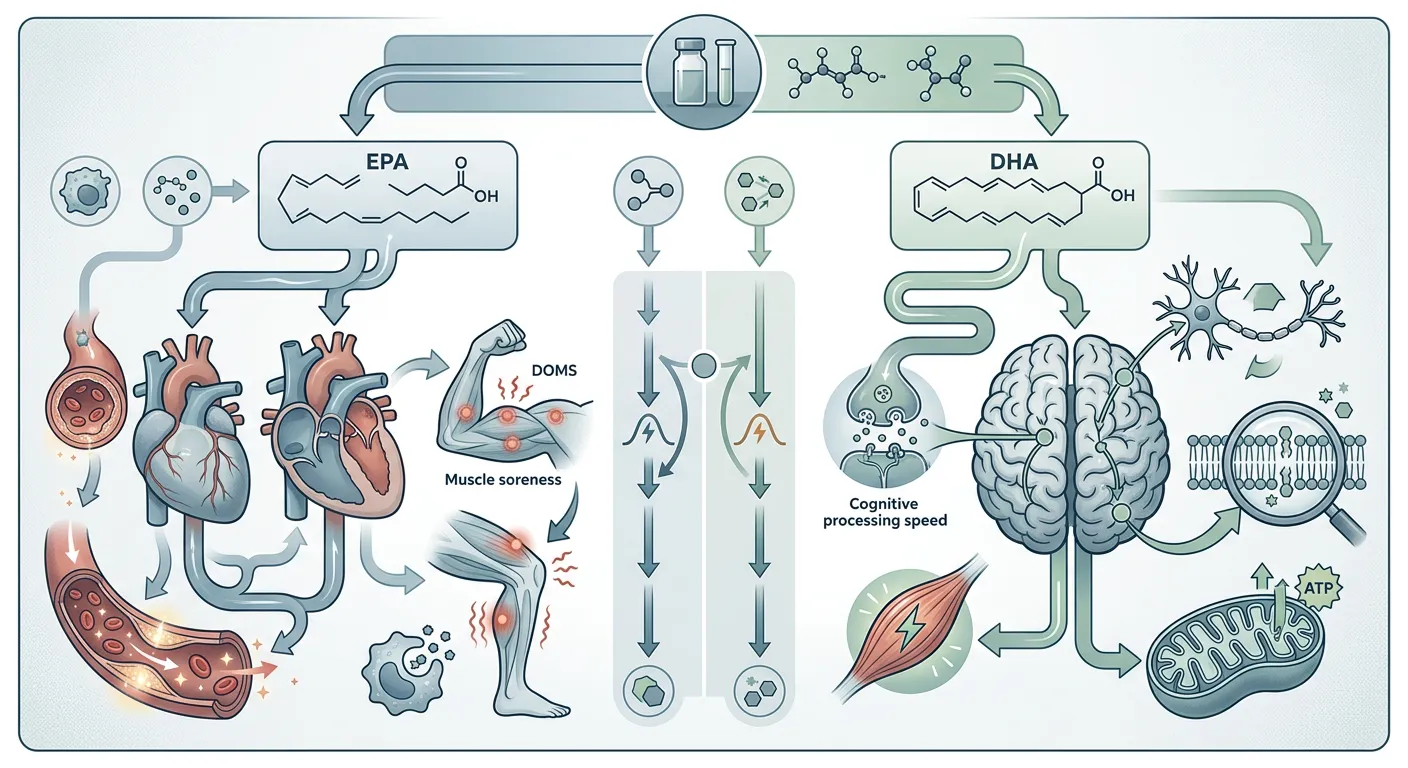
EPA is a primary modulator of inflammatory processes in the body. Intense training causes micro-tears in muscle fibers, which triggers an immune response and inflammation. This is a normal part of adaptation, but excessive inflammation can lead to severe muscle soreness (DOMS), delayed recovery, and an increased risk of injury.
EPA directly intervenes in this process. It competes with the pro-inflammatory Omega-6 fatty acid (arachidonic acid - AA) for the same enzymes (COX and LOX). When EPA blocks these enzymes, it produces eicosanoids (series 3 prostaglandins and leukotrienes) that are significantly less inflammatory than those derived from AA (series 2). This mechanism effectively reduces the inflammatory response in the body.
Simply put: EPA controls and extinguishes the inflammatory processes triggered by training. This allows the body to recover faster and with less pain.
2. DHA: The Architect of the Nervous System and Cells
DHA has a primarily structural role. It is a fundamental building block of cell membranes, especially in the brain and the retina of the eye. About 97% of the Omega-3 fatty acids in the brain are DHA.
For athletes, this is important. High concentrations of DHA in neuron membranes increase their flexibility. This facilitates the transmission of nerve impulses, improves communication between cells, and leads to faster reaction times, better concentration, and more effective decision-making during competition. Furthermore, DHA is a precursor to specialized pro-resolving mediators (SPMs) like resolvins and protectins, which actively help manage inflammation and initiate tissue repair processes.
Simply put: DHA builds and maintains the high-speed information highway of your nervous system. It ensures fast and accurate signal transmission from the brain to the muscles.
Scientific Sources
- Omega-3 Fatty Acids and Inflammatory Processes, 2017
- Omega-3 Fatty Acids Fact Sheet for Health Professionals - National Institutes of Health (NIH)
- Fish Oil Scientific Review - Examine.com
- Essential Fatty Acids - Linus Pauling Institute, Oregon State University
- EFSA Panel on Dietetic Products: Scientific Opinion on the substantiation of health claims related to EPA, DHA, 2012
The Synergistic Effect: Why Do They Work Better Together?
EPA and DHA have different primary roles, but they are most effective when working together. Recovery after training has two phases: first, controlling inflammation, and second, repairing damaged tissues. EPA aids in the first phase, and DHA is important for the second, especially in the regeneration of nerve and cellular structures.
Their combination provides complete support: EPA reduces excessive inflammation, and DHA provides the "building materials" for repairing cell membranes and optimizing nerve function. Taking only one acid would leave part of the process unaddressed. Therefore, most quality fish oil supplements contain both, albeit in different ratios.
What is the Practical Algorithm for Choosing?
Choose a product with a higher EPA content if:
- Your goal is to reduce muscle soreness and speed up recovery.
- You have joint pain or discomfort related to inflammation.
- You train intensely and frequently.
- You want to support your cardiovascular system (e.g., for triglyceride control).
🔵 Choose a product with a higher DHA content if:
- Your sport requires quick reactions, high concentration, and decision-making (e.g., combat sports, tennis, gaming).
- Your goal is long-term brain and nervous system health.
- You want to support eye health.
- You aim to improve the mind-muscle connection and motor control.
The recommended universal stack for athletes is a product with an EPA to DHA ratio of around 2:1 or 3:2, which is a good choice for most athletes seeking balanced benefits. The intake should be a total daily amount of 2000-3000 mg of combined EPA and DHA.
How Often Should We Take Omega-3?
Omega-3 intake should be consistent, not just on training days, as fatty acids accumulate in tissues over time.
- Daily Basis: Take 2-4 capsules of fish oil (depending on concentration), providing a total of about 1500 mg of EPA and 750 mg of DHA. Take them with a fat-rich meal for better absorption. You can split the dose into two – morning and evening.
- Peak Performance/Recovery Stack: During periods of heavy training or before an important competition, increase the dose to 2000 mg of EPA and 1000 mg of DHA daily for 1-2 weeks to enhance the anti-inflammatory and neuroprotective effects.
Expert Note
Don't just look at the total amount of fish oil per capsule. Always check the label for the exact EPA and DHA content. Two products might contain 1000 mg of fish oil, but one delivers 700 mg of active ingredients (EPA+DHA), while the other delivers only 300 mg. Quality and concentration are important.
🧭 When to Choose Which?
- Choose a formula with dominant EPA if you are recovering from an injury or are in a heavy training period focusing on strength and endurance.
- Choose a formula with dominant DHA if your sport requires high concentration, quick reflexes, and complex coordination.
- Combine them in a ratio of ~2:1 (EPA:DHA) for comprehensive support.
📖 What are EPA and DHA?
EPA (Eicosapentaenoic Acid) is a long-chain Omega-3 polyunsaturated fatty acid that primarily acts to reduce inflammation in the body.
DHA (Docosahexaenoic Acid) is a long-chain Omega-3 polyunsaturated fatty acid that is a major structural component of the brain, nervous system, and retina of the eyes.
⚖ Pros and Cons
| Pros (Combined Intake) | Cons / Risks |
|---|---|
| Combined effect on inflammation and recovery. | Consistent intake is necessary for accumulation and effect. |
| Supports physical and cognitive performance. | At very high doses, it may thin the blood (interaction with anticoagulants). |
| Proven benefits for cardiovascular health. | Possible mild stomach discomfort or fishy aftertaste with some products. |
🗣 Explained Simply
| Criterion | EPA | DHA |
|---|---|---|
| Role | Reduces inflammation. | Builds cells. |
| Analogy | Firefighter | Architect |
| Main Effect | Less muscle and joint pain. | Sharper mind and faster reactions. |
EPA is the rapid response team that controls damage after an incident (training). DHA is the construction crew that comes in afterward to rebuild the structure (cells) and upgrade the communication systems (nervous system).
Choose the right product for your goal:
- ❤ For general health and heart function: Explore our concentrated Omega-3 oils.
- For joints and recovery: Combine Omega-3 with products for joints.
- For focus and energy: Supplement with adaptogens and pre-workout products.
Combined protocol for maximum effect:
- Morning: Omega-3 (with food) for basic support.
- Before/During workout: Energy booster for focus and strength.
- After workout: Protein shake for muscle growth and Omega-3 (with food) for inflammation control.
⚖ When to choose a formula rich in EPA
- You want to reduce muscle soreness after intense workouts.
- You have chronic joint pain or are in a recovery period.
- You train for endurance (marathon, cycling) and want to control systemic inflammation.
- Your goal is to maintain healthy triglyceride levels.
⚖ When to choose a formula rich in DHA
- Your sport requires quick reactions and tactical thinking.
- You want to improve your concentration during long and grueling sessions.
- You are preparing for exams or other activities requiring high cognitive function.
- Long-term brain health is your priority.
Expert Note from Sport Zona
In my work, I notice that strength athletes and CrossFit competitors often underestimate the EPA:DHA ratio. When complaining about persistent stiffness and joint pain, switching to a formula with high EPA content (3:1 ratio or higher) often leads to noticeable relief within 3-4 weeks. Conversely, when working with gamers and combat sports athletes, focusing on DHA yields better results regarding "mental sharpness" and reduced reaction time.
Recommended products
Frequently asked questions
Can EPA and DHA be taken together?
Yes, and it is even recommended. Most quality fish oil supplements contain both acids as they work synergistically. What is key is not their individual intake, but the ratio between them, which is chosen according to the specific goal – recovery, cognitive function, or general health.
Which is better for beginners - EPA or DHA?
For a beginner athlete, the best approach is to choose a balanced supplement containing both EPA and DHA (e.g., in a 1:1 or 2:1 ratio). This provides a wide spectrum of benefits for general health. In the beginning, it is more important to build a habit of regular intake than to optimize the ratio.
When is the best time to take EPA and DHA?
The exact time of intake is not crucial. The most important thing is to take them during a meal that contains fat. This significantly improves their absorption. Many people prefer to take their dose with the most abundant meal of the day.
Are there any side effects from taking EPA or DHA?
At standard doses (1-3 grams combined per day), side effects are rare and usually mild – fishy aftertaste, indigestion, or stomach discomfort. Very high doses (over 5 grams) can affect blood clotting and should only be taken after consulting a doctor, especially if you are taking blood-thinning medication.
What is the recommended dosage of EPA and DHA?
To maintain good general health, 500-1000 mg of combined EPA and DHA daily is sufficient. For athletes aiming for an anti-inflammatory effect and supporting recovery, the effective dose is higher – between 2000 and 4000 mg (2-4 grams) in total. Always check the label for the exact content of EPA and DHA per capsule, not just the total amount of fish oil.