Choline vs. Phosphatidylserine: The Memory Neurotransmitter vs. The Brain Cell Membrane

Choline is the building block for nerve signals, while phosphatidylserine regulates them and protects them from stress. Understanding their roles improves mental and physical performance.
Short answer: Choline is the "building block" for the nervous system, directly involved in acetylcholine synthesis for focus and muscle contraction. Phosphatidylserine is the "shield" that protects cell membranes and reduces stress hormone cortisol levels by up to 30% after intense workouts. Practical tip: For sharp focus before a workout or mental work, take 300-600 mg of Choline (in the form of Alpha-GPC or Citicoline). To improve recovery and reduce stress, take 200-400 mg of Phosphatidylserine after training or in the evening.
We often focus on muscles – protein for growth, carbs for energy, creatine for strength. But what drives it all? The control center – the brain and nervous system. This is where two important, yet often overlooked, nutrients come in: choline and phosphatidylserine. Each plays a vital, but distinct, role in enhancing both mental and physical performance.
Your nervous system is like a communication network. Choline is the raw material – it forms the structures that allow signals to travel quickly and accurately. It's the foundation for muscle contraction and focus. Phosphatidylserine manages these signals, protecting the system from overload (stress and cortisol) and ensuring its smooth operation. Understanding the difference between these two roles helps you achieve better results.
This article is part of the Expert Supplement Hub — over 270 expert-verified articles by Petar Mitkov and the Sport Zona team.
Which is Better: Choline or Phosphatidylserine?
Choline is an essential nutrient that the body produces in insufficient quantities, while phosphatidylserine is a non-essential phospholipid that the body can synthesize. Choline primarily focuses on neurotransmission, the mind-muscle connection, and power output, while phosphatidylserine regulates stress, reduces cortisol, and aids recovery.
| Criterion | Choline | Phosphatidylserine |
|---|---|---|
| Biological Status | Essential nutrient (body produces it, but in insufficient amounts) | Non-essential phospholipid (body can synthesize it) |
| Primary Focus | Neurotransmission, mind-muscle connection, power output | Stress regulation, cortisol reduction, recovery |
| Main Mechanism | Precursor to acetylcholine (key neurotransmitter) | Modulation of the hypothalamic-pituitary-adrenal (HPA) axis |
| Time Horizon | Fast, acute effect (30-90 min before workout) | Cumulative effect (requires consistent intake) |
| Sport Focus | Strength and explosive sports, technically complex movements | Endurance sports, high-volume periods, overtraining |
| Key Form | Alpha-GPC or CDP-Choline | Phosphatidylserine from soy or sunflower lecithin |
What Are Choline and Phosphatidylserine?
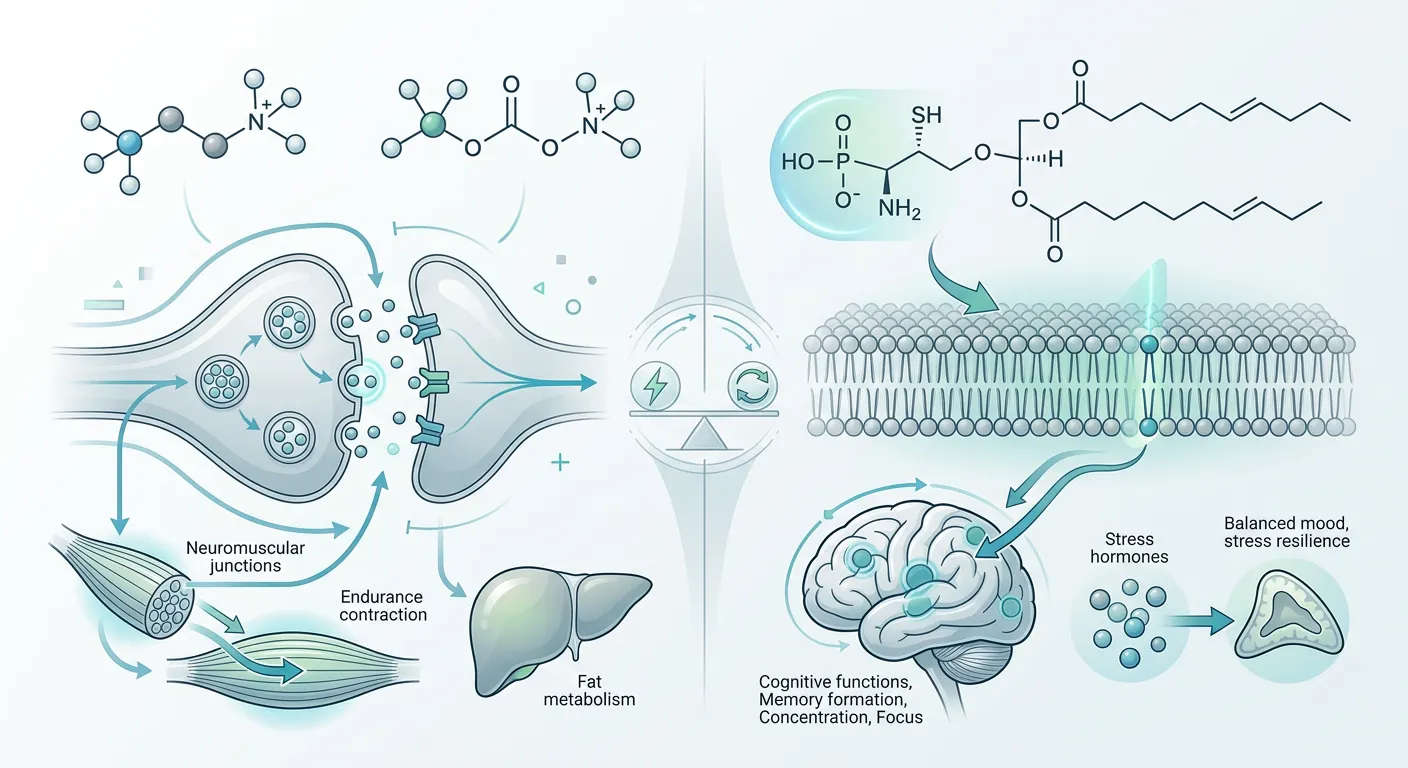
1. Choline: The Nervous System's "Fuel"
Choline's primary role in athletic performance is as a direct precursor to Acetylcholine – one of the most crucial neurotransmitters for movement and cognition. When your brain sends a signal to contract a muscle (like during a lift), it's transmitted via acetylcholine. Higher choline levels mean faster and more efficient acetylcholine synthesis. This leads to:- Improved Mind-Muscle Connection: More conscious and powerful control over working muscles.
- Increased Strength and Power: Research on forms like Alpha-GPC shows improvements in strength for exercises like the bench press and squat.
- Enhanced Focus and Alertness: Acetylcholine is critical for cognitive processes in the brain, beneficial for complex movements or long, grueling workouts.
Choline is the raw material your body uses to produce the communication molecule acetylcholine, responsible for muscle contractions and focus. More choline means the potential for stronger, clearer signals from the brain to the muscles.
Practical Observation
In strength athletes and CrossFit competitors, Alpha-GPC taken about 45-60 minutes before a heavy workout often leads to a noticeable feeling of "connection" with the weight. Athletes report better control during the eccentric phase (lowering) and more confidence initiating the concentric (lifting), especially in technical lifts like the clean & jerk or snatch.
2. Phosphatidylserine: The "Shield" Against Stress
Phosphatidylserine (PS) works differently. It's a phospholipid concentrated in cell membranes, particularly in the brain. Its main benefit for athletes isn't generating power, but managing the stress response. Intense exercise is a physical stressor that elevates levels of the catabolic hormone Cortisol. Short-term cortisol spikes are normal. Chronically elevated levels lead to:- Muscle tissue breakdown.
- Impaired recovery.
- Mental fatigue and burnout.
- Reduced immune function.
Simply put: Phosphatidylserine acts as a "shock absorber" for stress. It dampens the production of cortisol, the hormone that breaks down muscle and hinders recovery. This helps the body stay in a building, rather than breaking down, state.
Practical Observation
Phosphatidylserine is particularly useful for athletes during periods of very heavy and high-volume training, such as marathon preparation or bodybuilding contest prep. They often report better sleep, less muscle soreness, and a better overall sense of energy throughout the day, even when training stress is high.
Scientific Sources
- Choline - Fact Sheet for Health Professionals, National Institutes of Health
- The effects of alpha-glycerylphosphorylcholine on muscular strength, 2015
- The effects of phosphatidylserine on endocrine response to moderate intensity exercise, 2008
- Phosphatidylserine Scientific Review, Examine.com
- Choline, Linus Pauling Institute, Oregon State University
The Synergistic Effect: Why They Work Better Together?
Choline and phosphatidylserine are not competitors; they are complementary. Combining them enhances overall neurological function for peak athletic performance.
- Choline provides the power: It supplies the raw material for strong, fast muscle contractions and sharp focus (via acetylcholine).
- Phosphatidylserine protects from overload: It shields the system from the stress of intense training (by reducing cortisol).
The result? You can train harder and with more focus (thanks to choline), while simultaneously recovering faster and reducing the risk of overtraining (thanks to phosphatidylserine). This means improved training results and quicker recovery.
What is the Practical Algorithm for Choosing?
Choose Choline if:
- Your primary goal is maximum strength and explosiveness within the workout.
- You practice technically complex sports (weightlifting, gymnastics, martial arts).
- You want to improve your mind-muscle connection and focus during sets.
- You often use stimulants and are looking for a component to complement them.
🔵 Choose Phosphatidylserine if:
- Your primary goal is faster recovery between workouts.
- You are in a period of very high training volume or caloric deficit.
- You feel mentally fatigued, overtrained, or have trouble sleeping.
- You train for endurance (running, cycling, swimming) and want to reduce physiological stress.
Combination for Maximum Performance
The practical algorithm for athletes seeking both performance enhancement and accelerated recovery involves combining 300-600 mg of Alpha-GPC before training for focus and strength, and 200-400 mg of Phosphatidylserine in the evening before bed or post-workout to support recovery and manage cortisol.
How to Combine Choline and Phosphatidylserine for Best Results?
The 2026 protocol, "Foundation and Performance Stack," offers a systematic approach to achieving maximum results, dividing choline and phosphatidylserine intake on a daily basis and around workouts.
- Daily (Recovery Foundation): 200-300 mg of Phosphatidylserine taken in the evening. This helps normalize cortisol rhythm and improves sleep quality, which is the foundation of recovery.
- Pre-Workout (Performance Stack): 300-600 mg of Alpha-GPC (or equivalent CDP-Choline) 45-60 minutes before exercise. This ensures peak choline availability for acetylcholine synthesis precisely when it's most needed.
- Post-Workout (Accelerated Regeneration): A second dose of 100-200 mg of Phosphatidylserine can be added immediately after training to more quickly blunt the post-exercise cortisol surge.
Expert Note
Don't forget the importance of dietary sources. Two to three egg yolks per day can provide a significant portion of your choline needs. For phosphatidylserine, dietary sources are scarcer, making supplementation particularly effective, especially for vegans and vegetarians.
🧭 When to Choose Which?
- Choose Choline only if: your budget is tight and the priority is improving performance during the workout itself (more strength and focus).
- Choose Phosphatidylserine only if: your gym performance is good, but you suffer from poor recovery, high stress levels, or symptoms of overtraining.
- Combine both if: you are an athlete looking to optimize every aspect – from in-gym strength and focus to out-of-gym recovery speed.
📖 What are Choline and Phosphatidylserine?
Choline is an essential nutrient, similar to B vitamins. It's a building block for the neurotransmitter acetylcholine and is important for nervous system function, liver health, and metabolism.
Phosphatidylserine is a phospholipid and a vital component of cell membranes throughout the body, but it's particularly concentrated in the brain. It plays a role in cell signaling and modulating the hormonal response to stress.
⚖ Pros and Cons
| Pros | Cons |
|---|---|
| Choline: Fast-acting, direct effect on strength, synergistic with caffeine. | Choline: Some forms (bitartrate) are less effective, high doses can cause stomach discomfort. |
| Phosphatidylserine: Proven cortisol reduction, improves recovery, safe for long-term use. | Phosphatidylserine: Higher cost, requires accumulation, effect is not acute/instantaneous. |
🗣 Explained Simply
If you imagine your body as a race car:
| Criterion | Choline (The Gas Pedal) | Phosphatidylserine (The Cooling System) |
|---|---|---|
| Goal | To make you go faster NOW. | To let you go fast for LONGER. |
| Action | More fuel for the engine (power). | Prevents the engine from overheating. |
| Feeling | Better response, sharp control. | Less wear and tear, better endurance. |
Choose the right product for your goal:
- For focus and cognitive power: Check out our pre-workout formulas.
- For stress management and recovery: Explore our selection of adaptogens.
- 🧱 For building blocks: See our pure amino acids.
Combined protocol for elite results:
- Pre-workout: 1 serving of a choline-based pre-workout for focus.
- During workout: BCAAs or EAAs to reduce fatigue.
- Evening before sleep: 1 serving of Phosphatidylserine to optimize recovery.
⚖ When to Choose Choline
- You're looking for an acute, immediate effect on strength.
- Your workout requires maximum concentration.
- You want to improve your mind-muscle connection.
- You're preparing for a strength test or competition.
⚖ When to Choose Phosphatidylserine
- You feel overtrained and exhausted.
- Your recovery between workouts is slow.
- You're training with high volume or are in a caloric deficit.
- You want to improve your sleep quality.
Expert Note from Sport Zona
Working with athletes for over 12 years, I've noticed many focus on "stimulation" (choline, caffeine) but neglect "recovery" (phosphatidylserine, adaptogens). The best results come when an athlete understands that today's performance depends on effective stress management. Phosphatidylserine is often the missing piece of the puzzle that allows all supplements to work better.
Recommended products
Frequently asked questions
Can Choline and Phosphatidylserine be taken together?
Yes, and it is a highly recommended combination (stack). Choline provides the raw material for focus neurotransmitters (acetylcholine), and Phosphatidylserine protects nerve cells and helps regulate stress. Together, they provide comprehensive support for cognitive function and recovery.
Which is better for beginners - Choline or Phosphatidylserine?
Choline is a better choice for beginners. It is an essential nutrient required for basic cellular functions, including building cell membranes and metabolism. Phosphatidylserine is a more specialized supplement targeting stress management and is most beneficial under high physical or mental load.
When is the best time to take Choline and Phosphatidylserine?
Choline is most effective when taken in the morning or about 30-45 minutes before a workout or mental activity to support concentration. Phosphatidylserine can be taken at any time, but it is particularly useful after intense exercise or in the evening before sleep, as it helps reduce cortisol and improve sleep quality.
Are there any side effects from taking Choline or Phosphatidylserine?
Both supplements are very safe when following recommended dosages. Very high doses of Choline (above 3.5 grams per day) can cause stomach discomfort or a distinct fishy body odor. Phosphatidylserine is extremely well-tolerated, with only very high doses potentially causing mild insomnia. Individuals on blood-thinning medication should consult a doctor, as both substances may have a mild anticoagulant effect.
What is the recommended dosage for Choline and Phosphatidylserine?
For Choline, effective doses for cognitive support typically range from 300 to 1200 mg daily, most commonly in the form of Alpha-GPC or Citicoline. For Phosphatidylserine, the standard dosage is 100-300 mg per day. For athletes aiming to reduce post-workout cortisol, doses can go up to 400-600 mg.