NAC vs. Glutathione: The Detox Precursor vs. The Master Antioxidant
NAC is a precursor, and Glutathione is an active antioxidant. We are analyzing which of the two is more suitable for athletes.
Short answer: NAC is a precursor (building block) that the body uses to produce glutathione, and it is more effective at raising intracellular levels. Direct glutathione intake suffers from poor bioavailability, except in expensive liposomal forms. Practical advice: For antioxidant protection and recovery, take 600-1200 mg of NAC daily. Choose NAC for long-term support and liposomal glutathione only for short-term, intensive intervention for specific needs.
In sports, where every gram of energy and every day for recovery is critical, combating oxidative load is a constant battle. Intense training, despite its benefits, generates free radicals. These can damage cells, slow down recovery, and weaken the immune system. Two powerful allies in this fight are N-acetylcysteine (NAC) and Glutathione.
Many athletes wonder which of the two is more suitable. It can be likened to comparing a material supplier and a master builder. One provides the basic parts (NAC), and the other builds the finished defense (Glutathione). The question is not about who is stronger, but who is better for the specific situation, goals, and budget.
Here, we provide a full analysis of these two supplements. We will look at how they work, examine the scientific data on their efficacy, and offer a clear, practical approach. This will help you make the best decision for your training regimen and health.
This article is part of the Expert Hub for Nutritional Supplements — over 270 expertly reviewed articles by Petar Mitkov and the Sport Zona team.
What is the systemic difference between NAC and Glutathione?
NAC is a precursor (starting material) for glutathione synthesis, while Glutathione itself is an active tripeptide and the body's "master antioxidant" that directly neutralizes free radicals and participates in detoxification. NAC provides the amino acid L-cysteine, needed for endogenous glutathione production, while glutathione directly increases its levels in plasma and cells.
| Criterion | N-acetylcysteine (NAC) | Glutathione (GSH) |
|---|---|---|
| Biological Status | Precursor (starting material) | Active tripeptide (end product) |
| Primary Focus | Supporting endogenous (internal) glutathione production | Directly increasing plasma and cellular glutathione levels |
| Mechanism of Action | Provides the amino acid L-cysteine, which is needed for glutathione synthesis | Directly neutralizes free radicals and participates in detoxification |
| Oral Absorption | High. Easily absorbed and efficiently enters cells. | Low (for standard forms), moderate to high (for liposomal and S-acetyl forms) |
| Onset of Action | Slower but steady increase in intracellular glutathione. Suitable for long-term support. | Faster peak in plasma (especially with liposomal forms), suitable for acute conditions. |
| Additional Benefits | Strong mucolytic effect (thins mucus in the lungs), supports liver detoxification. | Key for recycling other antioxidants like vitamin C and E. |
| Price | Significantly more affordable | Higher price, especially for bioavailable liposomal or S-acetyl forms. |
How do NAC and Glutathione work?
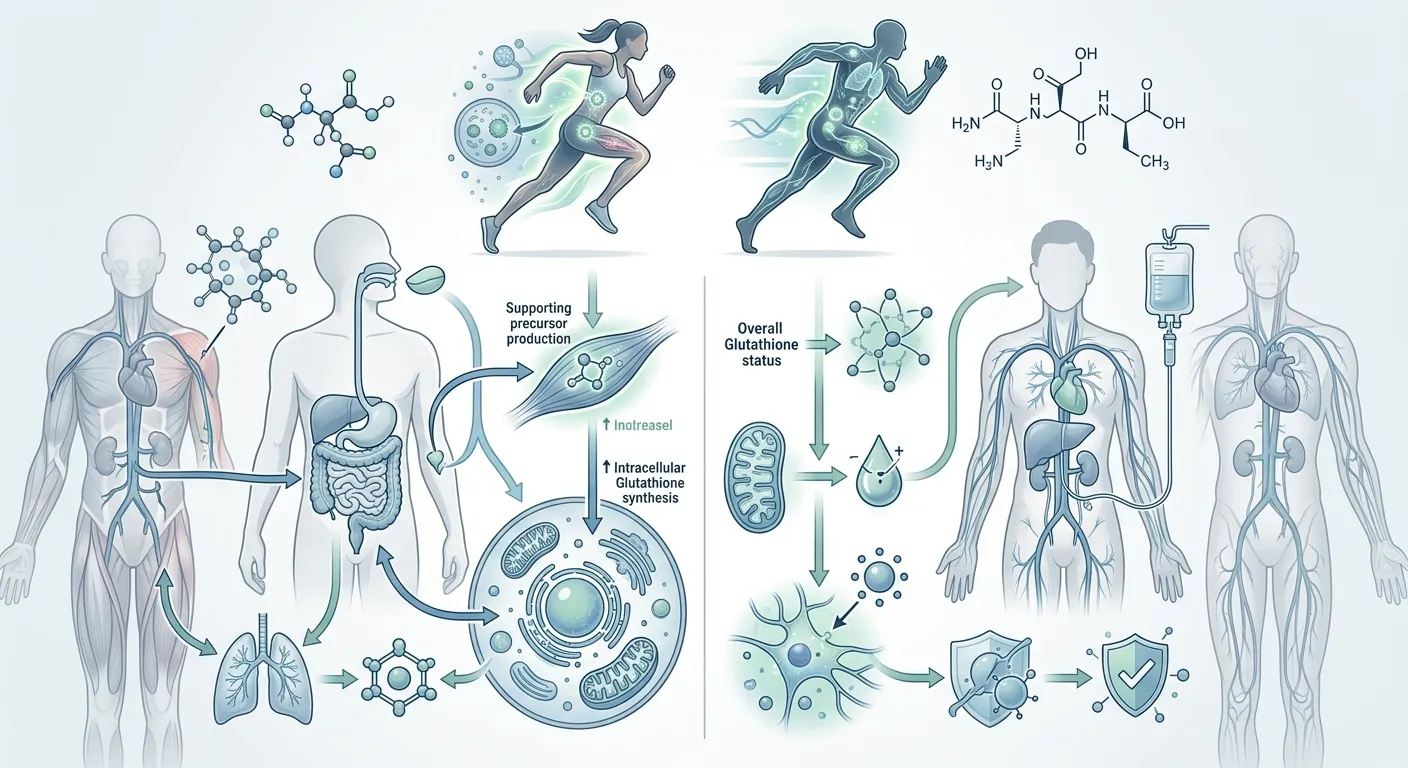
1. N-acetylcysteine (NAC): The Supplier
N-acetylcysteine (NAC) is an acetylated form of the amino acid L-cysteine, which is more stable and better absorbed due to the acetyl group. Its primary role is to provide cysteine to the cells.
This is important because the body's glutathione synthesis depends on three amino acids: glutamate, glycine, and cysteine. Glutamate and glycine are usually present in sufficient quantities. Cysteine is the limiting factor. When we give the body NAC, we provide it with the raw material to produce its own glutathione naturally, exactly when and where it is needed.
Simply put: Taking NAC provides the necessary cysteine. This allows cells to produce glutathione constantly and efficiently, keeping defense systems in good condition.
2. Glutathione: The Defender
Glutathione (GSH) is a tripeptide, often called the body's "master antioxidant." It is present in every cell and has several key roles: neutralizing free radicals, participating in the detoxification of xenobiotics (harmful external substances) in the liver, and regenerating other antioxidants like vitamins C and E.
For a long time, the problem with direct glutathione intake was its poor absorption. Passing through the digestive system, standard glutathione breaks down into its constituent amino acids before reaching the cells. New forms overcome this problem. Liposomal glutathione is "packaged" in fat spheres (liposomes) that protect it from stomach acids and allow direct absorption. S-acetyl L-glutathione (S-A-GSH) uses an acetyl group to easily cross cell membranes, where it releases active glutathione.
Simply put: Taking liposomal glutathione is direct. It acts immediately to combat oxidative stress without waiting for production.
Scientific Sources
Synergistic Effect: Why They Work Better Together?
The best approach is to combine the two. NAC and glutathione can work more powerfully together than separately, especially for elite athletes or people under significant stress.
Here's how they help each other:
- Long-term Foundation (NAC): Daily intake of NAC provides a steady supply of cysteine, maintaining the body's ability to produce glutathione at a high level. This ensures that reserves are always full.
- Rapid Response (Glutathione): Taking liposomal glutathione after a strenuous workout or competition provides an immediate influx of the active antioxidant. This is a quick fix for an acute problem, while the long-term protection maintained by NAC continues to work.
This combination provides the body with both resources for long-term endurance and a means to quickly address sudden spikes in oxidative stress.
What is the practical selection algorithm?
Choose NAC if:
- You want long-term, stable, and more affordable antioxidant support.
- Your goal is prevention, maintaining overall health, and a strong immune system.
- You also need support for your respiratory system (mucolytic effect).
- You have a limited budget but want proven effectiveness.
🔵 Choose Glutathione (liposomal) if:
- You need rapid recovery after extreme exertion, competition, or illness.
- You want the maximum direct and fast antioxidant effect.
- You have issues with methylation or other metabolic pathways that hinder conversion.
- Price is not an obstacle and you are looking for the most potent tool for rapid intervention.
Recommended Combined Protocol for Maximalists
The practical selection algorithm for athletes seeking the best involves considering individual goals and needs, as both NAC and glutathione offer distinct benefits.
- Morning (daily): 600-1200 mg NAC to maintain baseline levels.
- Immediately after training: 250-500 mg Liposomal Glutathione, taken within 30 minutes of finishing the workout, along with your protein shake.
What is the 2026 Protocol: "Foundation and Performance Stack"?
"Foundation and Performance Stack" is a modern protocol for 2026 that divides the nutritional approach by time, aiming for greater precision in nutritional progress.
- Daily Foundation: 600 mg NAC every morning on an empty stomach. This ensures a constant supply of cysteine and supports natural glutathione synthesis.
- After Intense Training (>90 min): 500 mg Liposomal Glutathione, taken within 30 minutes of finishing the workout, along with your protein shake.
- During High Stress or Illness: The NAC dose can be increased to 2x600 mg daily, and the liposomal glutathione dose to 2x250 mg (morning and evening) for 5-7 days.
Expert Note
This two-stage protocol is quite effective. NAC builds long-term defense, and glutathione acts as a rapid response against oxidative stress when it's most needed. An intelligent approach to optimize results and costs.
🧭 When to Choose Which?
- Choose NAC if your goal is daily, long-term immune and antioxidant capacity support at an affordable price.
- Choose Liposomal Glutathione if you need rapid and potent intervention for recovery after extreme exertion or during illness, and budget is not a concern.
- Combine both if you are an elite athlete or a person under constant physical and mental stress, seeking maximum protection and rapid response.
📖 What are NAC and Glutathione?
N-acetylcysteine (NAC) is a stable, easily absorbed form of the amino acid L-cysteine. It is a fundamental building block that the body uses to produce its own glutathione.
Glutathione (GSH) is the most powerful intracellular antioxidant in the human body. It is the "end product" – a tripeptide that directly neutralizes harmful free radicals and participates in cellular detoxification.
⚖ Pros and Cons
| Pros | Cons | |
|---|---|---|
| NAC | Highly absorbable, low cost, proven effective precursor, with additional benefits for the respiratory system. | Acts indirectly, raises glutathione levels more slowly, requires the body to perform synthesis. |
| Glutathione | Acts directly and quickly, bypasses synthesis steps, effective in acute conditions. | Significantly higher cost, low absorption of standard forms, effectiveness highly dependent on the form (liposomal). |
🗣 Explained Simply
If we imagine the body as a fortress under attack (from oxidative stress):
- NAC is the truck delivering bricks and cement for construction. Without it, the builders (cells) cannot repair the walls (produce glutathione). It is the foundation of defense.
- Glutathione is an elite squad of knights standing at the gate. They immediately repel attackers trying to break through. They are the fast and powerful response.
| Criterion | NAC | Glutathione |
|---|---|---|
| Role | Raw material supplier | Executor / Soldier |
| Speed | Slow but steady | Fast and direct |
| Approach | Prevention, maintenance | Intervention, treatment |
| Price |
Choose the right product for your goal:
Combine wisely for maximum results:
- For antioxidant foundation: Explore our Amino Acids, including high-quality NAC.
- For rapid recovery: Discover powerful formulas in the Recovery section.
- For overall support: Also check out Adaptogens for stress management.
Combined 3-Step Protocol
- Morning: 1 dose NAC for baseline support.
- Pre-workout: Fuel your energy with a pre-workout product.
- Post-workout: Accelerate recovery with 1 dose of Liposomal Glutathione and whey protein.
⚖ When to Choose NAC
- You want preventive, daily support.
- Budget is important to you.
- Your goal is to support the body's natural processes.
- You need additional benefit for your respiratory system.
⚖ When to Choose Glutathione
- You need maximum rapid intervention.
- You are recovering from extreme exertion or illness.
- Price is not an issue and you are looking for the most potent effect.
- You want to bypass the body's synthesis process.
Expert Note from Sport Zona
From experience with athletes, I see clearly – for the majority of trainees, regular NAC intake (600-1200 mg/day) is completely sufficient and very effective for maintaining antioxidant balance. We reserve the more expensive liposomal glutathione for specific cases: the final weeks before a competition, during intense competitive periods, or at the first signs of a viral infection when the immune system needs immediate and strong support. Don't overlook the foundation (NAC) in pursuit of a newer supplement.
Recommended products


Frequently asked questions
Can NAC and Glutathione be taken together?
Yes, but in most cases, it is unnecessary. Since NAC is a precursor to glutathione, taking it effectively raises the body's glutathione levels. Combining them does not offer significant additional benefits for most people and is not cost-effective. Focus on NAC for long-term support.
Which is better for beginners - NAC or Glutathione?
For beginners, N-acetylcysteine (NAC) is a significantly better choice. It is more affordable, has higher bioavailability when taken orally, and directly supplies the body with the raw material it needs to produce its own glutathione. This is a more effective and safer starting step.
When is the best time to take NAC and Glutathione?
NAC is best absorbed on an empty stomach to avoid competition with other amino acids from food. It can be taken once daily or split into two doses (e.g., morning and evening). For athletes, post-workout intake can help neutralize oxidative stress. Liposomal glutathione is also taken on an empty stomach.
Are there any side effects from taking NAC or Glutathione?
Both supplements are considered safe when following recommended dosages. High doses of NAC (over 1800 mg/day) can sometimes cause mild stomach discomfort like nausea. With glutathione, there are no common side effects, but it is important to choose a high-purity product. Consult a doctor before taking, especially if you have chronic conditions.
What is the recommended dosage for NAC and Glutathione?
The standard recommended dose for NAC is between 600 mg and 1200 mg per day, divided into one or two doses. For glutathione, the dosage depends heavily on the form. For liposomal or S-acetyl forms, it is typically between 100 mg and 500 mg per day. Regular glutathione powder or capsules have very low efficacy and are not recommended.