Sodium vs. Magnesium: The External Regulator vs. The Internal Balancer

Sodium initiates muscle contractions, and magnesium ensures smooth operation and recovery. Both minerals are key for athletic performance.
Short answer: Sodium is the #1 electrolyte for hydration and nerve function *during* exercise, while magnesium is key for muscle relaxation, energy production (ATP), and recovery *after* it. They are not interchangeable but complementary. Practical advice: Take 500-1000 mg of sodium per hour of intense exercise (via an electrolyte drink) and 200-400 mg of magnesium (bisglycinate, citrate) in the evening for better recovery.
Sodium and magnesium are often viewed differently by athletes. Sodium is often blamed for high blood pressure and water retention, while magnesium is seen as a solution to many problems like muscle cramps and poor recovery. Both minerals are necessary for good athletic performance, but they perform different and complementary roles.
The muscle cell is like an engine. In this sense, sodium is the spark that starts contraction. It is important for nerve impulses and explosive power. Magnesium, on the other hand, is like oil and coolant – it ensures smooth operation, helps the muscle relax after exertion, prevents cramps, and participates in recovery and energy replenishment for the next activity.
Knowing when and why to use each of them is important for any serious athlete – from long-distance runners to strength athletes. In this analysis, we will look at how they work, compare their functions, and provide practical guidelines for their use to achieve the best results.
This article is part of the Expert Hub for Nutritional Supplements — over 270 expertly verified articles by Petar Mitkov and the Sport Zona team.
What is the systemic difference between Sodium and Magnesium?
The comparative matrix presents a systemic analysis of Sodium and Magnesium by key criteria such as biological status, primary focus for athletes, key mechanism, time horizon of action, and proper intake.
| Criterion | Sodium | Magnesium |
|---|---|---|
| Biological Status | Major extracellular electrolyte | Major intracellular mineral; cofactor |
| Primary Focus for Athletes | Hydration, nerve impulse, muscle contraction | Muscle relaxation, energy metabolism (ATP), sleep |
| Key Mechanism | Drives the sodium-potassium pump for action potential | Cofactor for over 300 enzymes; stabilizes ATP |
| Time Horizon of Action | Immediate (during exertion) | Long-term (requires accumulation) |
| Proper Intake | Before/during prolonged exertion | Daily, primarily in the evening or after training |
| Specific Bonus | Prevents hyponatremia and dehydration | Improves sleep quality and recovery |
How do Sodium mechanisms work?
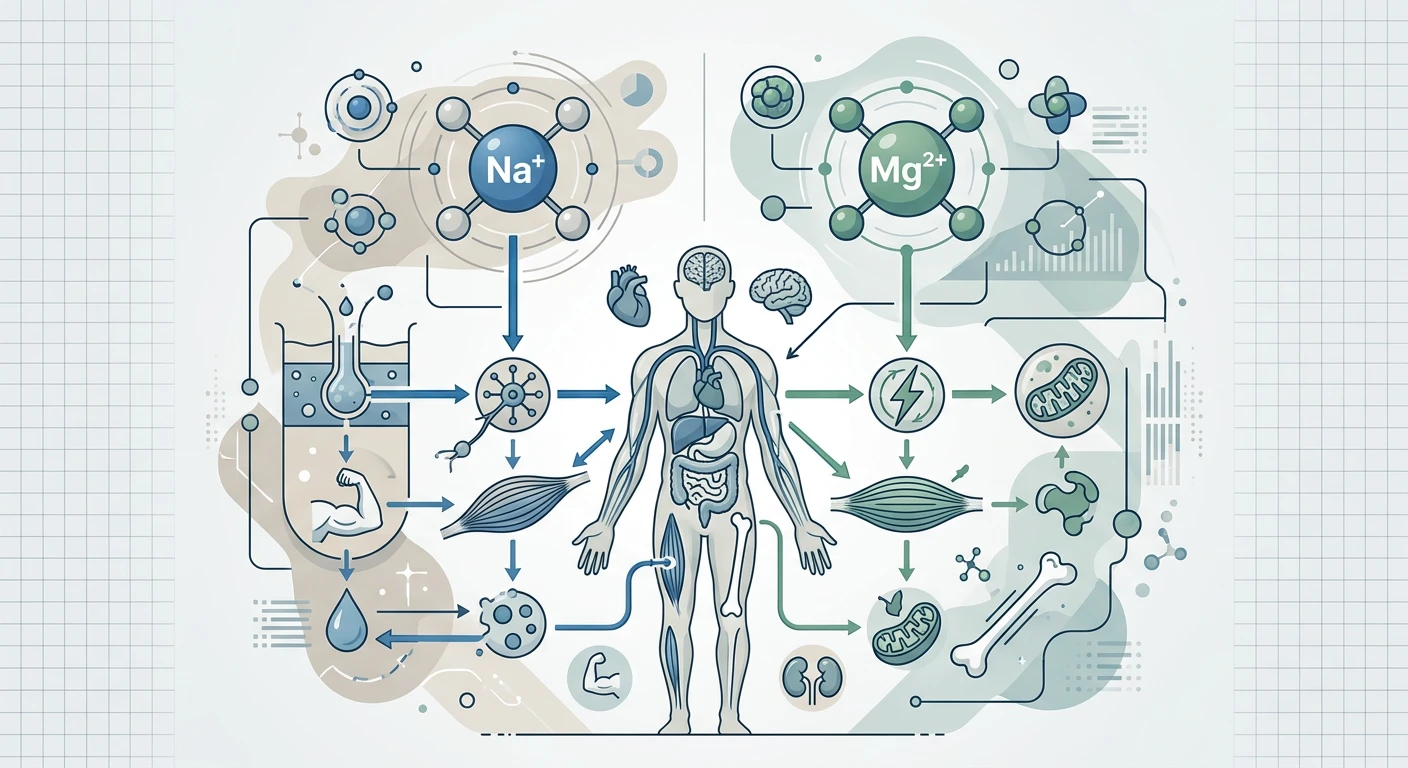
1. Sodium: The Electromechanical Engine of Contraction
Sodium is the main extracellular cation, vital for athletes, acting via the sodium-potassium pump (Na+/K+-ATPase) to generate an electrical charge and initiate muscle contractions by opening sodium channels and subsequent membrane depolarization.
Sodium is also important for maintaining plasma volume and osmotic pressure. When we sweat, we lose water and electrolytes, primarily sodium. If we drink only water, the sodium concentration in the blood can drop, leading to hyponatremia – a dangerous condition. Sodium also aids in the absorption of glucose and amino acids in the intestines, which is important for energy during sports.
Simply put: Sodium is like the "starter" for the muscle, allowing the nerve impulse to trigger a contraction. It also retains water in the blood, maintaining hydration and blood pressure during activity.
2. Magnesium: The Regulator of Relaxation and Energy
Magnesium is the fourth most abundant mineral in the body and the second most abundant cation within cells. It is required for over 300 enzyme systems that regulate biochemical reactions, including protein synthesis, muscle and nerve function, and blood sugar and blood pressure control.
For sports, magnesium is important for energy metabolism and muscle relaxation. The cell's primary energy currency – ATP – works best in a complex with magnesium (Mg-ATP). Without magnesium, ATP is unstable and cannot be used effectively. Magnesium also acts as a natural calcium antagonist. Calcium enters muscle cells to cause contraction. Magnesium competes with it for receptor binding and blocks calcium channels, which helps the muscle relax. Magnesium deficiency leads to increased neuromuscular excitability, manifesting as tremors, spasms, and cramps.
Simply put: Magnesium is like the "brake" and the "mechanic." It allows the muscle to relax after work by counteracting calcium. Additionally, it is important for recharging the body's energy stores (ATP).
Scientific Sources
- Office of Dietary Supplements - NIH: Magnesium Fact Sheet for Health Professionals
- Linus Pauling Institute - Micronutrient Information Center: Magnesium
- The Importance of Salt in the Athlete's Diet, 2015
- Examine.com: Magnesium In-depth Analysis
- EFSA: Dietary reference values for sodium, 2019
- Harvard T.H. Chan School of Public Health: Magnesium
The synergistic effect: Why do they work better together?
Although they have different functions, sodium and magnesium work together. The sodium-potassium pump, which is the basis of muscle contraction and nerve impulse (related to sodium), is an enzyme (ATPase) that requires magnesium to function. That is, Magnesium provides the energy for sodium to perform its task.
Healthy muscle function depends on the balance between contraction (stimulated by calcium and sodium) and relaxation (stimulated by magnesium and potassium). A deficiency in any of these elements disrupts the balance and leads to problems. An athlete who consumes enough sodium during training but has a chronic magnesium deficiency will likely still experience cramps, but they will occur more often at rest or during the night because the muscles cannot relax adequately. Conversely, an athlete with good magnesium levels who does not replenish the sodium lost through sweat risks acute cramps and impaired performance during exertion.
What is the practical algorithm for selection?
Choose Sodium if:
- You have an endurance workout lasting over 90 minutes.
- You train in hot and humid conditions and sweat profusely.
- You experience cramps, dizziness, or headaches *during* exertion.
- You want to optimize hydration and maintain plasma volume.
🔵 Choose Magnesium if:
- You suffer from muscle cramps or twitches *at rest* or at night.
- You want to improve sleep quality and recovery.
- You experience high physical or mental stress.
- You aim for long-term support for energy metabolism and muscle function.
The practical selection algorithm represents a recommended stack where athletes use Sodium (in an electrolyte drink) during training to maintain performance and hydration, and Magnesium (bisglycinate, citrate, or malate) in the evening before bed to improve recovery and muscle relaxation.
What is Protocol 2026: "Foundation and Performance Stack"?
Protocol 2026: "Foundation and Performance Stack" divides supplement intake into two phases: a foundational phase for daily use, and a training-specific phase aimed at improving performance.
- Daily Foundation: 200–400 mg of elemental magnesium, taken in the evening. Preferred forms are magnesium bisglycinate (for sleep and relaxation) or magnesium malate (if energy support is also desired). Daily sodium intake should come from food and be within recommendations (around 2-3 g).
- During Training (>90 min): 500–1000 mg of sodium per hour, dissolved in 500–750 ml of water. The amount depends heavily on individual sweat rate and intensity. Start with the lower limit and adjust according to feel. It can be obtained through electrolyte supplements or simply by adding ¼ to ½ tsp of table salt per liter of water.
Expert Note
Individual sodium needs vary significantly. Some athletes sweat and lose a lot of sodium – you might notice white salty traces on their clothes after training. For them, doses of 1000 mg/hour or even more may be necessary. It is best to experiment during training, not during competition, and learn to recognize your body's signals.
🧭 When to choose which?
- Focus on Sodium if the main goal is performance and hydration during long and intense exertion, especially in hot weather.
- Focus on Magnesium if the priority is recovery, sleep quality, and managing muscle cramps at rest.
- Combine them strategically (sodium during sport, magnesium in the evening) if you want to optimize the entire load and recovery cycle, which is the best approach for serious athletes.
📖 What are Sodium and Magnesium?
Sodium (Na): An electrolyte important for regulating the body's water balance, maintaining blood pressure, and the function of nerves and muscles. It is the primary electrolyte we lose through sweat.
Magnesium (Mg): An essential mineral involved in hundreds of enzymatic reactions, including energy production (ATP), DNA and protein synthesis, and the regulation of muscle relaxation and the nervous system.
⚖ Pros and Cons
| Pros | Cons | |
|---|---|---|
| Sodium | Improves hydration, prevents cramps during exercise, supports nerve function. | High intake (outside of sports) is associated with hypertension in sensitive individuals. |
| Magnesium | Improves sleep and recovery, reduces cramps at rest, supports energy metabolism. | Overdosing (especially with cheaper forms like oxide) can cause gastrointestinal discomfort. |
🗣 Explained Simply
| Criterion | Sodium | Magnesium |
|---|---|---|
| Metaphor | Gas pedal, spark | Brake pedal, oil |
| Main Job | To move the muscle (contraction) | To relax the muscle (relaxation) |
| Location of Action | Outside the cells | Inside the cells |
| When is it most important? | During exercise | After exercise and during the night |
Sodium is the "Go!" command, and Magnesium responds with "Stop and rest." Both are needed for efficient and safe movement.
Choose the right product for your goal:
- For energy and hydration during sports: Electrolyte and pre-workout formulas
- 🛌 For recovery and quality sleep: High-quality forms of magnesium
- For overall support: Explore our amino acids and BCAAs, often enriched with electrolytes.
Combined protocol with products:
- During training: Add electrolyte powder to your water.
- Immediately after training: Take a protein shake, which often contains essential minerals.
- Evening before bed: A capsule of magnesium bisglycinate for maximum recovery.
⚖ When to choose Sodium
- For endurance sports (running, cycling, triathlon).
- During training in hot weather leading to profuse sweating.
- If you experience cramps and weakness DURING physical exertion.
- If you are a "salty sweater" and see white traces on your clothes.
⚖ When to choose Magnesium
- If you experience muscle cramps and twitches AT REST or at night.
- For sleep problems, difficulty falling asleep, or frequent waking.
- When aiming to optimize recovery between training sessions.
- During periods of high stress that deplete magnesium stores.
Expert Note from Sport Zona
In my many years of working with athletes, I have noticed that the balance between sodium and magnesium is often an underestimated factor for performance. People either avoid salt and suffer cramps during long workouts, or they take magnesium without replenishing the electrolytes lost during training. View them not as adversaries, but as partners: one acts during physical activity, the other repairs the damage afterward. Their correct dosage and timing are necessary for success.
Recommended products
Frequently asked questions
Can Sodium and Magnesium be taken together?
Yes, absolutely. They do not interfere with each other and even work synergistically. Sodium is important during exercise for hydration, and magnesium is important after exercise for recovery. Many electrolyte drinks contain both minerals. It is important to maintain their balance, especially during prolonged exertion.
Which is better for beginners - Sodium or Magnesium?
For most beginners who do not train for more than an hour and do not sweat profusely, taking additional magnesium in the evening (200 mg) is more beneficial for improving sleep and recovery. Additional sodium is rarely needed unless workouts are very intense or in hot weather.
When is the best time to take Sodium and Magnesium?
The best time to take sodium is before and during prolonged exercise (over 60-90 minutes), dissolved in water as part of an electrolyte drink. Magnesium is best absorbed in the evening, about an hour before sleep, or immediately after exercise to aid muscle relaxation and recovery.
Are there side effects from taking Sodium or Magnesium?
Yes. Excessive sodium intake can lead to high blood pressure, water retention, and bloating. Too much magnesium (usually over 400-500 mg at once) can cause gastrointestinal discomfort and diarrhea, especially with lower-quality forms like magnesium oxide.
What is the recommended dosage for Sodium and Magnesium?
For sodium, athletes may need 500-1000 mg per hour of intense exertion. For magnesium, the recommended daily intake is about 420 mg for men and 320 mg for women, with athletes often benefiting from an additional 200-400 mg in supplement form.