Niacin (B3) vs. Pantothenic Acid (B5): The Energy Booster vs. The Stress Saver

Niacin (B3) and Pantothenic acid (B5) are important for energy metabolism. B3 regulates energy flow, while B5 is a key precursor for Coenzyme A.
Short answer: Niacin (B3) is critical for energy metabolism and vasodilation (the so-called "pump"), while Pantothenic Acid (B5) is key for hormone synthesis (cortisol, testosterone) and stress management. Practical advice: For general support, take a balanced B-complex. For performance focus, aim for 16-20 mg of niacin daily. For better stress recovery, 5-10 mg of pantothenic acid is sufficient. Do not exceed 35 mg of niacin daily from supplements without medical consultation.
B vitamins are key for athletic performance. They convert food into energy, without which the body cannot function. Niacin (vitamin B3) and pantothenic acid (vitamin B5) are often associated with energy metabolism, but they have different roles that every athlete should understand.
Niacin (B3) regulates energy flow – it directs energy and supports blood vessels. Pantothenic acid (B5) is involved in Coenzyme A, which breaks down and synthesizes almost all fuels – carbohydrates, fats, and proteins. Without it, energy from food is not accessible.
This article analyzes the two vitamins to help you understand when to use each or a combination of both for maximum results.
This article is part of the Expert Hub for Nutritional Supplements — over 270 expert-verified articles by Petar Mitkov and the Sport Zona team.
What is the comparative matrix between Niacin (B3) and Pantothenic Acid (B5)?
The comparative matrix between Niacin (Vitamin B3) and Pantothenic Acid (Vitamin B5) represents a systematic analysis of their biological statuses, main focuses, key mechanisms, and time horizons of action in the body, with B3 being a precursor to NAD+ and NADP+, and B5 being a precursor to Coenzyme A (CoA).
| Criterion | Niacin (Vitamin B3) | Pantothenic Acid (Vitamin B5) |
|---|---|---|
| Biological Status | Precursor of coenzymes NAD+ and NADP+ | Precursor of Coenzyme A (CoA) |
| Main Focus | Energy transfer, DNA repair, lipid metabolism | Central metabolic hub, synthesis of fatty acids and hormones |
| Key Mechanism | Participates in over 400 enzymatic redox reactions | Participates in acyl group transfer (basis of metabolism) |
| Time Horizon | Fast (energy) and long-term (lipid profile, DNA) | Constant and structural (necessary for every metabolic step) |
| Specific Bonus | Improves cholesterol (high doses), vasodilation | Supports adrenal function, skin health, hormone synthesis |
| Upper Limit (UL) | 35 mg/day (for nicotinic acid and niacinamide) from supplements | Not established; considered very safe |
How do the mechanisms work?
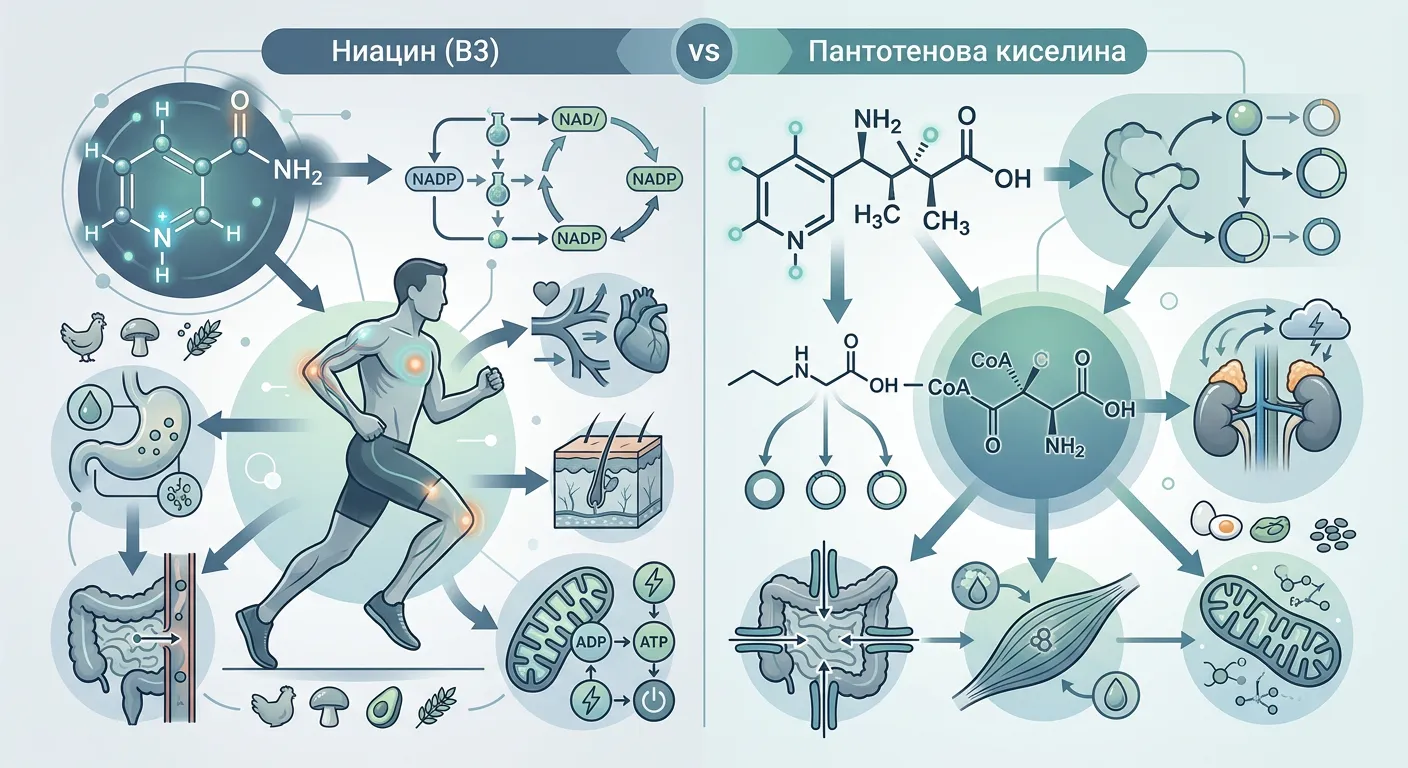
1. Niacin (B3): Energy Dispatcher and Cholesterol Regulator
Niacin is a building block for two key coenzymes: nicotinamide adenine dinucleotide (NAD+) and nicotinamide adenine dinucleotide phosphate (NADP+). These molecules are critical for catabolic (breaking down) and anabolic (building up) processes. NAD+ participates in glycolysis and the Krebs cycle, where it transports electrons from the breakdown of glucose and fats to the electron transport chain for ATP (adenosine triphosphate) production – the cell's primary energy currency. NADP+ is important for anabolic processes such as fatty acid and steroid synthesis, as well as for the regeneration of glutathione – a powerful antioxidant. Additionally, niacin, particularly nicotinic acid in high doses, improves lipid profile by lowering LDL ("bad") cholesterol and triglycerides and increasing HDL ("good") cholesterol.Niacin (B3) is a key cofactor that supports the creation of NAD+ – a primary coenzyme that serves as the cell's energy "battery," transferring energy from food for all muscle contractions and cellular processes.
2. Pantothenic Acid (B5): The Universal Metabolic Tool
Pantothenic acid is part of Coenzyme A (CoA). The "A" stands for "acetylation" – the transfer of acyl groups, which is the basis of all intermediary metabolism. CoA is absolutely essential for:- Entry into the Krebs Cycle: CoA binds to the breakdown products of glucose, fats, and amino acids, forming acetyl-CoA – the molecule that "fuels" the Krebs cycle for energy production.
- Fatty Acid Synthesis and Oxidation: CoA is needed for both building fats (for energy storage) and breaking them down (beta-oxidation) to release energy.
- Synthesis of Steroid Hormones, Cholesterol, and Neurotransmitters: The production of cortisol, testosterone, estrogen, and acetylcholine depends on CoA.
Simply put: Pantothenic acid (B5) helps process nutrients. It takes carbohydrates and fats and prepares them for energy production or for building new cells.
Scientific Sources
- Peechakara, B.V. and Gupta, M. Niacin. StatPearls, 2023.
- Office of Dietary Supplements - NIH. Niacin Fact Sheet for Health Professionals.
- Linus Pauling Institute. Pantothenic Acid.
- EFSA Panel on Dietetic Products, Nutrition and Allergies (NDA). Scientific Opinion on Dietary Reference Values for pantothenic acid. EFSA Journal, 2014.
- Examine.com. Niacin - Health benefits, dosage, side effects.
- Harvard T.H. Chan School of Public Health. Niacin – Vitamin B3.
The Synergistic Effect: Why Do They Work Better Together?
Niacin and pantothenic acid do not compete; they work together to produce energy. Their synergy is evident in the Krebs cycle – the cell's primary energy process.
Pantothenic acid (as CoA) introduces the fuel (acetyl-CoA) into the cycle. Without it, the cycle cannot function. Once the fuel enters, a series of reactions extracts energy in the form of electrons. Here, niacin (as NAD+) collects these electrons and transports them to the electron transport chain, where most ATP is produced. If one is missing, the entire process slows down or stops. That's why most quality B-complex formulas contain both vitamins in balanced ratios.
What is the best practical algorithm for selection?
Choose Niacin (B3) if:
- You need support for your lipid profile (high LDL, low HDL), but only after consulting a doctor and using the appropriate form (nicotinic acid).
- You are looking for improved peripheral circulation (use "flush-free" forms like inositol hexanicotinate to avoid discomfort).
- You have specific needs related to cellular health and DNA repair.
- You consume a diet low in tryptophan (which the body can convert to niacin) and whole grains.
🔵 Choose Pantothenic Acid (B5) if:
- You are under high physical or mental stress, for adrenal support.
- Your training volume is very high and you need to optimize energy metabolism and recovery.
- You want to support skin health, hair, and wound healing.
- You are looking for broad-spectrum metabolic support without the risk of side effects.
Recommended Stack for General Support
The practical algorithm for choosing a B vitamin supplement for most athletes is to take a quality B-complex, which provides baseline levels of all B vitamins in complementary ratios. For specific needs, such as high stress, a small additional dose of B5 (250-500 mg) can be added, while high doses of niacin should only be taken under medical supervision.
What is the 2026 Protocol: "Foundation and Performance Stack"?
The 2026 Protocol: "Foundation and Performance Stack" represents a modern approach to B-vitamin supplementation, focusing on synergy and the right timing of intake for consistently maintaining proper levels, rather than isolated megadoses.
- Daily (Foundation): Take a quality B-complex with food in the morning. Look for a formula with around 15-25 mg of niacin (as niacinamide) and 25-50 mg of pantothenic acid. This covers basic needs.
- During High Stress or Volume: Add 250 mg of pantothenic acid (B5) after training or in the evening to support recovery and adrenal function.
- Important for Niacin (B3): Avoid taking high doses of nicotinic acid (over 50-100 mg) in the hours around training. This can reduce the body's ability to use fats for fuel, which is undesirable for endurance sports.
Expert Note on the Protocol
In my work with athletes over many years, I have observed that isolated intake of B vitamins is rarely the best solution. The body uses them together, and too much of one can disrupt the absorption of another. For most people, the solution is a high-quality B-complex taken in the morning. Adding separate pantothenic acid makes sense for athletes under significant stress. High doses of niacin are for medical cases, not for sports supplementation.
🧭 When to Choose Which?
- Choose Niacin (B3) (in specific forms) if your goal is beyond direct sports performance – for example, cholesterol control (under medical supervision) or supporting circulation.
- Choose Pantothenic Acid (B5) if you are under intense training and high stress, and want to support your adrenal glands and overall metabolism.
- Combine them (via B-complex) as a foundation for any physically active person. This is the safest and most effective approach for most athletes.
📖 What are Niacin (B3) and Pantothenic Acid (B5)?
- Niacin (Vitamin B3): A water-soluble vitamin, a precursor to the coenzymes NAD+ and NADP+, important for energy production, DNA repair, and cell signaling.
- Pantothenic Acid (Vitamin B5): A water-soluble vitamin, a key component of Coenzyme A (CoA), central to the metabolism of carbohydrates, fats, and proteins.
⚖ Pros and Cons
| Niacin (B3) | Pantothenic Acid (B5) |
|---|---|
| Pros: Effective for cholesterol control (high doses); improves circulation; important for energy and DNA repair. | Pros: Very safe; supports adrenal glands; central to all metabolism; promotes skin health. |
| Cons: "Niacin flush" (redness, itching) from nicotinic acid; risk of hepatotoxicity at high doses; may suppress fat burning around training. | Cons: Deficiency is very rare; benefits of megadoses for athletic performance are not conclusively proven; the effect is more supportive than directly stimulating. |
🗣 Explained Simply
The difference is like between the power grid and the foreman with tools on a construction site:
- Niacin (B3) is the power grid. It provides the energy (ATP) for all the machines to run. Without power, nothing happens.
- Pantothenic acid (B5) is the foreman with the tools. It takes the materials (carbohydrates, fats, proteins) and supplies them to the workers or uses them to build new structures.
Choose the right product for your goal:
- Basic Energy and Metabolism: Start with a quality B-complex to provide the foundation.
- Anti-Stress and Recovery: Combine B-complex with adaptogens like ashwagandha for synergistic effects on stress.
- Workout Support: For energy during exertion, consider pre-workout formulas, but check the niacin content in them!
⚖ When to choose Niacin (B3)
- For lipid profile control (with a doctor).
- If you are looking for a vasodilating effect (outside of sports).
- For general cellular energy support.
- With a diet low in this vitamin.
⚖ When to choose Pantothenic Acid (B5)
- Under high physical and emotional stress.
- During intense training periods.
- To support skin and hair health.
- As safe, broad-spectrum metabolic support.
Expert Note from Sport Zona
After many years of working with athletes, I have noticed that isolated intake of B vitamins is rarely the best solution. The body uses them in a complex balance, and an imbalance in favor of one can disrupt the absorption of another. For most people, the solution is a high-quality B-complex taken in the morning. Adding separate pantothenic acid makes sense for athletes preparing for competition who are under immense stress. High doses of niacin are intended for medical cases, not for sports supplementation.
Recommended products
Frequently asked questions
Can Niacin (B3) and Pantothenic Acid (B5) be taken together?
Yes, it is even recommended. They are part of the B-complex group and work in synergy for optimal metabolism. They do not compete for absorption, and taking them together provides more comprehensive support for the body.
Which is better for beginners - Niacin (B3) or Pantothenic Acid (B5)?
For beginners, the best approach is not to choose one over the other, but to ensure adequate amounts of both through a balanced diet or a high-quality multivitamin/B-complex. Specialized intake is for advanced athletes with specific goals.
When is it best to take Niacin (B3) and Pantothenic Acid (B5)?
As water-soluble vitamins, they can be taken at any time of the day. It is recommended to take them with food to improve absorption and avoid potential stomach discomfort. If a pumping effect from Niacin is desired, it can be taken 30-45 minutes before a workout.
Are there side effects of taking Niacin (B3) or Pantothenic Acid (B5)?
Pantothenic Acid (B5) is extremely safe and has no known side effects even at high doses. Niacin (B3), in its form as nicotinic acid, can cause the so-called niacin flush (warmth, itching, skin redness), which is harmless but unpleasant. Flush-free forms (such as niacinamide) avoid this. Very high doses (over 500 mg) should only be taken under medical supervision.
What is the recommended dosage of Niacin (B3) and Pantothenic Acid (B5)?
The recommended daily intake for adults is about 16 mg for Niacin (B3) and 5 mg for Pantothenic Acid (B5). Active athletes may need slightly higher doses, but it is important not to exceed the upper limit for Niacin of 35 mg daily (from supplements) without medical consultation. For B5, there is no established upper limit due to its high safety.