Vitamin C vs. Vitamin E: The Water-Soluble Defender vs. The Fat-Soluble Protector

Vitamin C protects aqueous zones, vitamin E protects lipid zones. Understanding them helps to restore and reduce muscle damage.
Short Answer: Vitamin C is a water-soluble antioxidant, key for immune function and short-term recovery, while Vitamin E is fat-soluble and protects cell membranes from long-term damage. They work synergistically. Practical advice: For athletes, take 250–500 mg of Vitamin C daily (post-workout) and 15 mg (22.4 IU) of Vitamin E (d-alpha-tocopherol) with a fat-rich meal. Do not exceed 2000 mg of Vitamin C and 1000 mg of Vitamin E daily.
Vitamin C and Vitamin E are well-known antioxidants, but they have different roles in an athlete's body. Vitamin C acts in the watery parts of the body – in the blood and intercellular fluids. It is the first line of defense against free radicals formed during intense training.
Vitamin E is fat-soluble and integrates into cell membranes. Its job is to protect these membranes from damage. It works in a lipid environment, protecting cells from the inside. Understanding how they function will help you better optimize your recovery, reduce muscle damage, and support your immune system.
This article is part of the Expert Hub for Nutritional Supplements — over 270 expertly verified articles by Petar Mitkov and the Sport Zona team.
What is the main difference between Vitamin C and Vitamin E?
Vitamin C (Ascorbic Acid) is a water-soluble antioxidant acting in an aqueous environment, while Vitamin E (Tocopherols) is a fat-soluble protector operating in the lipid environment of cell membranes.
| Criterion | Vitamin C (Ascorbic Acid) | Vitamin E (Tocopherols) |
|---|---|---|
| Biological Status | Water-soluble | Fat-soluble |
| Primary Area of Action | Aqueous environment (plasma, cytosol) | Lipid environment (cell membranes) |
| Primary Mechanism | Electron donor, regenerates Vitamin E | Interrupts the chain reaction of lipid peroxidation |
| Time Horizon | Rapid action, short half-life | Long-lasting protection, stored in tissues |
| Specific Athletic Benefit | Collagen synthesis (joints), immune support | Reduced muscle damage (DOMS) |
| Upper Limit (UL) | 2,000 mg/day | 1,000 mg/day (~1500 IU) |
What are the mechanisms of Vitamin C and E?
Vitamin C and Vitamin E are antioxidants that act in different parts of the body and use different methods to neutralize oxidative stress from strenuous physical exertion.
1. Vitamin C: The Rapid Response in Aqueous Environments
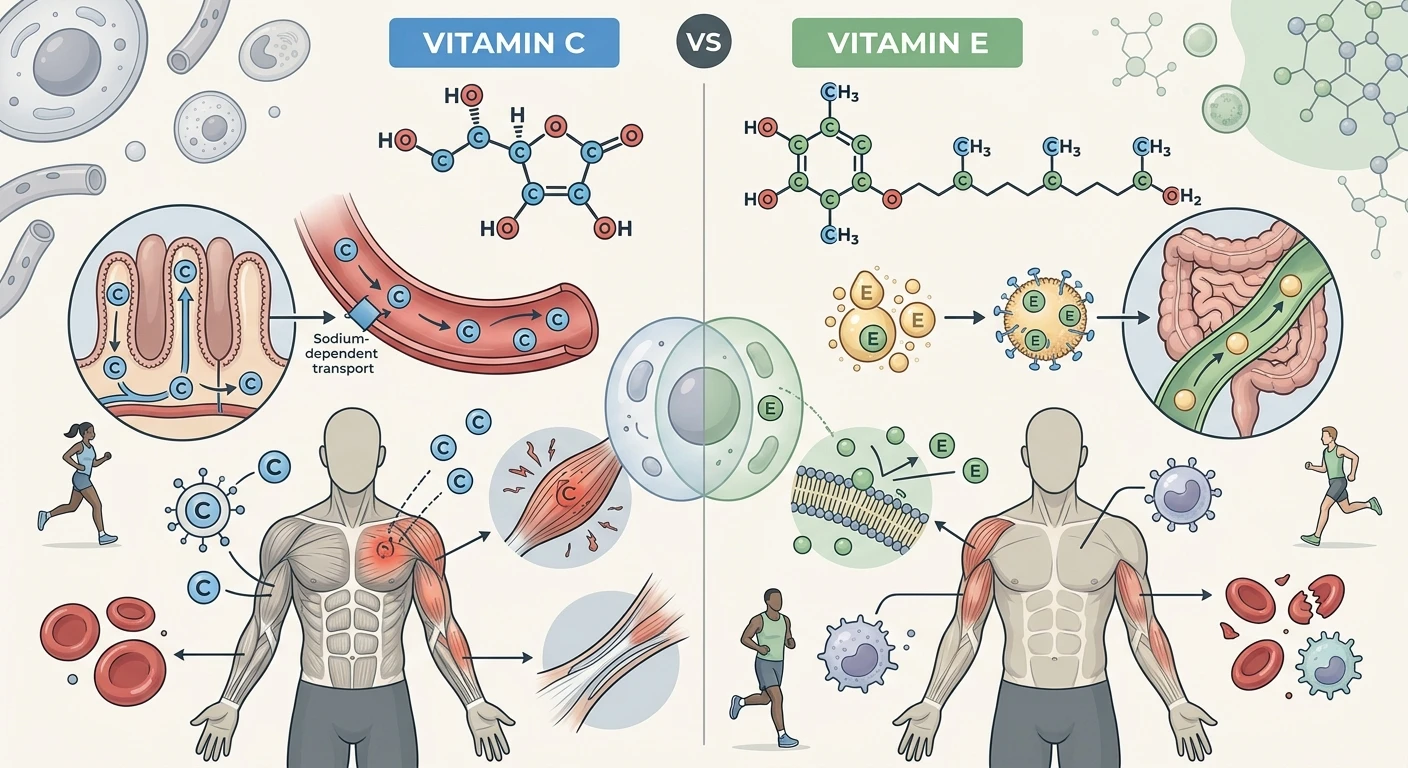
As a water-soluble antioxidant, ascorbic acid circulates freely in blood plasma and intracellular fluids. Its primary function is to "donate" electrons to unstable free radicals. This neutralizes them before they can damage important structures like DNA or proteins. Thus, Vitamin C effectively combats the short-term but intense oxidative stress during exercise.
Vitamin C is also an important cofactor in collagen synthesis – the main protein that builds connective tissue, tendons, joint cartilage, and skin. For athletes, this means healthier joints and faster recovery from micro-tears in tissues. It supports immune function by stimulating the activity of white blood cells.
Simply put: Vitamin C cleans up. It removes harmful free radicals from the blood and helps "repair" connective tissue by providing building blocks for collagen.
2. Vitamin E: The Structural Defender of Cell Membranes
Vitamin E is a group of fat-soluble compounds, with alpha-tocopherol being the most active. Its fat-soluble nature allows it to integrate directly into the lipid bilayer of cell membranes. This gives it a strategic advantage. From this position, it acts as a "chain breaker."
When free radicals attack the fatty acids in the membrane, they initiate a chain reaction called lipid peroxidation, which can lead to cell breakdown. Vitamin E absorbs the blow by accepting the radical and stopping the chain reaction before it spreads. This is important for muscle cells, whose membranes are subjected to significant mechanical stress and oxidative attacks during contractions.
Scientific Sources
- Vitamin C - Fact Sheet for Health Professionals, National Institutes of Health (NIH)
- Vitamin E, Linus Pauling Institute at Oregon State University
- Combined vitamin C and E supplementation during exhausting exercise, 2007
- Vitamin C - Scientific Review on Usage, Dosage, Side Effects, Examine.com
- Vitamin E - Fact Sheet for Health Professionals, National Institutes of Health (NIH)
- Vitamin E, The Nutrition Source, Harvard T.H. Chan School of Public Health
The Synergistic Effect: Why Do They Work Better Together?
Vitamin C and E work in combination. When Vitamin E neutralizes a free radical in the cell membrane, it becomes a weak radical itself (a tocopheroxyl radical) and loses its antioxidant capacity. This is where Vitamin C comes in.
Water-soluble Vitamin C, located at the interface between the aqueous and lipid environments, "donates" an electron to the oxidized Vitamin E. This "recharges" Vitamin E, returning it to its active form and allowing it to continue protecting the membrane. Without Vitamin C, Vitamin E would be depleted more quickly. Thus, Vitamin C protects the aqueous environment while simultaneously supporting protection in the lipid environment. They complement each other effectively.
How to Choose Between Vitamin C and Vitamin E?
The choice of Vitamin C, Vitamin E, or a combination is an individual decision determined by specific goals, the type of physical exertion, and the individual's personal needs.
Take Vitamin C if:
- You want to boost your immune system during heavy training periods or in winter.
- You need support for the health of your joints, tendons, and connective tissue (collagen synthesis).
- You are looking for rapid, general antioxidant protection against daily stress and workouts.
- Your diet is low in fresh fruits and vegetables.
🔵 Take Vitamin E if:
- Your training involves many eccentric movements that cause severe muscle soreness (DOMS).
- Your goal is to reduce direct muscle cell damage and speed up their recovery.
- You want long-lasting, structural protection for cell membranes.
- Your diet is low in fats, nuts, and seeds.
Recommended Stack for Maximum Synergy:
For comprehensive antioxidant support, combine 500-1000 mg of Vitamin C (divided into two doses) with 200-400 IU (134-268 mg) of Vitamin E in the form of mixed tocopherols. Take them with a meal containing fats to improve Vitamin E absorption.
What is Protocol 2026?
Protocol 2026 is a modern approach to antioxidant supplementation that avoids excessively high doses and focuses on strategic intake, supporting the body's natural defense mechanisms.
- Daily Basis: 500 mg Vitamin C and 200 IU Vitamin E (mixed tocopherols), taken in the morning with a meal rich in healthy fats (avocado, nuts, olive oil).
- Post-Workout: An additional 500 mg of Vitamin C (preferably as calcium ascorbate for gentler stomach action) along with your protein shake to aid recovery and Vitamin E regeneration.
- During Extreme Exertion: During periods of double training sessions or competitions, the Vitamin E dose can be temporarily increased to 400 IU to provide additional protection for muscle membranes.
Expert Note on Dosage
More is not always better. Studies show that excessively high doses of antioxidants, especially around workouts, can blunt important adaptation signaling pathways. The goal is to manage excessive damage, not to completely eliminate oxidative stress, which is a necessary stimulus for growth.
🧭 When to Choose What?
- Take Vitamin C if your primary concern is immunity, joint health, and general antioxidant protection in aqueous environments.
- Take Vitamin E if you are focusing on reducing muscle damage from heavy and eccentric training and protecting cell membranes.
- Combine them if you are an athlete who needs complete, dual-phase (aqueous and lipid) antioxidant protection for recovery and consistency.
📖 What are Vitamin C and Vitamin E?
Vitamin C (Ascorbic Acid) is a water-soluble vitamin and antioxidant that is important for immune function, collagen synthesis, and protecting cells from oxidative stress in aqueous environments.
Vitamin E (Tocopherols and Tocotrienols) is a fat-soluble vitamin that acts as a primary antioxidant in cell membranes, protecting them from lipid peroxidation and maintaining their structural integrity.
⚖ Pros and Cons
| Vitamin C | Vitamin E |
|---|---|
| Pros: Rapid action, supports immunity and collagen, low toxicity risk. | Pros: Protects muscle membranes, reduces muscle damage, long-lasting effect. |
| Cons: Short half-life (requires frequent intake), high doses can cause stomach discomfort. | Cons: Fat-soluble (can accumulate), high doses can affect blood clotting. |
🗣 Explained Simply
If your body were a city, here's how the two vitamins work:
- Vitamin C is the "Police": It patrols the "streets" (blood vessels) and arrests the "criminals" (free radicals) before they invade the "buildings" (cells).
- Vitamin E is the "Wall": It's built into the walls of each "building" (cell) and absorbs impacts to prevent the building from collapsing.
They don't interfere with each other; they complement each other. The police keep the streets clean, and the walls keep the buildings strong.
Choose the Right Product for Your Goal:
- For overall antioxidant support: Multivitamins and Minerals
- For healthy joints and connective tissue: Joint and Collagen Formulas
- For maximum recovery: Proteins and Amino Acids
Combined Recovery Protocol:
⚖ When to Take Vitamin C
- To support the immune system
- For healthy joints and collagen synthesis
- As a primary water-soluble antioxidant
- To regenerate Vitamin E
⚖ When to Take Vitamin E
- During intense, muscle-damaging workouts
- To protect cell membranes
- To reduce DOMS symptoms
- As a primary fat-soluble antioxidant
Expert Note from Sport Zona
In my many years working with athletes, I've seen that consistency is more important than intensity. Frequent interruptions due to colds or excessive muscle soreness derail training cycles. Moderate intake of Vitamin C and E isn't a magic formula for better performance, but rather insurance against disruptions. It's an investment in more healthy training days, which ultimately leads to significantly better results.
Recommended products
Frequently asked questions
Can Vitamin C and Vitamin E be taken together?
Yes, and it is even recommended. They have a synergistic effect – Vitamin C helps regenerate Vitamin E after it has neutralized free radicals. Combined intake provides more complete antioxidant protection for the body.
Which is better for beginners - Vitamin C or Vitamin E?
Both vitamins are fundamental for health. For beginner athletes, who often experience muscle pain and stress on the immune system, Vitamin C may have a more noticeable effect initially due to its role in collagen synthesis and immunity. In the long term, both are equally important.
When is the best time to take Vitamin C and Vitamin E?
Vitamin C is water-soluble and can be taken at any time, but many athletes prefer it after training to aid recovery. Vitamin E is fat-soluble, so it is best taken with food containing fats (e.g., nuts, avocado, olive oil) for maximum absorption.
Are there side effects from taking Vitamin C or Vitamin E?
At recommended doses, both are safe. Very high doses of Vitamin C (>2000 mg/day) can cause gastrointestinal upset. Excessive intake of Vitamin E (>1000 mg/day) can increase the risk of bleeding, as it interferes with blood clotting.
What is the recommended dosage of Vitamin C and Vitamin E?
The recommended daily intake (RDI) for adults is about 90 mg for Vitamin C and 15 mg (22.4 IU) for Vitamin E. Active athletes can take 250-1000 mg of Vitamin C, while for Vitamin E, the dose usually remains close to the RDI, unless there is a specific medical recommendation.