Vitamin E vs. Vitamin A: The Antioxidant Defender vs. The Visual Immune Sentinel

Vitamin E protects cells from free radicals, and Vitamin A directs tissue repair and building. Both are important for athletes.
Short answer: Vitamin E is a fat-soluble antioxidant that protects cell membranes from oxidative stress after training. Vitamin A is key for vision, immune function, and cell differentiation. Practical tip: For athletes, combine 15-30 mg (22.4-45 IU) of vitamin E (as d-alpha-tocopherol) with 700-900 mcg RAE of vitamin A daily, taken with a fat-containing meal for optimal absorption. Do not exceed upper limits.
When we train hard, the body is subjected to stress. To recover properly and function well, it needs calories, macronutrients, and micronutrients that regulate important processes. Vitamins A and E are two such micronutrients. Both are fat-soluble and act as antioxidants, but they have different roles in an athlete's body.
We can compare them to a team building a new building after destruction (training). Vitamin A is like the architect. It guides the process – determining where cells should go, how they should develop to build healthy tissues, a strong immune system, and good vision. Without it, recovery is chaotic. Vitamin E is the security guard of the construction site. It protects and neutralizes damage caused by free radicals, which can harm the building materials (cells).
To optimize recovery, protect ourselves from illness, and achieve good athletic results, it is important to understand when and how to use each of these vitamins. This article will examine both vitamins to give you a clear picture.
This article is part of the Expert Hub for Nutritional Supplements — over 270 expertly verified articles by Petar Mitkov and the Sport Zona team.
What is a Comparative Matrix for Systemic Analysis?
A comparative matrix is a systematic analysis tool that compares Vitamin E (Tocopherol) and Vitamin A (Retinol/Carotenoids) across various criteria, including biological status, primary focus, mechanism, and time horizon, to evaluate their properties, roles, and risks.
| Criterion | Vitamin E (Tocopherol) | Vitamin A (Retinol/Carotenoids) |
|---|---|---|
| Biological Status | Fat-soluble vitamin | Fat-soluble vitamin |
| Primary Focus | Antioxidant protection of cell membranes | Cell differentiation, vision, immune function |
| Mechanism | Interrupts the chain reaction of lipid peroxidation | Binds to nuclear receptors (RAR/RXR) and regulates gene expression |
| Time Horizon | Immediate, protective (during and after oxidative stress) | Long-term, structural (for growth and maintenance) |
| Risk of Toxicity | Moderate (very high doses can affect blood clotting) | High (especially from retinol), can lead to hypervitaminosis A |
| Specific Benefit for Athletes | Reduced muscle damage and inflammation after training | Maintained immunity during heavy loads, epithelial tissue health |
What are the Mechanisms of Action of Vitamins?
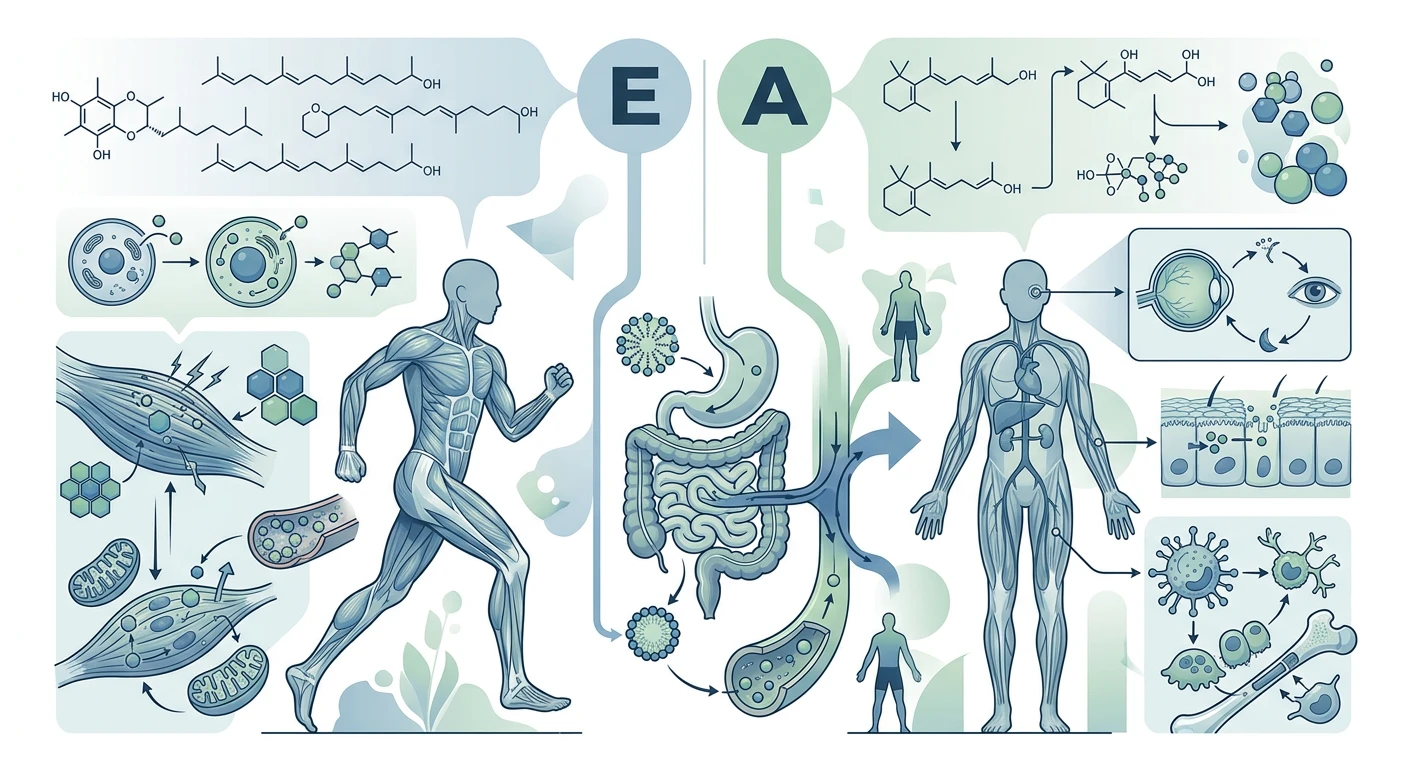
1. Vitamin E: The Guardian of Cell Membranes
Vitamin E's primary role is antioxidant protection of cells, especially in fatty environments, by protecting cell membranes from lipid peroxidation caused by free radicals generated during intense training.
Vitamin E, mainly in the form of Alpha-tocopherol, integrates into these membranes. When a free radical attacks, vitamin E neutralizes it by donating an electron. Vitamin E itself becomes a radical, but a much less reactive one, and is quickly regenerated by other antioxidants like vitamin C. This stops the chain reaction that would otherwise damage the cell membrane, causing muscle damage and inflammation.
Simply put: Vitamin E embeds itself into the walls of muscle cells like a bodyguard. When free radicals (from training) try to damage them, it takes the hit and neutralizes them, keeping the cell healthy.
2. Vitamin A: The Architect of Vision and Growth
Vitamin A controls gene expression, a more fundamental function than vitamin E's direct antioxidant protection. It exists in two main forms: Retinoids (retinol, from animal sources) and Carotenoids (beta-carotene, from plant sources), which the body can convert into vitamin A.
The active form, retinoic acid, enters the cell nucleus and binds to specific receptors (RAR and RXR). This complex acts as a switch that activates or deactivates certain genes. Thus, vitamin A controls processes such as:
- Cell differentiation: It instructs stem cells on what to become – skin cells, immune cells (T-cells, B-cells), bone cells.
- Immune function: It regulates the production and function of important immune cells, which is crucial for athletes at risk of infections due to heavy training.
- Vision: Retinol is an essential component of rhodopsin, a pigment in the retina that captures light and is necessary for night vision.
Simply put: Vitamin A is like a construction engineer who reads the body's genetic blueprint and instructs cells on how to build and repair tissues, especially the immune system and skin.
Scientific Sources
- Vitamin E Fact Sheet for Health Professionals, National Institutes of Health (NIH)
- Vitamin A Fact Sheet for Health Professionals, National Institutes of Health (NIH)
- Vitamin E, Linus Pauling Institute, Oregon State University
- Vitamin E and athletic performance, Journal of the International Society of Sports Nutrition, 2014
- Scientific Opinion on Dietary Reference Values for vitamin A, EFSA Journal, 2015
What is the Synergistic Effect: Why Do They Work Better Together?
Despite their different functions, vitamins A and E work in combination. Vitamin E protects vitamin A from oxidation in the digestive tract and tissues, improving its bioavailability and effectiveness. In turn, adequate vitamin A levels are necessary for the synthesis of proteins that transport vitamin E in the body.
Their combination is very beneficial for the immune system. Vitamin A aids in the production of new immune cells, while vitamin E protects them from oxidative damage while fighting pathogens. For athletes, this means fewer missed training sessions due to colds and faster tissue recovery.
What is the Practical Algorithm for Choosing Vitamin E and Vitamin A?
Choose Vitamin E if:
- Your goal is to reduce muscle soreness and damage after intense workouts.
- You participate in high-intensity and endurance sports (running, cycling, CrossFit).
- Your diet is rich in polyunsaturated fats (omega-3, nuts, seeds), which require antioxidant protection.
- You want to support recovery and reduce inflammatory processes.
🔵 Choose Vitamin A if:
- You get sick often or your immune system is weakened by heavy training cycles.
- You have problems with night vision or dry eyes.
- Your diet is restricted and low in animal products (liver, dairy) and orange/green vegetables.
- You want to improve the health of your skin and mucous membranes, which are the first barrier against infections.
Combination for Comprehensive Support
The practical algorithm for choosing Vitamin E and Vitamin A is to combine a moderate dose of Mixed Tocopherols (vitamin E) with Beta-carotene, which is a safer pro-vitamin form of vitamin A, providing a protective and structural effect without a high risk of toxicity.
How Important is the 2026 Protocol "Foundation and Performance Stack"?
The 2026 "Foundation and Performance Stack" protocol represents an approach to good health and high performance that emphasizes consistent and moderate nutrient intake rather than megadoses.
- Daily Foundation:
- Vitamin E: 100–200 IU (67–134 mg) in the form of mixed tocopherols. This form offers more benefits than alpha-tocopherol alone.
- Vitamin A: 5,000–10,000 IU (3-6 mg) in the form of Beta-carotene. The body converts only as much as it needs, eliminating the risk of retinol toxicity. The upper limit for retinol intake is 10,000 IU (3,000 mcg) per day.
- After Intense Training:
- No additional dose is needed if the daily intake is consistent. Antioxidant capacity is built over time. Excessive antioxidant intake immediately after training can interfere with beneficial adaptive signals.
Expert Note
From experience, I know that athletes are often tempted to take high doses of vitamin A (retinol) during the winter months hoping to avoid illness. This is not a good strategy. I have observed headaches and dry skin, which are early signs of toxicity. Stick to beta-carotene – it's safer and just as effective in the long run.
🧭 When to Choose Which?
- Choose Vitamin E if your focus is on reducing muscle damage and faster recovery after intense exertion.
- Choose Vitamin A (beta-carotene) if you want to strengthen your immune system, especially during periods of overtraining risk, or if your diet is limited.
- Combine both in moderate doses for comprehensive, synergistic support of recovery and immunity – this is the best approach for most athletes.
📖 What are Vitamin E and Vitamin A?
Vitamin E (Tocopherol): A fat-soluble antioxidant that protects cell membranes from oxidative damage caused by free radicals.
Vitamin A (Retinol/Carotenoids): A fat-soluble vitamin that regulates gene expression, cell growth, immune function, and vision.
⚖ Pros and Cons
| Pros | Cons | |
|---|---|---|
| Vitamin E | Potent antioxidant; reduces muscle damage; relatively safe. | High doses can thin blood; may blunt training adaptation. |
| Vitamin A | Critical for immunity and vision; supports cell growth. | High risk of toxicity (retinol); requires careful dosing. |
🗣 Explained Simply
If your body were a race car:
| Criterion | Vitamin E | Vitamin A |
|---|---|---|
| Main Role | Protection | Regulation and Construction |
| Metaphor | Paint Shield (protects from rust/oxidation) | Onboard Computer (manages systems) |
| When is it Important? | During and after the race (for damage) | In the garage (for maintenance and upgrades) |
Choose the Right Product for Your Goal:
- For comprehensive health support: Explore our multivitamin and mineral formulas.
- For maximum recovery: Combine with amino acids and BCAAs to also provide the building blocks.
- For pre-workout energy: Fuel up with quality pre-workout products.
Combined Protocol for Athletes
- Pre-workout: Fuel up with energy and focus from a nitric oxide booster.
- Daily: Ensure the foundation with vitamins and minerals, including beta-carotene and vitamin E.
- Post-workout: Accelerate recovery with whey protein and amino acids.
⚖ When to Choose Vitamin E
- Your workouts are long and exhausting.
- You want to reduce muscle soreness.
- Your diet includes a lot of vegetable oils and nuts.
- Your primary goal is muscle recovery.
⚖ When to Choose Vitamin A
- Your immune system is weak.
- You skip meals and your diet is poor.
- You want to strengthen the body's protective barriers (skin, mucous membranes).
- You notice worsening night vision.
Expert Note from Sport Zona
In my practice, I observe that many athletes take high doses of vitamin E for antioxidant effects after intense workouts but neglect the important role of vitamin A for immunity. This is a mistake. Athletes achieve the best results who maintain stable, moderate levels of both vitamins through a varied diet and sensible supplementation. Instead of looking for a "magic bullet" in high doses of one, build a solid foundation. This is the path to longevity in sports.
Recommended products
Frequently asked questions
Can Vitamin E and Vitamin A be taken together?
Yes, taking them together is not only possible but also recommended. Vitamin E helps protect Vitamin A from oxidation. Since both are fat-soluble, take them with a meal containing fat to improve absorption. Follow the recommended dosages to avoid toxicity.
Which is better for beginners - Vitamin E or Vitamin A?
For beginner athletes, the focus should be on a balanced diet. Neither vitamin is "better". Consult a specialist before starting high-dose supplementation. The best start is a quality multivitamin complex that provides basic amounts of both.
When is the best time to take Vitamin E and Vitamin A?
As they are fat-soluble vitamins, the best time to take Vitamin E and Vitamin A is during a meal that contains fat (e.g., with olive oil, nuts, avocado, or fish). This significantly improves their absorption by the body.
Are there side effects from taking Vitamin E or Vitamin A?
Yes, both vitamins can be toxic if taken in excess. High doses of Vitamin A (hypervitaminosis A) can damage the liver and cause headaches. Excessively high doses of Vitamin E can interfere with blood clotting. Always adhere to the recommended upper limits.
What is the recommended dosage of Vitamin E and Vitamin A?
The Recommended Daily Allowance (RDA) for Vitamin A is 900 mcg RAE for men and 700 mcg RAE for women. For Vitamin E, it is 15 mg (22.4 IU) for adults. Athletes may have slightly increased needs, but it is crucial not to exceed the upper tolerable intake level of 3,000 mcg for Vitamin A and 1,000 mg for Vitamin E.