Biceps ve Triceps Antrenmanı — Kol Setleri
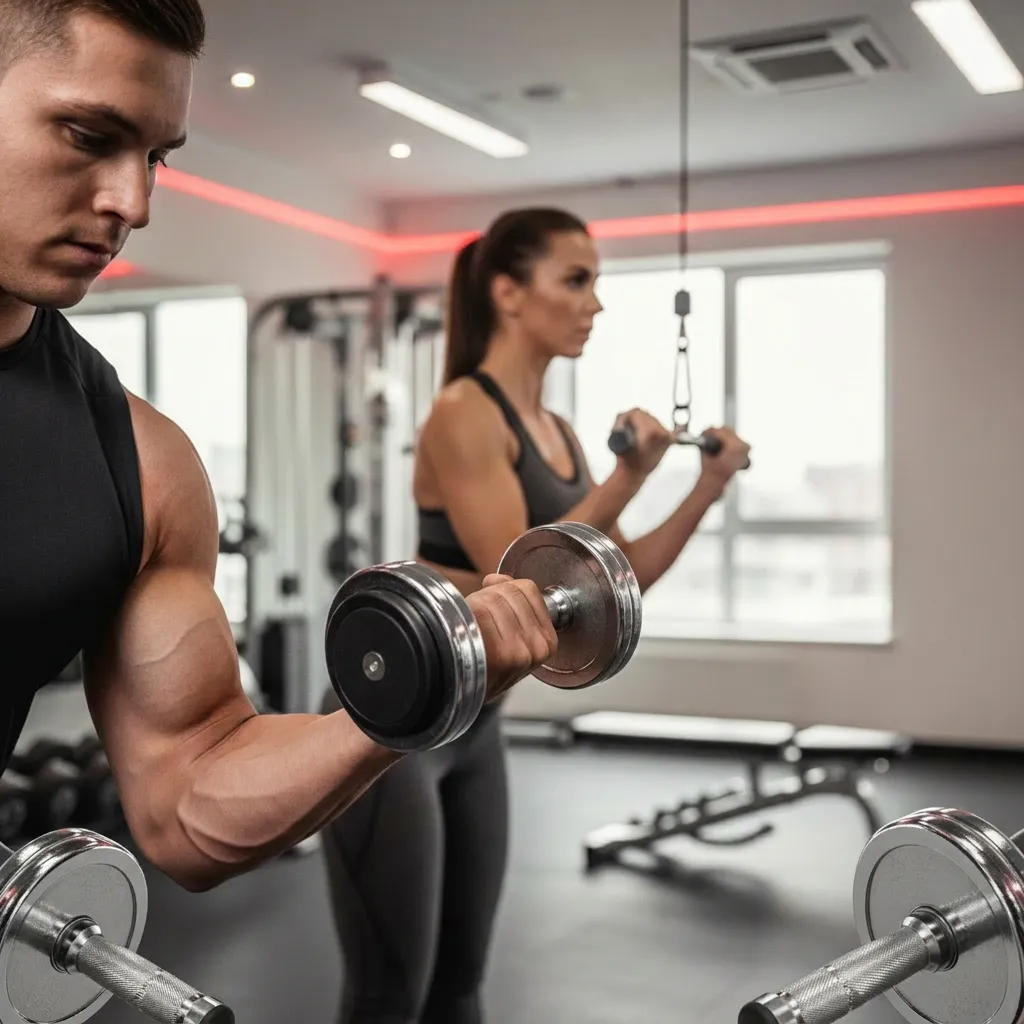
Bu makale, etkili egzersizler, antrenman yapılandırma yöntemleri ve kas gelişimini en üst düzeye çıkarmak için teknikler sunarak biseps ve triseps antrenmanı için kapsamlı bir rehberdir. Etkileyici kollara sahip olmak için hacim, yoğunluk ve ilerlemeye nasıl doğru bir şekilde yaklaşacağınızı öğreneceksiniz.
Biceps and triceps training is a specialized approach to strength training, focused on developing the muscle groups responsible for flexing and extending the elbow joint. It aims to increase muscle mass, strength, and endurance of the arms through precisely selected exercises, adapted volume, intensity, and training frequency.
Arms are a calling card for any trainee. Big, strong, and well-shaped biceps and triceps make a strong impression. They contribute to improved functionality and better performance in other exercises such as push-ups, pull-ups, and bench presses. While many people think they just need to do endless sets for biceps and triceps to achieve results, effective training requires a methodical approach based on scientific principles.
Anatomy of Strength: Biceps and Triceps
💬 Simply put: Biceps and triceps workouts help build strong and shaped arms, which are important for an impressive look and for better strength in many other exercises.
Before diving into the exercises, it's important to understand the basic functions of these muscle groups.
- Biceps (Biceps Brachii): Consists of two heads – long and short. Its main function is flexing the forearm at the elbow (flexion) and supination (rotating the palm upwards). It also weakly participates in shoulder joint flexion.
- Triceps (Triceps Brachii): Consists of three heads – long, lateral, and medial. Its main function is extending the forearm at the elbow (extension). The long head also assists in shoulder joint adduction and extension.
Since you are training both muscle groups, which are antagonists to each other (they perform opposite movements), you can train them together in one session. This ensures balanced development and helps prevent imbalances. One of the most well-known approaches is the so-called "antagonist superset," where you perform an exercise for the biceps, then immediately after it an exercise for the triceps, before resting. According to a study by Robbins et al. (2010), this method can lead to greater training volume and less fatigue than performing exercises sequentially.
Volume and Frequency – How Much is Enough?
Training volume (number of sets and repetitions) and frequency (how often you train a given muscle group) are key factors for muscle growth. General recommendations for hypertrophy vary, but studies by Schoenfeld et al. (2017) suggest that 10-20 working sets per muscle group per week are optimal for most people.
For biceps and triceps, 2-3 exercises of 3-4 sets each per muscle group within one workout (2-3 times a week) is a good start. You can split your workouts like this:
- Full Split: Train biceps and triceps during an upper body training day, including back and chest.
- Dedicated Day: A separate training day just for arms if you want to prioritize them.
- Push/Pull/Legs (PPL): Train triceps on the "Push" day (chest, shoulders, triceps) and biceps on the "Pull" day (back, biceps).
Biceps Workout: Curl Variations
To maximize biceps growth, it's important to use various curl variations that work the muscle from different angles and emphasize its different heads.
1. Barbell Bicep Curl
This is a fundamental exercise for building mass. It allows the use of relatively heavy weight and is excellent for activating both heads of the biceps.
- Execution: Stand upright, grip the barbell with an underhand grip (palms forward), hands shoulder-width apart. Bend your elbows, lifting the barbell towards your shoulders without swinging your body. Lower slowly.
- Sets and repetitions: 3-4 sets of 8-12 repetitions.
2. Standing/Seated Dumbbell Bicep Curl
Allows for a greater range of motion and works each bicep individually. You can do alternating curls or with wrist rotation (supination) for greater biceps activation.
- Execution: With dumbbells in hand, palms facing forward or neutral. Bend your elbows, lifting the dumbbells towards your shoulders. You can rotate your palms upwards during the movement. Lower slowly.
- Sets and repetitions: 3 sets of 10-15 repetitions per arm.
3. Hammer Curl
Emphasizes the brachialis (muscle under the biceps that adds thickness) and brachioradialis (forearm muscle). Performed with a neutral grip (palms facing each other).
- Execution: Hold dumbbells with a neutral grip. Bend your elbows, lifting the dumbbells towards your shoulders without rotating your wrists. Lower slowly.
- Sets and repetitions: 3 sets of 10-15 repetitions.
4. Concentration Curl
Isolates the biceps and allows for maximum concentration on the contraction. An excellent finisher for the workout.
- Execution: Sit down, place the elbow of one arm on the inner side of your thigh. Curl the dumbbell towards your shoulder, keeping the bicep constantly tensed.
- Sets and repetitions: 2-3 sets of 12-15 repetitions per arm.
Triceps Workout: Push-downs, French Press, and More
The triceps make up about 2/3 of the upper arm mass, so they are crucial for achieving overall arm size.
1. Triceps Push-down
One of the most popular exercises, which can be performed with a straight bar, V-bar, or rope to emphasize different heads.
- Execution: Stand in front of a cable machine, grip the handle with an overhand grip, elbows tucked to your sides. Extend your arms downwards, fully straightening your elbows. Return to the starting position with control.
- Sets and repetitions: 3-4 sets of 10-15 repetitions.
2. Lying Triceps Extension (French Press)
An excellent exercise for stimulating the long head of the triceps.
- Execution: Lie on a bench, grip a straight or EZ bar/dumbbells with a narrow overhand grip. Arms are extended upwards. Lower the bar/dumbbells towards your forehead (or behind your head) by bending only at the elbows. Extend back to the starting position.
- Sets and repetitions: 3-4 sets of 8-12 repetitions.
3. Overhead Triceps Extension (Dumbbell/Cable)
Another exercise that strongly engages the long head of the triceps by placing it in a stretched position.
- Execution: Sit or stand upright, hold one dumbbell with both hands (or use a rope from a low pulley). Lift the dumbbell overhead, then lower it behind your head by bending at the elbows. Extend back to the starting position.
- Sets and repetitions: 3 sets of 10-15 repetitions.
4. Dips
Although a compound exercise, dips work the triceps very effectively, especially when performed with a narrow grip and an upright torso.
- Execution: Grip parallel bars. Lower your body down by bending your elbows until your shoulders are below your elbows. Push back up to the starting position. Add weight if necessary.
- Sets and repetitions: 3 sets to failure or 8-12 repetitions with added weight.
Sample Arm Workout Plan
Here is a sample plan that you can adapt to your needs and fitness level. This plan is intended to be performed 1-2 times per week, combined with training for other muscle groups.
| Exercise | Sets | Repetitions | Rest (sec) |
|---|---|---|---|
| Barbell Bicep Curl | 3 | 8-12 | 60-90 |
| Triceps Push-down (with rope) | 3 | 10-15 | 60-90 |
| Dumbbell Hammer Curl | 3 | 10-15 | 60-90 |
| One-arm Overhead Dumbbell Extension | 3 | 10-15 (each arm) | 60-90 |
| Concentration Curl | 2 | 12-15 (each arm) | 45-60 |
| Dumbbell Triceps Kickback | 2 | 12-15 (each arm) | 45-60 |
Progressive Overload and Technique
The most important principle for muscle growth is progressive overload. This means you must constantly challenge your muscles to work harder than before. This can be achieved by:
- Increasing the weight.
- Increasing the number of repetitions.
- Increasing the number of sets.
- Decreasing rest time between sets.
- Improving technique and control over the movement.
Never sacrifice technique for weight. Improper execution reduces the effectiveness of the exercise and significantly increases the risk of injury. Focus on slow, controlled movements, especially during the eccentric phase (lowering the weight).
- Increases muscle mass: Targeted training stimulates hypertrophy.
- Improves strength: Stronger arms help with other movements.
- Aesthetic appearance: Well-developed arms contribute to a balanced physique.
- Functionality: Enhances daily activities and athletic performance.
- Injury prevention: Strengthens tendons and joints around the elbow.
- Overtraining: Excessive volume can lead to exhaustion and slow progress.
- Elbow injuries: Improper technique or excessive weight can strain the joints (e.g., tendinitis).
- Imbalances: Over-focusing on only one muscle group can lead to imbalances with other muscles.
- Plateau: Without progressive overload, results may stagnate.
- Time-consuming: Unnecessarily many exercises and sets can unnecessarily lengthen the workout.
Nutrition and Recovery
No workout, however well-structured, will yield maximum results without adequate nutrition and recovery. For muscle growth, the body needs:
- Sufficient protein: Around 1.6-2.2 grams per kilogram of body weight to provide the necessary amino acids for repair and growth.
- Adequate caloric intake: A slight caloric surplus is necessary for building muscle mass.
- Carbohydrates: An energy source for workouts and for replenishing glycogen stores.
- Healthy fats: Important for hormonal health and overall well-being.
- Quality sleep: At least 7-9 hours of sleep per night is critical for hormonal recovery and muscle growth.
Without these components, progress will be severely limited. Training is just the stimulus; growth happens during rest and recovery.
See more in the fitness guides of Sport Zona Academy.
📚 Scientific Sources
- Dose-Response Relationship Between Weekly Resistance Training Volume and Increases in Muscle Mass: A Systematic Review and Meta-Analysis, 2017
- Effects of Resistance Training Frequency on Measures of Muscle Hypertrophy: A Systematic Review and Meta-Analysis, 2016
- Changes in exercise selection are more effective than changes in load schemes for improving muscular strength, 2014
🔬 Expert Note from Sport Zona
From my long-term observation, the most common mistake is focusing on volume at the expense of intensity. Many trainees do too many sets and reps with light weights, which does not adequately stimulate muscle growth. For real results, try to reach failure at the end of your working sets.
See more in the fitness guides of Sport Zona Academy.
Önerilen ürünler


Sıkça sorulan sorular
How often should I train my arms?
Optimal frequency is 2-3 times per week, with 48-72 hours of rest between workouts for the same muscle group. You can train your arms on a separate day or incorporate them into upper body workouts.
What are the optimal sets and reps for biceps and triceps?
For hypertrophy (muscle growth), 10-20 working sets per muscle group per week are recommended. This can be distributed into 3-4 sets per exercise, with 8-15 repetitions.
Can I train biceps and triceps on the same day?
Yes, this is a common and effective approach. You can use antagonistic supersets (biceps exercise followed by a triceps exercise) to save time and potentially increase workout volume.
What are the best exercises for arm mass?
For biceps: barbell curl, dumbbell curl from standing. For triceps: skullcrushers with a barbell (lying or overhead), weighted dips. Add isolation exercises for complete muscle development.