Chelated Minerals vs. Standard Minerals: The Absorbable Provider vs. The Basic Source

Chelated minerals are better absorbed than standard ones. The choice depends on goals and tolerance.
Short answer: Chelated minerals (e.g., bisglycinate) have up to 4 times higher bioavailability and significantly fewer stomach side effects compared to standard forms (oxides, carbonates). Practical advice: For athletes with high needs or sensitive stomachs, invest in chelated forms for key minerals — 200-400 mg of magnesium bisglycinate in the evening and 15-30 mg of zinc picolinate with food.
Choosing the right supplements is important for anyone looking to improve recovery and performance. Minerals are fundamental – they are small but absolutely essential for thousands of biochemical reactions. However, the question is not just whether to take minerals like magnesium, zinc, or iron, but in what form.
There are two main categories on the market: standard mineral salts (like oxides and sulfates) and chelated minerals (bound to amino acids). The difference in how the body utilizes them determines their effectiveness, tolerability, and the results you achieve.
This article examines both types of minerals. We will explain their absorption, compare their strengths and weaknesses, and provide practical advice on when to prefer one over the other to maximize benefits for your athletic goals.
This article is part of the Expert Hub for Nutritional Supplements — over 270 expertly verified articles by Petar Mitkov and the Sport Zona team.
What is the systemic analysis between chelated and standard minerals?
The comparative matrix presents a systemic analysis between chelated and standard minerals, examining criteria such as bioavailability (high to excellent 40-60%+ for chelated vs. low to moderate 4-40% for standard), absorption mechanism, and gastrointestinal tolerance.
| Criterion | Chelated Minerals | Standard Minerals |
|---|---|---|
| Bioavailability | High to excellent (40-60%+) | Low to moderate (4-40%) |
| Absorption Mechanism | Active transport via amino acid pathways | Passive diffusion, ion channels (competition) |
| Gastrointestinal Tolerance | Excellent, minimal risk of discomfort | Moderate to poor (often causes diarrhea, bloating) |
| Interaction with Foods | Minimal (protected from phytates, oxalates) | Significant (absorption is easily blocked) |
| Price Range | Higher | Lower |
| Typical Examples | Magnesium bisglycinate, Zinc picolinate, Iron bisglycinate | Magnesium oxide, Zinc sulfate, Iron sulfate |
What is the mechanism of action of chelated and standard minerals?
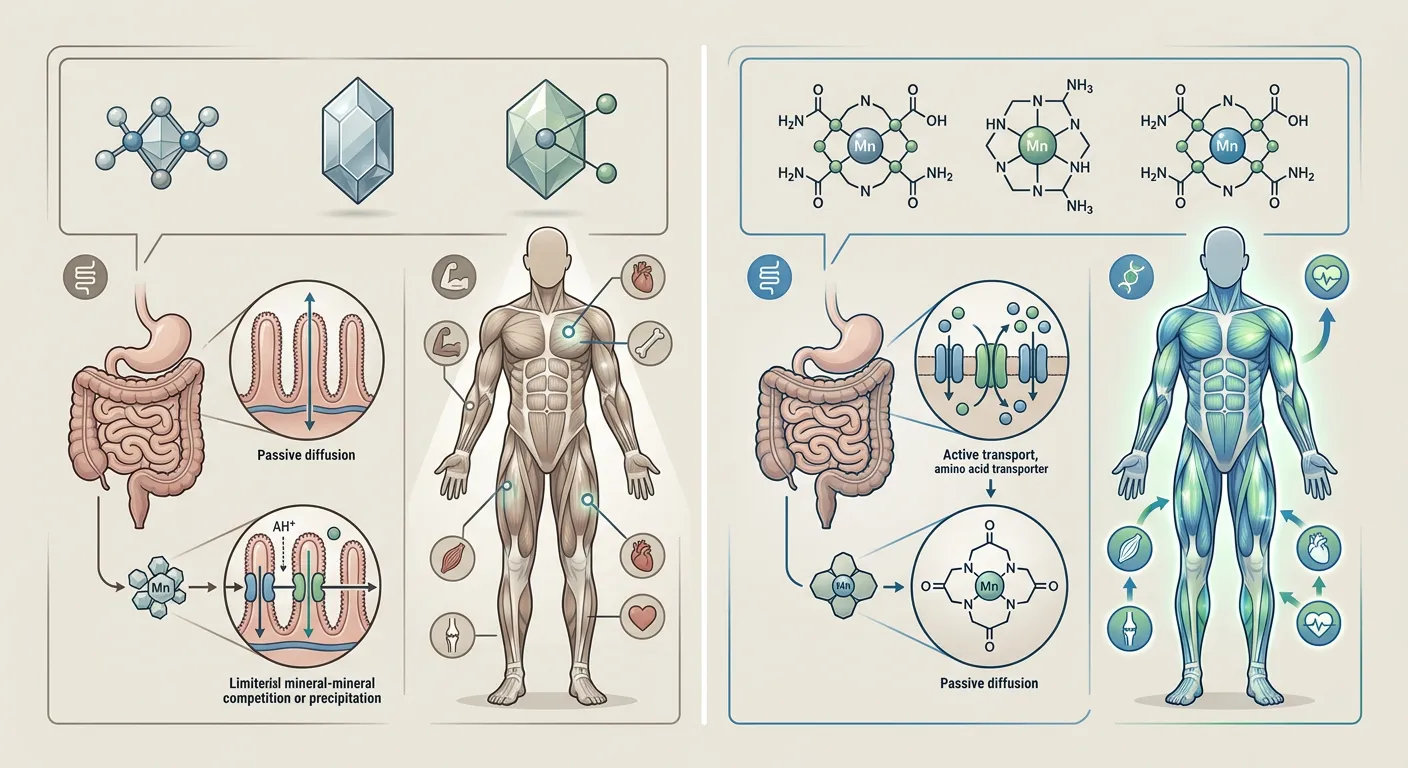
1. Chelated Minerals: Intelligent Delivery
Chelation (from the Greek "chele" - claw, pinch) is a process where a mineral ion is tightly bound to an organic molecule, most commonly an amino acid (like glycine, methionine, or aspartate). This forms a stable, electrically neutral complex called an amino acid chelate. The key advantage of this structure is that it "masks" the mineral. Instead of competing for absorption with other minerals through the limited ion channels in the intestines, the chelated complex is recognized by the body as an amino acid and actively transported through the much more efficient and numerous peptide and amino acid pathways. This protects the mineral from binding with dietary inhibitors like phytates (in grains and nuts) and oxalates (in spinach, beets), which would otherwise make it indigestible and cause it to be excreted from the body.A chelated mineral is like an "express delivery" for the body, prioritized with a protein "tag" that directs it to the fast lane for amino acid absorption, while a standard mineral is unpackaged and not part of a priority flow, for which the body has to compete.
2. Standard (Inorganic) Minerals: The Path of Resistance
Standard mineral forms are inorganic salts – for example, magnesium oxide, iron sulfate, or zinc carbonate. When they enter the acidic environment of the stomach, these salts dissociate (break down) into free, positively charged mineral ions (Mg²⁺, Fe²⁺, Zn²⁺). These ions are highly reactive. They must compete with each other for the same transport channels in the small intestine. For instance, a high dose of zinc can block copper absorption, and calcium can interfere with iron absorption. Furthermore, these free ions readily bind with the aforementioned phytates and oxalates from food, forming insoluble complexes that cannot be absorbed. Unabsorbed minerals in the large intestine have an osmotic effect – they attract water, which often leads to stomach discomfort, bloating, and diarrhea. This is particularly characteristic of magnesium oxide.Scientific Sources
- Biol Trace Elem Res. (1990) Bioavailability of iron from ferric pyrophosphate in the rat. - Comparison of iron absorption from different forms.
- Linus Pauling Institute at Oregon State University - Magnesium. - Detailed analysis of different magnesium forms and their bioavailability.
- Examine.com - Magnesium Supplementation Guide. - Independent analysis of scientific evidence for different magnesium forms.
- EFSA Journal (2006) Opinion of the Scientific Panel on Food Additives... on Ferrous bisglycinate. - EFSA opinion on the safety and bioavailability of ferrous bisglycinate.
- National Institutes of Health (NIH) Office of Dietary Supplements - Zinc Fact Sheet. - Information on different zinc forms and factors affecting its absorption.
The synergistic effect: Why combination is important?
With minerals, the combined effect comes from using a well-formulated Chelated Mineral Complex. When you take several standard minerals simultaneously (e.g., in a cheap multivitamin), they enter into direct competition. A high dose of calcium can reduce the absorption of zinc and iron.
With chelated forms, this negative effect is significantly reduced. Since each mineral travels its own "VIP corridor" (the amino acid pathway), they do not interfere with each other. This allows the body to absorb adequate amounts of each mineral, even when taken together. Thus, synergy leads to more complete and balanced intake of all micronutrients, without one hindering another.
Which is better: chelated or standard minerals?
The choice between chelated and standard minerals is complex and depends on your individual goals, budget, and tolerance.
Choose CHELATED if:
- You have a sensitive stomach or digestive issues (Irritable Bowel Syndrome, Crohn's disease).
- You want to correct an established deficiency and need fast and effective absorption.
- You are taking high doses of a particular mineral (e.g., Over 400 mg of magnesium) for therapeutic purposes.
- Your diet is rich in phytates and oxalates (vegan, vegetarian, consumption of many whole grains).
- Your goal is maximum athletic performance and recovery, where every improvement in absorption matters.
🔵 Choose STANDARD if:
- Budget is an important factor and you are looking for the most affordable option.
- You are doing general prevention with low doses and have no specific health problems.
- You do not have a sensitive stomach and tolerate standard forms well without discomfort.
- You are taking them as part of a general multivitamin, where doses are low and competition is not as pronounced.
- You are taking minerals for which the difference in absorption is smaller (e.g., Potassium citrate).
Recommended stack for athletes: For maximum results, the foundation should be built on chelated forms. Combine Magnesium bisglycinate (200-400 mg) in the evening for nervous system recovery, Zinc picolinate (15-30 mg) for immune and hormonal support, and if needed, Iron bisglycinate (around 25 mg) to improve oxygen transport.
What is the 2026 Protocol: "Foundation and Performance Stack"?
The 2026 protocol, titled "Foundation and Performance Stack," represents a modern approach to mineral supplementation for athletes, dividing intake into a base and a goal-specific stack.
- Daily Foundation (Morning): A high-quality multivitamin complex that uses a combination of chelated and good organic forms (like citrates) for essential micronutrients. This ensures a baseline level without needing to buy many different products.
- Post-Workout: 5-10 mg of zinc picolinate along with your protein shake to aid recovery and reduce oxidative stress.
- Evening (30-60 min before sleep): 300-400 mg of elemental magnesium in the form of Magnesium bisglycinate or taurate. These forms have a calming effect on the nervous system, improve sleep quality, and promote muscle relaxation without causing stomach discomfort.
Expert Note
Not everything needs to be chelated. For minerals like potassium, the citrate form is well-absorbed and often more practical. Focus on chelated forms for minerals that are most problematic for absorption and most important for athletic performance: Magnesium, zinc, and iron.
🧭 When to choose which?
- Choose Chelated if you want maximum absorption and no stomach discomfort, especially at high doses.
- Choose Standard if budget is the main factor and you are looking for basic, low-dose prevention without complaints.
- Combine strategically: Use standard forms for general needs and invest in chelated forms for key minerals like magnesium and zinc, where the difference is most pronounced.
📖 What is a Chelated and Standard Mineral?
Chelated Mineral: A mineral chemically bound to an amino acid (e.g., magnesium Bisglycinate). This bond protects it in the digestive tract and makes it more efficiently absorbed via amino acid transport pathways.
Standard Mineral: An inorganic salt of a mineral (e.g., magnesium Oxide). In the stomach, it breaks down into a free ion, which has lower bioavailability, competes with other minerals, and can cause stomach discomfort.
⚖ Pros and Cons
| Chelated Minerals | Standard Minerals |
|---|---|
| High bioavailability Excellent stomach comfort Fewer interactions with foods |
Low price Wide availability Small tablet size |
| Higher price Larger capsule size (due to amino acid) |
Low bioavailability Risk of stomach discomfort Competition for absorption |
🗣 Simply Explained
If you are building a house, Standard minerals are like a truck dumping bricks in front of the site. Some will be used, but many may break or remain unused. Chelated minerals are like a drone delivering bricks directly into the mason's hands – fast, precise, and without waste.
| Criterion | Chelated (VIP Pass) | Standard (Regular Ticket) |
|---|---|---|
| Absorption | Maximum | Low to moderate |
| Comfort | Gentle on the stomach | May cause discomfort |
| Price | Higher | Low |
Choose the right product for your goal:
- For overall health and foundation: Multivitamins and minerals with balanced forms.
- For energy and performance: Creatine, nitric oxide boosters, and targeted chelated minerals.
- For joints and recovery: Joint formulas, often enriched with chelated zinc, manganese, and copper.
Combined protocol for maximum effect:
- Morning: Foundation of multivitamins.
- Post-Workout: Protein + 15 mg Zinc picolinate.
- Evening: 400 mg Magnesium bisglycinate for good sleep and recovery.
⚖ When to choose Chelated Minerals
- If you have stomach problems.
- If you want the best absorption.
- If you are taking medications or foods that block absorption.
- If you have a diagnosed deficiency.
⚖ When to choose Standard Minerals
- If your budget is severely limited.
- For general prevention without specific needs.
- If you are sure you tolerate them well.
- As part of a cheap multivitamin for basic needs.
Expert Note from Sport Zona
In my practice with athletes, I have seen the difference hundreds of times. Switching from magnesium oxide to magnesium bisglycinate almost always eliminates stomach discomfort and visibly improves sleep quality within a week. The more expensive option is not always better, but with minerals, especially at high doses for sports purposes, the form significantly impacts the final result, not just what's on the label. Investing in chelated forms for magnesium and zinc pays off many times over in terms of recovery and comfort.
Recommended products


Frequently asked questions
Can Chelated Minerals and Standard Minerals be taken together?
Yes, they can be combined and are often found together in multivitamin formulas. For optimal absorption and to avoid competition between minerals (e.g., zinc and iron), it is good practice to take different minerals at different times of the day.
Which is better for beginners - Chelated Minerals or Standard Minerals?
For beginners aiming to cover their basic needs without a large budget, standard forms in a quality multivitamin complex are perfectly adequate. Chelated forms are recommended for proven deficiency, high athletic demands, or a sensitive stomach.
When is the best time to take Chelated Minerals and Standard Minerals?
Most minerals are best absorbed with food to reduce the risk of stomach irritation. Magnesium is often taken in the evening before sleep due to its calming effect. Iron and zinc are best taken with food, but separately from calcium-rich products.
Are there side effects from taking Chelated Minerals or Standard Minerals?
Yes. Standard forms (oxides, sulfates) more often cause gastrointestinal discomfort, bloating, or diarrhea. Chelated forms are many times gentler. However, excessive intake of any mineral, regardless of its form, can lead to toxicity or disrupt the balance of other minerals in the body.
What is the recommended dosage for Chelated Minerals and Standard Minerals?
Dosage depends on the specific mineral, not its form. Due to the better absorption of chelated forms, a lower dose is often needed to achieve an effect equivalent to a higher dose of a standard form. For example, the effect of 200 mg of magnesium bisglycinate may be similar to that of 400-500 mg of magnesium oxide.