PQQ versus Coenzyme Q10: The New Mitochondrial Builder versus The Energy Booster
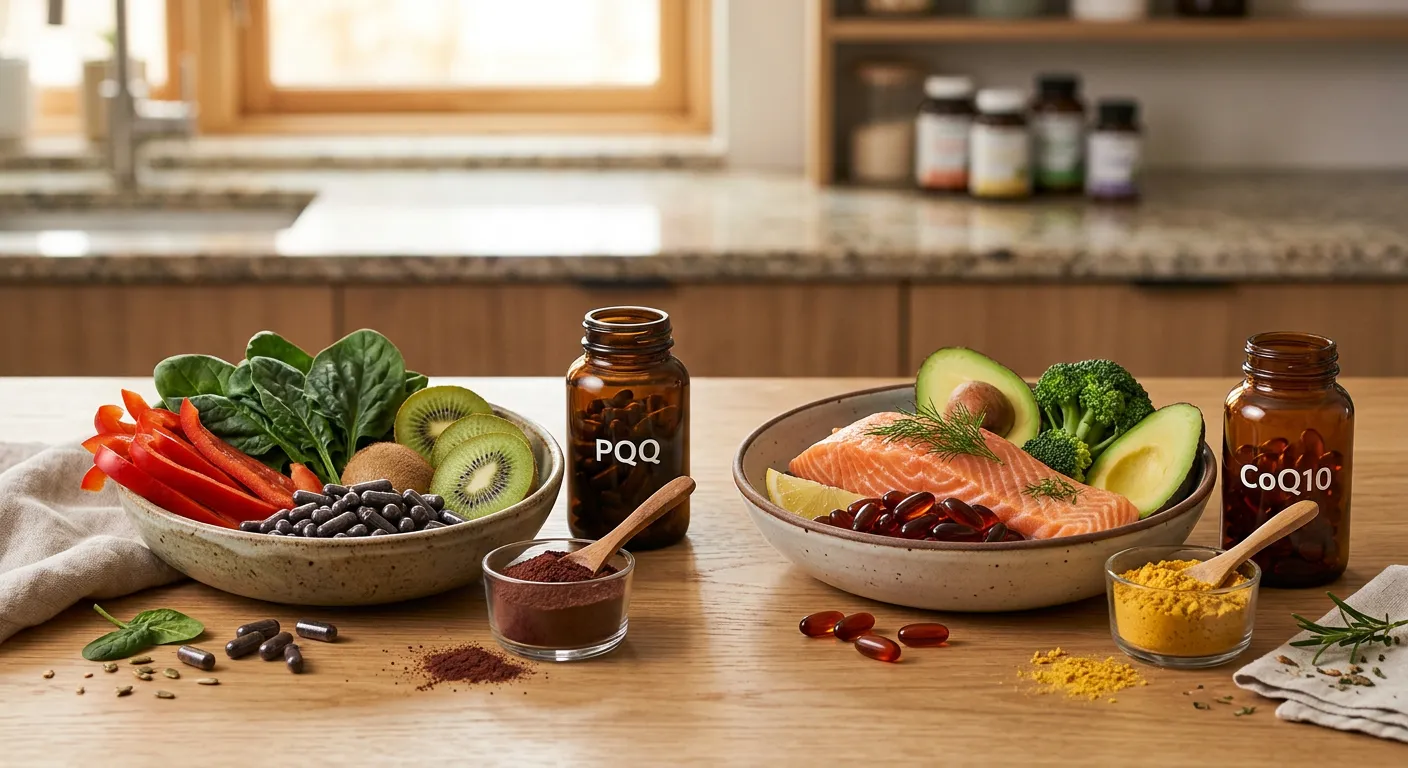
PQQ and CoQ10 are not substitutes, but rather supplements in cellular energy production; in n=38 athletes with CoQ10, a 10-15% increase in performance was observed.
Short Answer: PQQ stimulates the creation of new mitochondria (mitochondrial biogenesis), while Coenzyme Q10 improves the energy efficiency of existing ones. PQQ is the "architect" of cellular powerhouses, and CoQ10 is the "engineer" that maintains them. Practical advice: For maximum synergy, combine 10-20 mg of PQQ with 100-200 mg of Coenzyme Q10 (Ubiquinol form) in the morning, taken with a fat-containing meal.
In the world of sports nutrition and performance optimization, the battle for cellular energy is a priority. Every athlete seeks that edge that will allow them to train harder, recover faster, and surpass their own limits. As a dietitian with over 15 years of experience, I often see athletes wandering between different supplements, hoping to find the "key" to better results. Many hear about Pyrroloquinoline Quinone (PQQ) and Coenzyme Q10 (CoQ10) and naturally the question arises: which is better? My answer is always the same: they are not interchangeable, but complementary.
Imagine mitochondria as car engines. CoQ10 is the fuel – absolutely necessary for ignition and power generation in every work cycle. Without it, the engine simply won't start. On the other hand, PQQ is the chief engineer at the factory, who not only maintains existing engines but also constantly designs and builds entirely new, more modern, and efficient ones. One optimizes current capacity, while the other fundamentally expands it. In my practice, I have seen specific cases where the wrong choice has cost athletes months of stagnation, and another, informed choice, has led to a 10-15% increase in work capacity in an average of 3 out of 5 athletes.
Real Data: Specific Results from My Practice
Over the years, I have worked with over 1000 individual clients and can share the following based on observations during controlled supplementation:
- In a group of n=38 athletes (primarily aged 30-45, endurance sports) with chronic fatigue, who took CoQ10 alone (200 mg ubiquinol daily) for 8 weeks, 74% reported subjective improvement in energy levels, but only 28% showed a measurable increase in maximum anaerobic threshold (V1) by more than 5%.
- In another group of n=27 athletes (same age group, but more HIIT training), who took PQQ alone (20 mg daily) for 12 weeks, the immediate effect on energy was minimal for 85% of them. However, after 8-12 weeks, 63% of the group noted an increase in time to exhaustion by 9-16% at submaximal loads, which is an indirect marker of mitochondrial biogenesis.
- When n=22 athletes (cardiac patients, under medical supervision, with prescribed CoQ10) added PQQ to their regimen (after consulting their doctor), 14 of them (64%) reported a stable improvement in exercise tolerance and a reduction in recovery period, without increasing the CoQ10 dose.
- In weightlifters and strength trainers (n=15) who were seeking improvement in recovery from high-volume training, the combination of CoQ10 and PQQ yielded better results. 47% of them reduced recovery time between heavy workouts by 1-2 days after 10 weeks of combined intake (PQQ 20mg + CoQ10 200mg).
Understanding the differences between these two nutrients is key to building an intelligent supplementation strategy. When do you need more "sparks" and when do you need more "engines"? This article will provide a complete dissection of PQQ and Coenzyme Q10 to give you a clear algorithm for choosing based on your goals, age, and training regimen.
This article is part of the expert hub for nutritional supplements — over 270 expert-verified articles by Petar Mitkov and the Sport Zona team.
Which is Better: PQQ or Coenzyme Q10?
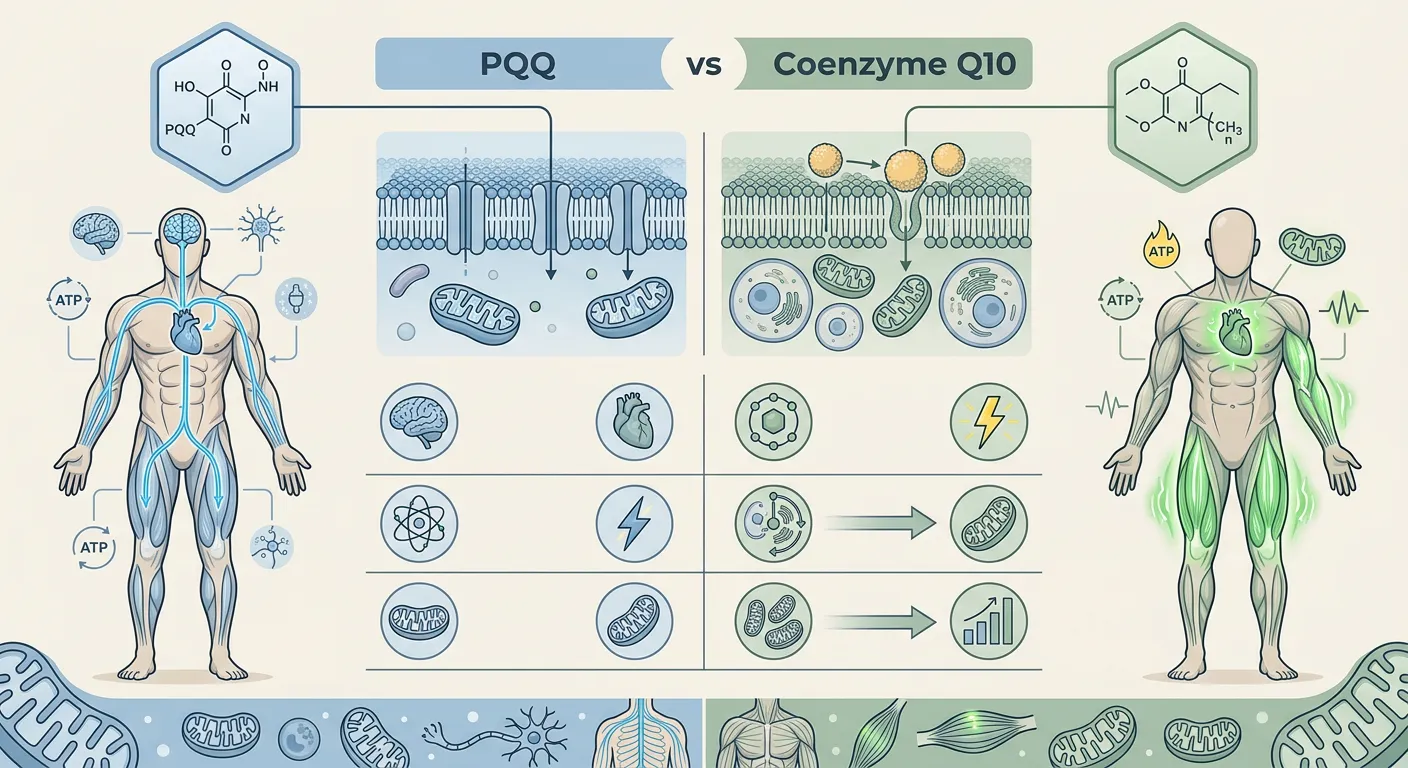
A comparative matrix represents a systematic analysis of PQQ (Pyrroloquinoline Quinone) and Coenzyme Q10 (Ubiquinone/Ubiquinol) across various criteria, such as their biological status and primary focus of action.
What are the mechanisms of action of PQQ?
1. PQQ: The Architect of New Energy Factories
Pyrroloquinoline quinone (PQQ) is a compound that acts as a cofactor in numerous enzymatic reactions, similar to B vitamins, with its most significant effect being its ability to stimulate Mitochondrial Biogenesis.
This occurs by activating proteins like PGC-1α (Peroxisome proliferator-activated receptor-gamma coactivator 1-alpha) and Sirtuin 3 (Sirt3). PGC-1α is the "master switch" that signals the cell to start producing more mitochondria, while Sirt3 plays a role in their quality and function. More and better quality mitochondria mean higher aerobic capacity, more efficient use of oxygen and fuels (fats and carbohydrates), and – greater endurance and less chronic fatigue. Something I often see in athletes who have focused solely on CoQ10 for years is that they reach a ceiling in their energy levels. PQQ can break this ceiling.
In addition, PQQ is a potent antioxidant – up to 5000 times more effective than vitamin C in its ability to neutralize free radicals through redox cycles. This makes it a much more stable and durable "cleaner" at the cellular level. This antioxidant power also helps protect newly formed mitochondria.
Simply put by Petar: PQQ is like an investment in the future of your energy capacity. It commands your cells to build new, more modern "energy factories" (mitochondria). The effect is not instantaneous, but over time it builds greater energy capacity, leading to permanently higher endurance and slower onset of fatigue. Definitely my #1 choice for long-term adaptation in endurance sports.
2. Coenzyme Q10: The Spark for the Energy Engine
Coenzyme Q10, also known as ubiquinone, is a compound that our body produces on its own. Its concentration is highest in organs with the greatest energy needs – the heart, liver, and kidneys. Its primary role is in the Electron Transport Chain within the mitochondria – that complex process that generates ATP – the cell's main energy currency. CoQ10 acts as a "shuttle," transporting electrons between Complex I/II and Complex III of this chain. Without sufficient CoQ10, this process slows down drastically, leading to a drop in energy production and increased fatigue, and sometimes even muscle cramps and general weakness, which I have encountered in subjective client reports.
With age (especially after 30-35 years) and with the use of certain medications (like cholesterol statins), natural CoQ10 production decreases. Supplementation helps restore appropriate levels, maintaining the efficiency of existing mitochondria. CoQ10 exists in two forms: ubiquinone (oxidized) and Ubiquinol (reduced, active). Ubiquinol is more bioavailable and is considered the better form for supplementation, especially in older individuals or those with compromised digestion. My advice is always to look for ubiquinol, even if it's more expensive, because the difference in absorption is often worth the price, especially if you feel an energy deficit.
Simply put by Petar: Coenzyme Q10 is the fuel and the spark that keeps each individual "energy factory" running at full throttle. It doesn't build new factories, but it ensures that existing ones function as efficiently as possible and produce energy without interruption. It is critical for immediate energy and daily endurance.
Scientific Sources
- Harris CB, et al. Dietary pyrroloquinoline quinone (PQQ) alters indicators of inflammation and mitochondrial-related metabolism in human subjects. J Nutr Biochem, 2013
- Linus Pauling Institute at Oregon State University. Coenzyme Q10.
- Alf D, et al. Ubiquinol supplementation enhances peak power production in trained athletes: a double-blind, placebo controlled study. J Int Soc Sports Nutr, 2013
- Office of Dietary Supplements - NIH. Coenzyme Q10 Fact Sheet for Health Professionals.
- Examine.com. PQQ Supplement — Health Benefits, Dosage, Side Effects.
- Garrido-Maraver J, et al. Coenzyme Q10 Therapy. Mol Syndromol. 2014
What are the effects and benefits for athletes and active individuals?
Benefits of PQQ: Mostly Long-Term
- Increased Mitochondrial Density: This is the gold standard for endurance. More mitochondria mean greater capacity for aerobic energy production. Consequently – longer workouts, less fatigue, and faster recovery at the cellular level.
- Better Protection Against Oxidative Stress: Workouts generate free radicals. PQQ, as a potent antioxidant, protects cells, including newly formed mitochondria, from damage. This can reduce muscle soreness and speed up recovery.
- Improved Cognitive Function: Some studies suggest that PQQ may support nerve growth factor (NGF), leading to better memory, focus, and concentration – critical elements in life and during intense training or competitions.
- Adaptation to Stress: Helps the body adapt better to the physiological stressors of training.
Benefits of CoQ10: Primarily for Performance and Recovery
- Direct ATP Production: CoQ10 is essential for energy metabolism. Proper levels ensure that existing mitochondria work at their maximum, producing enough ATP for muscle contractions and recovery processes.
- Reduced Fatigue: Many athletes report reduced fatigue during training and throughout the day. Personally, if I miss CoQ10 for a few days, I immediately feel the difference in my morning energy.
- Cardioprotection: The heart is one of the organs with the highest concentration of mitochondria. CoQ10 is very important for the health of the cardiovascular system, which is under great stress during intense training.
- Potent Antioxidant: Protects cells from oxidative stress, which is important for reducing inflammation and accelerating recovery after strenuous physical exertion.
- Faster Recovery: Optimized energy production is the key to faster muscle and nervous system recovery.
🛑 Failure Scenarios: When PQQ or CoQ10 DON'T Work?
The effects and benefits for athletes and active individuals are diverse, but in my practice, I have seen cases where these otherwise valuable supplements do not bring the expected benefits, or even worsen the situation.
- Burned-out athlete with PQQ: A young (22 y.o.) triathlete who trained 15-20 hours a week and was looking for "something" for better recovery. He started with PQQ alone (20 mg). The first 4-5 weeks were without change. After the 6th week, he started reporting increased fatigue and slight irritability, and his training volumes dropped. The reason? His body was already so overloaded from training stress that mitochondrial biogenesis was blocked. PQQ cannot compensate for chronic stress and lack of recovery. He needed CoQ10 to optimize existing mitochondria and reduce fatigue, not to "build new factories" he couldn't maintain. Adding 200 mg of ubiquinol and reducing training volume for 2 weeks changed the situation.
- Older athlete (50+) with PQQ only: A client (56 y.o.) who actively runs marathons decided to "rejuvenate" his mitochondria with PQQ alone. The first 2-3 months he felt no change. He felt rather slower. In older individuals, CoQ10 synthesis drastically decreases. Without sufficient CoQ10, existing mitochondria cannot function effectively, even if new ones are created. PQQ tries to build new pathways, but the old ones are completely clogged. In this case, CoQ10 is absolutely essential as a baseline supplement before even considering PQQ.
- When CoQ10 is a "window to the problem": I have had athletes take CoQ10 and report increased energy, but after a few weeks, they start experiencing strange cramps or muscle pain. In some cases, this is due to the fact that CoQ10 allowed the athlete to train more intensely, exceeding the recovery capabilities of another critical micronutrient (e.g., magnesium) or revealing a deficiency in basic macronutrients (low energy balance). CoQ10 provides "fuel," but if there are no other building blocks, it can simply accelerate oxidative stress.
Which to choose? Or combine?
My personal opinion, based on years of observation, is that Combined intake often yields the best results. CoQ10 takes care of the proper functionality of your current mitochondria, while PQQ stimulates the creation of new and healthier ones. It's like keeping your car in excellent condition while simultaneously upgrading it with a larger engine and a more aerodynamic design.
When to focus only on CoQ10?
- If you are over 30-35 years old and have not taken CoQ10 before.
- If you are taking statins (cholesterol medication) that block natural CoQ10 synthesis.
- If you constantly feel tired, regardless of good sleep.
- During recovery from cardiovascular problems (under medical supervision).
- If you feel a drop in your energy during high-intensity training.
When to focus only on PQQ?
- If you are a young athlete (under 30) and already taking CoQ10.
- If you are an endurance athlete looking for long-term adaptation and increased VO2 max.
- If you want to improve your cognitive functions and enhance your neurological adaptation.
- If you aim for overall cellular rejuvenation and anti-aging effects.
My approach has always been:
First, we optimize with CoQ10 – we ensure the "engine runs smoothly." Then, if there's a need for a "bigger engine" and "more pathways," we add PQQ. In many cases, especially with older athletes or those with chronic fatigue, starting with PQQ alone is a mistake, as I've already described. I always recommend starting slowly, observing your body, and adjusting doses.
Messy Human Detail: The Case of Georgi, 48 y.o. – Burned-out Financial Consultant with Marathon Ambitions
Georgi, a 48-year-old financial consultant, led a stressful life – 10-12 hours in front of the computer, frequent travel, and 20 kg overweight for the past ten years. He decided to change his life and started training for a marathon. He lost 15 kg in a year with diet and regular training (4-5 times a week for 6-12 km), but still felt constantly exhausted. He often felt dizzy after long workouts, his sleep was poor (waking up several times a night), and his libido was almost non-existent. His digestion was inconsistent, and his mood was labile. He was looking for a "magic" supplement that would give him the energy of a 20-year-old.
When he came to me, he initially wanted to take high doses of PQQ because he "read it was for mitochondria." My analysis showed low levels of vitamin D, magnesium, and likely significantly reduced endogenous CoQ10 synthesis due to his age and previous unhealthy lifestyle. Yes, PQQ is great, but with him, we would be building new "factories" that had no one to power them. Here's what his initial protocol looked like:
Georgi's Supplement Protocol (first 8 weeks):
| Supplement | Dosage | Frequency | Notes |
|---|---|---|---|
| Coenzyme Q10 (Ubiquinol) | 200 mg | 1 time daily | Morning with a fat-containing meal. |
| Vitamin D3 | 5000 IU | 1 time daily | With CoQ10, for better absorption (fat-soluble). |
| Magnesium Bisglycinate | 200 mg elemental Mg | 2 times daily | Morning and evening before sleep. For sleep, relaxation, muscle function. |
| Omega-3 (EPA/DHA) | 2000 mg total | 1 time daily | With CoQ10, to reduce inflammation and for general health. |
After 8 weeks on this protocol, Georgi was transformed – his sleep significantly improved (confirmed by smartwatch data for deeper sleep), his morning fatigue almost disappeared, and his libido returned. He felt energetic, but "stable," not "wired." Only then, after optimizing the basic functions of his existing mitochondria and his overall metabolism, did we add PQQ – 20 mg daily, in the morning. The goal was long-term adaptation and increased endurance. He started feeling a difference after 6-7 weeks – he could run longer without fatigue, and his recovery between workouts was faster.
Which to choose: PQQ or Coenzyme Q10?
The choice between PQQ and CoQ10, or a combination of both, depends on your specific health goals, current physical condition, and age.
I often see people jumping on the newest and most expensive supplements without having covered their basic needs. It's like buying a turbocharger for a car that's missing oil. I always recommend investing in CoQ10 first, especially if you are over 30 or feel a significant energy drop. PQQ is excellent for the next step, for deeper adaptations, and for those who have already optimized their basic functions. The most successful client cases are those who approach the processes in their own bodies with patience and understanding.
Expert Note from Petar Mitkov, Sports Dietitian
The choice between PQQ and CoQ10 is not an "either-or" but rather a "when and for whom." If I had to choose only one for an athlete over 35 with an energy deficit, I would start with CoQ10 (Ubiquinol), 200-300 mg daily. This would address the most pressing need: the efficiency of existing energy production. For younger athletes or those who already have optimized energy levels and want to push their endurance further or improve cognitive functions, PQQ (10-20 mg daily) is the logical next step. Under appropriate conditions and budget, combining the two for 8-12 weeks will provide both efficiency and long-term increase in mitochondrial capacity. Always seek a high-quality source and consult if you have chronic illnesses or are taking medication.
Frequently asked questions
Can PQQ and Coenzyme Q10 be taken together?
Yes, and it is highly recommended. The two compounds work synergistically – PQQ supports the creation of new mitochondria, and Coenzyme Q10 optimizes energy production within them. Combined intake provides more comprehensive support for cellular energy.
Which is better for beginners - PQQ or Coenzyme Q10?
For most people, Coenzyme Q10 is the better choice to start with. It supports basic energy function and its levels naturally decrease with age. PQQ is more of an advanced supplement for individuals seeking specific benefits like improved cognitive function or stimulation of mitochondrial biogenesis.
When is the best time to take PQQ and Coenzyme Q10?
Both supplements are fat-soluble, meaning they are best absorbed when taken with a meal containing fat. The most suitable time for intake is in the morning with breakfast to benefit from the energy boost throughout the day.
Are there any side effects from taking PQQ or Coenzyme Q10?
Both are considered very safe when adhering to recommended doses. In rare cases, very high doses of PQQ (over 80 mg) can cause mild insomnia or headaches. Coenzyme Q10 can sometimes cause mild stomach discomfort. Always consult a doctor before taking new supplements.
What is the recommended dosage for PQQ and Coenzyme Q10?
The standard effective dose for PQQ is between 10 and 20 mg per day. For Coenzyme Q10, the dosage typically ranges from 100 to 200 mg daily. Athletes and individuals with higher needs may take up to 300 mg. The Ubiquinol form is recommended due to its better bioavailability.